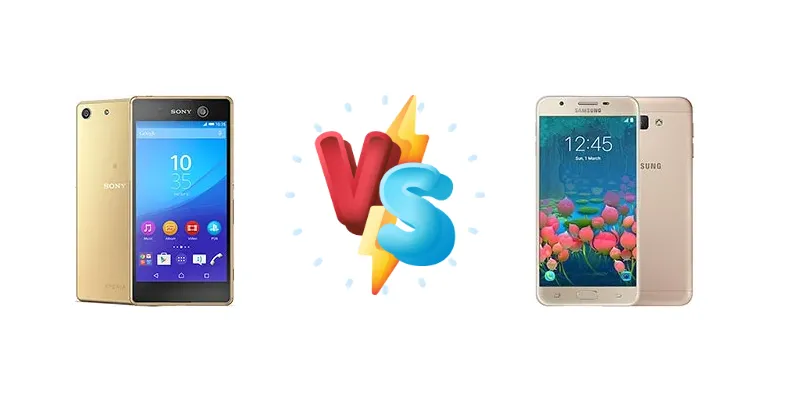
Choosing a budget-friendly smartphone can be tough. The Sony Xperia M5 Dual and Samsung Galaxy J5 Prime were popular contenders in their time, offering different strengths. This comprehensive comparison will break down their key features to help you decide which one is right for you.
🏆 Quick Verdict
The Xperia M5 Dual boasts a superior camera and brighter display, while the Galaxy J5 Prime offers a more efficient chipset and potentially better software support. Ultimately, the M5 Dual is better for photography enthusiasts, while the J5 Prime is a solid all-rounder for everyday use.
| Network |
|---|
| 2G bands | GSM 850 / 900 / 1800 / 1900 - SIM 1 & SIM 2 | GSM 850 / 900 / 1800 / 1900 - SIM 1 & SIM 2 |
| 3G bands | HSDPA 850 / 900 / 1900 / 2100 - E5633, E5643, E5663 | HSDPA 850 / 900 / 1900 / 2100 |
| 4G bands | 1, 3, 5, 7, 8, 20 - E5633 | 1, 3, 5, 7, 8, 20, 38, 40 - EMEA, India |
| Speed | HSPA 42.2/5.76 Mbps, LTE Cat4 150/50 Mbps | HSPA 42.2/5.76 Mbps, LTE Cat4 150/50 Mbps |
| Technology | GSM / HSPA / LTE | GSM / HSPA / LTE |
| | 1, 3, 5, 7, 8, 28, 40 - E5663 | 1, 3, 5, 7, 8, 28, 38, 40 - Australia |
| Launch |
|---|
| Announced | 2015, August. Released 2015, September | 2016, September 19. Released 2016, October |
| Status | Discontinued | Discontinued |
| Body |
|---|
| Build | - | Glass front (Gorilla Glass), aluminum/plastic back, aluminum frame |
| Dimensions | 145 x 72 x 7.6 mm (5.71 x 2.83 x 0.30 in) | 142.8 x 69.5 x 8.1 mm (5.62 x 2.74 x 0.32 in) |
| SIM | Nano-SIM + Nano-SIM | Nano-SIM + Nano-SIM |
| Weight | 142.6 g (5.04 oz) | 143 g (5.04 oz) |
| | IP68 dust/water resistant (up to 1.5m for 30 min) | - |
| Display |
|---|
| Protection | Scratch-resistant glass | Corning Gorilla Glass (market dependent) |
| Resolution | 1080 x 1920 pixels, 16:9 ratio (~441 ppi density) | 720 x 1280 pixels, 16:9 ratio (~294 ppi density) |
| Size | 5.0 inches, 68.9 cm2 (~66.0% screen-to-body ratio) | 5.0 inches, 68.9 cm2 (~69.4% screen-to-body ratio) |
| Type | IPS LCD | PLS LCD |
| Platform |
|---|
| CPU | Octa-core 2.0 GHz Cortex-A53 | Quad-core 1.4 GHz Cortex-A53 |
| Chipset | Mediatek MT6795 Helio X10 (28 nm) | Exynos 7570 Quad (14 nm) |
| GPU | PowerVR G6200 | Mali-T720 MP2 |
| OS | Android 5.0 (Lollipop), upgradable to 5.1 (Lollipop) | Android 6.0.1 (Marshmallow), upgradable to Android 8.0 (Oreo) |
| Memory |
|---|
| Card slot | microSDXC (dedicated slot) | microSDXC (dedicated slot) |
| Internal | 16GB 3GB RAM | 16GB 2GB RAM, 32GB 2GB RAM |
| | eMMC 5.0 | eMMC 5.0 |
| Main Camera |
|---|
| Features | LED flash, HDR, panorama | LED flash, panorama, HDR |
| Single | 21.2 MP, f/2.2, PDAF | 13 MP, f/1.9, 28mm (wide), AF |
| Video | 4K@30fps, HDR | 1080p@30fps |
| Selfie camera |
|---|
| Single | 13 MP, f/2.0, AF | 5 MP, f/2.2 |
| Video | 1080p@30fps | - |
| Sound |
|---|
| 3.5mm jack | Yes | Yes |
| 35mm jack | Yes | Yes |
| Loudspeaker | Yes | Yes |
| Comms |
|---|
| Bluetooth | 4.1, A2DP, LE, aptX | 4.2, A2DP, LE |
| NFC | Yes | No |
| Positioning | GPS, GLONASS | GPS, GLONASS/ BDS (region dependent) |
| Radio | FM radio, RDS | FM radio; recording |
| USB | microUSB 2.0 | microUSB 2.0, OTG |
| WLAN | Wi-Fi 802.11 a/b/g/n, dual-band, Wi-Fi Direct, DLNA, hotspot | Wi-Fi 802.11 b/g/n, Wi-Fi Direct |
| Features |
|---|
| Browser | HTML, Adobe Flash | - |
| Sensors | Accelerometer, proximity, compass | Fingerprint (front-mounted), accelerometer, proximity |
| Battery |
|---|
| Music play | Up to 62 h 30 min | Up to 54 h |
| Stand-by | Up to 495 h (2G) / Up to 504 h (3G) | - |
| Talk time | Up to 11 h 49 min (2G) / Up to 12 h 11 min (3G) | Up to 16 h (3G) |
| Type | Li-Ion 2600 mAh, non-removable | Li-Ion 2400 mAh, non-removable |
| Misc |
|---|
| Colors | Black, White, Gold | Black, Gold |
| Models | E56333E5643, E5663, E5633 | SM-G570F, SM-G570F/DD, SM-G570F, SM-G570Y, SM-G570M |
| Price | About 110 EUR | About 120 EUR |
| SAR | 0.32 W/kg (head) 1.39 W/kg (body) | 0.71 W/kg (head) |
| SAR EU | 0.19 W/kg (head) 0.40 W/kg (body) | 0.42 W/kg (head) 0.83 W/kg (body) |
| Tests |
|---|
| Audio quality |
Noise -94.1dB / Crosstalk -93.4dB | - |
| Display |
Contrast ratio: 839 (nominal), 2.69(sunlight) | - |
| Loudspeaker |
Voice 65dB / Noise 64dB / Ring 68dB
| - |
| Performance |
Basemark OS II 2.0: 860Basemark X: 7780 | - |
Sony Xperia M5 Dual
- Excellent camera quality
- Bright and vibrant display
- 4K video recording
- More powerful processor
- Can feel sluggish at times
- Older software
- Potentially shorter software support
Samsung Galaxy J5 Prime
- Efficient chipset
- Smooth user experience
- Potentially longer software support
- Reliable performance
- Less impressive camera
- Dimmer display
- Less powerful processor
Display Comparison
The Xperia M5 Dual's display shines with a significantly higher contrast ratio (839 nominal, 2.69 in sunlight) compared to the J5 Prime, offering better visibility outdoors. While the J5 Prime's display is adequate, it lacks the M5 Dual's punch and brightness. Both use LCD panels, so don't expect OLED-level colors.
Camera Comparison
The Xperia M5 Dual's camera is a major highlight. It features a 21MP rear camera with impressive image quality, especially in well-lit conditions. The J5 Prime's camera is decent but doesn't match the M5 Dual's detail and dynamic range. The M5 Dual also offers 4K video recording, a feature absent in the J5 Prime.
Performance
The Xperia M5 Dual's Octa-core 2.0 GHz Cortex-A53 processor and Mediatek Helio X10 chipset offer more raw processing power than the Galaxy J5 Prime's Quad-core 1.4 GHz Cortex-A53 and Exynos 7570. However, the J5 Prime's 14nm manufacturing process provides better power efficiency, potentially leading to slightly better real-world battery life despite the less powerful CPU. The M5 Dual can feel slightly sluggish at times.
Battery Life
Both phones feature a 2650mAh battery. While the M5 Dual has a more powerful processor, the J5 Prime's more efficient chipset gives it a slight edge in battery life under moderate usage. Expect a full day of use from either device.
Buying Guide
The Sony Xperia M5 Dual is ideal for users who prioritize camera quality and a vibrant display. The Samsung Galaxy J5 Prime is a good choice for those seeking a reliable, efficient phone with a smoother user experience and potentially longer software updates.
Frequently Asked Questions
❓ Which phone is better for gaming?
The Xperia M5 Dual has a more powerful processor, but its performance can be hampered by software optimization. The Galaxy J5 Prime offers smoother, more consistent performance for less demanding games.
❓ Which phone will receive software updates for longer?
Samsung generally provides longer software support for its devices. The Galaxy J5 Prime is likely to receive updates for a longer period than the Xperia M5 Dual.