
Sony Xperia M5 Dual vs. Apple iPhone 13 Pro Max: A Generational Leap?
| Phones Images | |||||
|---|---|---|---|---|---|
|
🏆 Quick Verdict
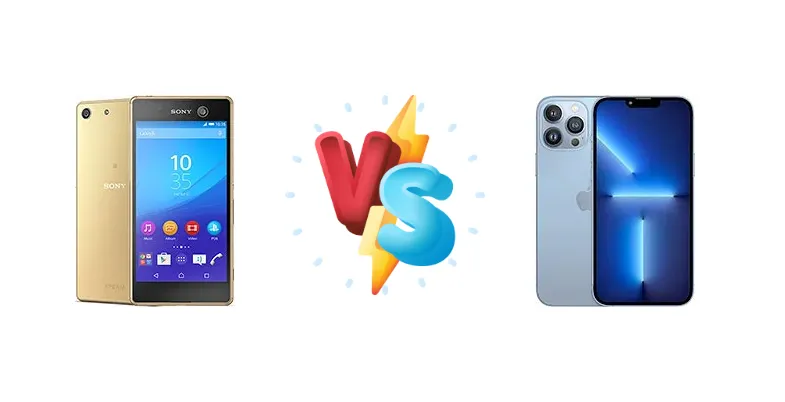
The iPhone 13 Pro Max utterly dominates this comparison. While the Xperia M5 Dual was a decent phone in its time, the iPhone's superior performance, camera, display, and battery life make it the clear winner. This is a battle of generations, and the iPhone's advanced technology shines through.
| PHONES | ||
|---|---|---|
| Phone Names | Sony Xperia M5 Dual | Apple iPhone 13 Pro Max |
| Network | ||
|---|---|---|
| 2G bands | GSM 850 / 900 / 1800 / 1900 - SIM 1 & SIM 2 | GSM 850 / 900 / 1800 / 1900 |
| 3G bands | HSDPA 850 / 900 / 1900 / 2100 - E5633, E5643, E5663 | HSDPA 850 / 900 / 1700(AWS) / 1900 / 2100 |
| 4G bands | 1, 3, 5, 7, 8, 20 - E5633 | 1, 2, 3, 4, 5, 7, 8, 12, 13, 17, 18, 19, 20, 25, 26, 28, 30, 32, 34, 38, 39, 40, 41, 42, 46, 48, 66 - A2643, A2644, A2645 |
| 5G bands | - | 1, 2, 3, 5, 7, 8, 12, 20, 25, 28, 30, 38, 40, 41, 48, 66, 77, 78, 79 SA/NSA/Sub6 - A2643, A2644 |
| Speed | HSPA 42.2/5.76 Mbps, LTE Cat4 150/50 Mbps | HSPA, LTE, 5G, EV-DO Rev.A 3.1 Mbps |
| Technology | GSM / HSPA / LTE | GSM / CDMA / HSPA / EVDO / LTE / 5G |
| 1, 3, 5, 7, 8, 28, 40 - E5663 | 1, 2, 3, 5, 7, 8, 12, 20, 25, 28, 29, 30, 38, 40, 41, 48, 66, 71, 77, 78, 79 SA/NSA/Sub6 - A2641 | |
| Launch | ||
|---|---|---|
| Announced | 2015, August. Released 2015, September | 2021, September 14 |
| Status | Discontinued | Available. Released 2021, September 24 |
| Body | ||
|---|---|---|
| Build | - | Glass front, glass back, stainless steel frame |
| Dimensions | 145 x 72 x 7.6 mm (5.71 x 2.83 x 0.30 in) | 160.8 x 78.1 x 7.7 mm (6.33 x 3.07 x 0.30 in) |
| SIM | Nano-SIM + Nano-SIM | · Nano-SIM + eSIM· Nano-SIM + Nano-SIM |
| Weight | 142.6 g (5.04 oz) | 240 g (8.47 oz) |
| IP68 dust/water resistant (up to 1.5m for 30 min) | IP68 dust/water resistant (up to 6m for 30 min) Apple Pay (Visa, MasterCard, AMEX certified) | |
| Display | ||
|---|---|---|
| Protection | Scratch-resistant glass | Ceramic Shield glass |
| Resolution | 1080 x 1920 pixels, 16:9 ratio (~441 ppi density) | 1284 x 2778 pixels, 19.5:9 ratio (~458 ppi density) |
| Size | 5.0 inches, 68.9 cm2 (~66.0% screen-to-body ratio) | 6.7 inches, 109.8 cm2 (~87.4% screen-to-body ratio) |
| Type | IPS LCD | Super Retina XDR OLED, 120Hz, HDR10, Dolby Vision, 1000 nits (HBM), 1200 nits (peak) |
| Platform | ||
|---|---|---|
| CPU | Octa-core 2.0 GHz Cortex-A53 | Hexa-core (2x3.23 GHz Avalanche + 4x1.82 GHz Blizzard) |
| Chipset | Mediatek MT6795 Helio X10 (28 nm) | Apple A15 Bionic (5 nm) |
| GPU | PowerVR G6200 | Apple GPU (5-core graphics) |
| OS | Android 5.0 (Lollipop), upgradable to 5.1 (Lollipop) | iOS 15, upgradable to iOS 26.1 |
| Memory | ||
|---|---|---|
| Card slot | microSDXC (dedicated slot) | No |
| Internal | 16GB 3GB RAM | 128GB 6GB RAM, 256GB 6GB RAM, 512GB 6GB RAM, 1TB 6GB RAM |
| eMMC 5.0 | NVMe | |
| Main Camera | ||
|---|---|---|
| Features | LED flash, HDR, panorama | Dual-LED dual-tone flash, HDR (photo/panorama) |
| Single | 21.2 MP, f/2.2, PDAF | 12 MP, f/2.2, 23mm (wide), 1/3.6" SL 3D, (depth/biometrics sensor) |
| Triple | - | 12 MP, f/1.5, 26mm (wide), 1/1.7", 1.9µm, dual pixel PDAF, sensor-shift OIS 12 MP, f/2.8, 77mm (telephoto), PDAF, 1/3.4", 1.0µm, OIS, 3x optical zoom 12 MP, f/1.8, 13mm, 120˚ (ultrawide), 1/3.4", 1.0µm, PDAF TOF 3D LiDAR scanner (depth) |
| Video | 4K@30fps, HDR | 4K@24/25/30/60fps, 1080p@25/30/60/120/240fps, 10-bit HDR, Dolby Vision HDR (up to 60fps), ProRes, stereo sound rec. |
| Selfie camera | ||
|---|---|---|
| Features | - | HDR |
| Single | 13 MP, f/2.0, AF | 12 MP, f/2.2, 23mm (wide), 1/3.6", 1.0µm SL 3D, (depth/biometrics sensor) |
| Video | 1080p@30fps | 4K@24/25/30/60fps, 1080p@25/30/60/120fps, gyro-EIS |
| Sound | ||
|---|---|---|
| 3.5mm jack | Yes | No |
| 35mm jack | Yes | No |
| Loudspeaker | Yes | Yes, with stereo speakers |
| Comms | ||
|---|---|---|
| Bluetooth | 4.1, A2DP, LE, aptX | 5.0, A2DP, LE |
| NFC | Yes | Yes |
| Positioning | GPS, GLONASS | GPS, GLONASS, GALILEO, BDS, QZSS |
| Radio | FM radio, RDS | No |
| USB | microUSB 2.0 | Lightning, USB 2.0 |
| WLAN | Wi-Fi 802.11 a/b/g/n, dual-band, Wi-Fi Direct, DLNA, hotspot | Wi-Fi 802.11 a/b/g/n/ac/6, dual-band, hotspot |
| Features | ||
|---|---|---|
| Browser | HTML, Adobe Flash | - |
| Sensors | Accelerometer, proximity, compass | Face ID, accelerometer, gyro, proximity, compass, barometer |
| - | Ultra Wideband (UWB) support | |
| Battery | ||
|---|---|---|
| Charging | - | Wired, PD2.0, 50% in 30 min 15W wireless (MagSafe) 15W wireless (Qi2) - requires iOS 17.2 update |
| Music play | Up to 62 h 30 min | - |
| Stand-by | Up to 495 h (2G) / Up to 504 h (3G) | - |
| Talk time | Up to 11 h 49 min (2G) / Up to 12 h 11 min (3G) | - |
| Type | Li-Ion 2600 mAh, non-removable | Li-Ion 4352 mAh (16.75 Wh) |
| Misc | ||
|---|---|---|
| Colors | Black, White, Gold | Graphite, Gold, Silver, Sierra Blue, Alpine Green |
| Models | E56333E5643, E5663, E5633 | A2643, A2484, A2641, A2644, A2645, iphone14,3 |
| Price | About 110 EUR | € 423.38 / $ 394.86 / £ 355.00 |
| SAR | 0.32 W/kg (head) 1.39 W/kg (body) | 1.18 W/kg (head) 1.20 W/kg (body) |
| SAR EU | 0.19 W/kg (head) 0.40 W/kg (body) | 0.99 W/kg (head) 0.98 W/kg (body) |
| Tests | ||
|---|---|---|
| Audio quality | Noise -94.1dB / Crosstalk -93.4dB | - |
| Battery life | - | Endurance rating 121h |
| Camera | - | Photo / Video |
| Display | Contrast ratio: 839 (nominal), 2.69(sunlight) | Contrast ratio: Infinite (nominal) |
| Loudspeaker | Voice 65dB / Noise 64dB / Ring 68dB | -24.0 LUFS (Very good) |
| Performance | Basemark OS II 2.0: 860Basemark X: 7780 | AnTuTu: 801691 (v9) GeekBench: 4706 (v5.1) GFXBench: 60fps (ES 3.1 onscreen) |
Sony Xperia M5 Dual
- Compact size
- Decent camera for its time
- Expandable storage (microSD)
- Affordable (used)
- Outdated processor
- Low screen brightness
- Limited software updates
- Poor performance by modern standards
Apple iPhone 13 Pro Max
- Exceptional performance
- Stunning display
- Top-tier camera system
- Long battery life
- Premium build quality
- Excellent software support
- High price
- No expandable storage
- Large size
Display Comparison
The iPhone 13 Pro Max boasts a significantly brighter display (1050 nits) and an 'infinite' contrast ratio, offering exceptional color accuracy and visibility even in direct sunlight. The Xperia M5 Dual's contrast ratio of 839 (nominal) and 2.69 (sunlight) is adequate but pales in comparison. The iPhone's Super Retina XDR display is a major advantage.
Camera Comparison
The iPhone 13 Pro Max's camera system is renowned for its exceptional image quality, advanced features like Cinematic mode, and impressive video recording capabilities. The Xperia M5 Dual's camera was good for its time, but it lacks the sophistication and performance of the iPhone's system. Low-light performance is dramatically better on the iPhone.
Performance
The A15 Bionic chip in the iPhone 13 Pro Max is leaps and bounds ahead of the Mediatek Helio X10 in the Xperia M5 Dual. The iPhone delivers blazing-fast performance for demanding apps, games, and multitasking, while the Xperia M5 Dual can feel sluggish by today's standards. The A15's efficiency also contributes to better battery life.
Battery Life
The iPhone 13 Pro Max offers exceptional battery life, achieving an endurance rating of 121 hours. While the Xperia M5 Dual's battery life was decent for its era, it's nowhere near the iPhone's longevity. The iPhone's efficient chipset and optimized software contribute to its superior battery performance.
Buying Guide
The Xperia M5 Dual is suitable for someone seeking a very basic, budget-friendly phone for calls and simple tasks, primarily for nostalgic reasons or if finding a very cheap used device is a priority. The iPhone 13 Pro Max is for users who demand top-tier performance, a stunning camera, a vibrant display, and long-lasting battery life, and are willing to pay a premium.