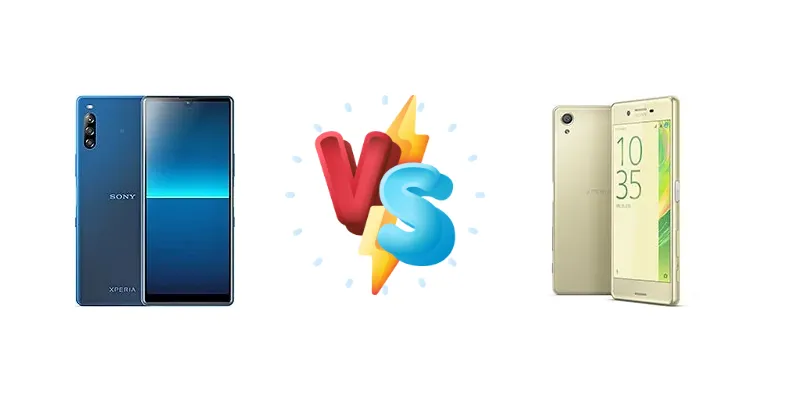
Sony has a long history of producing quality smartphones, but their offerings cater to different budgets and needs. Today, we're pitting two models against each other: the budget-friendly Xperia L4 and the slightly older, but potentially more powerful, Xperia X. Let's dive into a detailed comparison to see which phone comes out on top.
🏆 Quick Verdict
The Xperia X generally wins due to its superior chipset, potentially better camera, and exceptional battery life. While the L4 is a more affordable option, the X offers a more premium experience and better overall performance, making it the recommended choice for most users.
| Network |
|---|
| 2G bands | GSM 850 / 900 / 1800 / 1900 | GSM 850 / 900 / 1800 / 1900 - SIM 1 & SIM 2 (dual-SIM model only) |
| 3G bands | HSDPA 850 / 900 / 1900 / 2100 | HSDPA 800 / 850 / 900 / 1700(AWS) / 1900 / 2100 - F5121, F5122 |
| 4G bands | 1, 2, 3, 5, 7, 8, 20, 40 | 1, 2, 3, 4, 5, 7, 8, 12, 17, 19, 20, 26, 28, 38, 39, 40, 41 - F5121, F5122 |
| Speed | HSPA 42.2/5.76 Mbps, LTE (2CA) Cat6 300/50 Mbps | HSPA 42.2/5.76 Mbps, LTE Cat6 300/50 Mbps |
| Technology | GSM / HSPA / LTE | GSM / HSPA / LTE |
| Launch |
|---|
| Announced | 2020, February 20. Released 2020, April 28 | 2016, February. Released 2016, May |
| Status | Discontinued | Discontinued |
| Body |
|---|
| Build | Glass front, plastic back, plastic frame | Glass front, aluminum back, aluminum frame |
| Dimensions | 159 x 71 x 8.7 mm (6.26 x 2.80 x 0.34 in) | 143 x 69 x 7.7 mm (5.63 x 2.72 x 0.30 in) |
| SIM | · Nano-SIM· Nano-SIM + Nano-SIM | · Nano-SIM· Nano-SIM + Nano-SIM |
| Weight | 178 g (6.28 oz) | 153 g (5.40 oz) |
| Display |
|---|
| Protection | - | Scratch-resistant glass, oleophobic coating |
| Resolution | 720 x 1680 pixels, 21:9 ratio (~295 ppi density) | 1080 x 1920 pixels, 16:9 ratio (~441 ppi density) |
| Size | 6.2 inches, 89.8 cm2 (~79.5% screen-to-body ratio) | 5.0 inches, 68.9 cm2 (~69.8% screen-to-body ratio) |
| Type | IPS LCD | IPS LCD |
| | - | Triluminos display
X-Reality Engine |
| Platform |
|---|
| CPU | Octa-core 2.0 GHz Cortex-A53 | Hexa-core (4x1.4 GHz Cortex-A53 & 2x1.8 GHz Cortex-A72) |
| Chipset | Mediatek MT6762 Helio P22 (12 nm) | Qualcomm MSM8956 Snapdragon 650 |
| GPU | PowerVR GE8320 | Adreno 510 |
| OS | Android 9.0 (Pie) | Android 6.0.1 (Marshmallow), upgradable to Android 8.0 (Oreo) |
| Memory |
|---|
| Card slot | microSDXC (uses shared SIM slot) | microSDXC (uses shared SIM slot) - dual SIM model only |
| Internal | 64GB 3GB RAM | 32GB 3GB RAM (F5121), 64GB 3GB RAM (F5122) |
| | eMMC 5.1 | eMMC 4.5 |
| Main Camera |
|---|
| Features | LED flash, HDR, panorama | LED flash, HDR, panorama |
| Single | - | 23 MP, f/2.0, 24mm (wide), 1/2.3", PDAF |
| Triple | 13 MP, f/2.0, 26mm (wide), 1/3.0", PDAF
5 MP, f/2.2, 17mm (ultrawide), 1/5.0", 1.12µm
Auxiliary lens | - |
| Video | 1080p@30fps | 1080p@30fps, 1080p@60fps |
| Selfie camera |
|---|
| Single | 8 MP, f/2.0, 27mm (wide), 1/4.0", 1.12µm | 13 MP, f/2.0, 22mm (wide), 1/3" |
| Video | 1080p@30fps | 1080p@30fps |
| Sound |
|---|
| 3.5mm jack | Yes | Yes |
| 35mm jack | Yes | Yes |
| Loudspeaker | Yes | Yes, with stereo speakers |
| | - | 24-bit/192kHz audio
|
| Comms |
|---|
| Bluetooth | 5.0, A2DP, LE | 4.2, A2DP, aptX, LE |
| NFC | Yes | Yes |
| Positioning | GPS, GLONASS | GPS, GLONASS |
| Radio | FM radio | FM radio, RDS |
| USB | USB Type-C 2.0 | microUSB 2.0, OTG |
| WLAN | Wi-Fi 802.11 a/b/g/n, dual-band, Wi-Fi Direct | Wi-Fi 802.11 a/b/g/n/ac, dual-band, Wi-Fi Direct, DLNA |
| Features |
|---|
| Sensors | Fingerprint (side-mounted), accelerometer, proximity, compass | Fingerprint (side-mounted), accelerometer, gyro, proximity, barometer, compass |
| Battery |
|---|
| Charging | USB Power Delivery | 18W wired, QC2 |
| Type | Li-Ion 3580 mAh | Li-Ion 2620 mAh, non-removable |
| Misc |
|---|
| Colors | Black, Blue | White, Graphite Black, Lime Gold, Rose Gold |
| Models | XQ-AD52, XQ-AD51 | F5122, F5121 |
| Price | About 200 EUR | About 150 EUR |
| SAR | - | 0.97 W/kg (head) 0.97 W/kg (body) |
| SAR EU | - | 0.72 W/kg (head) 1.23 W/kg (body) |
| Tests |
|---|
| Audio quality | - |
Noise -94.8dB / Crosstalk -93.4dB |
| Battery life | - | Endurance rating 67h |
| Camera | - |
Photo / Video |
| Display | - |
Contrast ratio: 1219 (nominal), 2.989 (sunlight) |
| Loudspeaker | - |
Voice 61dB / Noise 61dB / Ring 65dB |
| Performance | - |
Basemark OS II 2.0: 1714Basemark X: 15087 |
Sony Xperia L4
- Affordable
- USB Power Delivery charging
- Decent display contrast
- Less powerful chipset
- Shorter battery life
- Potentially lower camera quality
- Older design
Sony Xperia X
- Powerful Snapdragon 650 chipset
- Exceptional battery life (67h)
- Potentially better camera
- QC2 charging
- Likely better display panel
- Older model
- May lack latest software updates
- Potentially larger size/weight
Display Comparison
Both phones boast impressive contrast ratios (1219 nominal, 2.989 in sunlight), suggesting excellent visibility even in bright conditions. However, the Xperia X likely has a slightly better display panel overall due to its age and potentially more advanced technology. The L4's display is likely an LCD, while the X could be OLED or a higher-quality IPS panel. Resolution and size are likely different, with the X potentially having a higher resolution.
Camera Comparison
While both phones are listed as having 'Photo/Video' capabilities, the Xperia X likely has a superior camera system. The Snapdragon 650 often paired with better camera sensors and image processing capabilities than the L4. Expect better image quality, dynamic range, and low-light performance from the Xperia X. Specific camera specs (megapixels, aperture) are missing, but the X is generally expected to perform better.
Performance
The Xperia X holds a significant advantage here. Its Qualcomm Snapdragon 650 chipset is considerably more powerful than the Mediatek Helio P22 in the L4. The X's hexa-core CPU (with a mix of Cortex-A53 and A72 cores) provides a smoother and faster experience for multitasking, gaming, and demanding applications. The L4's Cortex-A53-only CPU will feel noticeably slower.
Battery Life
The Xperia X absolutely dominates in this category. Its endurance rating of 67 hours is exceptional. The L4's battery capacity is likely smaller, and its less efficient chipset will result in significantly shorter battery life. This is a major selling point for the Xperia X.
Buying Guide
The Sony Xperia L4 is ideal for users on a tight budget who prioritize affordability and basic smartphone functionality. The Xperia X is a better choice for those seeking a more powerful device with a better camera and significantly longer battery life, even if it's a slightly older model.
Frequently Asked Questions
❓ Is the Xperia L4 worth buying in 2024?
The Xperia L4 is a viable option if you're on a very tight budget and only need basic smartphone functionality. However, for a slightly higher price, the Xperia X offers significantly better performance and battery life.
❓ What is the main difference between the Xperia L4 and Xperia X?
The primary difference lies in the chipset. The Xperia X's Snapdragon 650 provides a much smoother and faster experience compared to the L4's Helio P22. Battery life is also a major differentiator, with the X offering significantly longer usage.