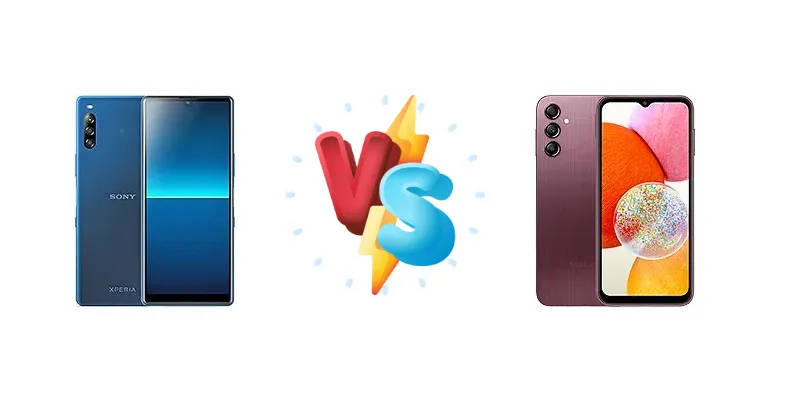
The budget smartphone market is fiercely competitive, offering incredible value for your money. Today, we're pitting two contenders against each other: the Sony Xperia L4 and the Samsung Galaxy A14. Both aim to deliver a solid experience without breaking the bank, but which one comes out on top?
🏆 Quick Verdict
The Samsung Galaxy A14 generally wins due to its superior processor, brighter display, and more versatile camera system. While the Xperia L4 offers a clean Android experience, the A14 provides a more compelling overall package for most users seeking a budget-friendly phone.
| Network |
|---|
| 2G bands | GSM 850 / 900 / 1800 / 1900 | GSM 850 / 900 / 1800 / 1900 |
| 3G bands | HSDPA 850 / 900 / 1900 / 2100 | HSDPA 850 / 900 / 2100 |
| 4G bands | 1, 2, 3, 5, 7, 8, 20, 40 | 1, 3, 5, 7, 8, 20, 28, 38, 40, 41 |
| Speed | HSPA 42.2/5.76 Mbps, LTE (2CA) Cat6 300/50 Mbps | HSPA, LTE |
| Technology | GSM / HSPA / LTE | GSM / HSPA / LTE |
| Launch |
|---|
| Announced | 2020, February 20. Released 2020, April 28 | 2023, February 28 |
| Status | Discontinued | Available. Released 2023, March 27 |
| Body |
|---|
| Build | Glass front, plastic back, plastic frame | Glass front, plastic back, plastic frame |
| Dimensions | 159 x 71 x 8.7 mm (6.26 x 2.80 x 0.34 in) | 167.7 x 78 x 9.1 mm (6.60 x 3.07 x 0.36 in) |
| SIM | · Nano-SIM· Nano-SIM + Nano-SIM | · Nano-SIM· Nano-SIM + Nano-SIM |
| Weight | 178 g (6.28 oz) | 201 g (7.09 oz) |
| Display |
|---|
| Resolution | 720 x 1680 pixels, 21:9 ratio (~295 ppi density) | 1080 x 2408 pixels, 20:9 ratio (~400 ppi density) |
| Size | 6.2 inches, 89.8 cm2 (~79.5% screen-to-body ratio) | 6.6 inches, 104.9 cm2 (~80.2% screen-to-body ratio) |
| Type | IPS LCD | PLS LCD |
| Platform |
|---|
| CPU | Octa-core 2.0 GHz Cortex-A53 | Octa-core (2x2.0 GHz Cortex-A75 & 6x1.8 GHz Cortex-A55) - Version AOcta-core (4x2.0 GHz Cortex-A55 & 4x2.0 GHz Cortex-A55) - Version B |
| Chipset | Mediatek MT6762 Helio P22 (12 nm) | Mediatek MT6769 Helio G80 (12 nm) - Version AExynos 850 (8 nm) - Version B |
| GPU | PowerVR GE8320 | Mali-G52 MC2 |
| OS | Android 9.0 (Pie) | Android 13, upgradable to Android 15, One UI 7 |
| Memory |
|---|
| Card slot | microSDXC (uses shared SIM slot) | microSDXC (dedicated slot) |
| Internal | 64GB 3GB RAM | 64GB 4GB RAM, 128GB 4GB RAM, 128GB 6GB RAM |
| | eMMC 5.1 | - |
| Main Camera |
|---|
| Features | LED flash, HDR, panorama | LED flash, panorama, HDR |
| Single | - | 13 MP, f/2.0, (wide) |
| Triple | 13 MP, f/2.0, 26mm (wide), 1/3.0", PDAF
5 MP, f/2.2, 17mm (ultrawide), 1/5.0", 1.12µm
Auxiliary lens | 50 MP, f/1.8, 26mm (wide), 1/2.75", 0.64µm, PDAF
5 MP, f/2.2, 17mm (ultrawide), 1/5.0", 1.12µm
2 MP (macro) |
| Video | 1080p@30fps | 1080p@30fps |
| Selfie camera |
|---|
| Single | 8 MP, f/2.0, 27mm (wide), 1/4.0", 1.12µm | 13 MP, f/2.0, 26mm (wide), 1/3.1", 1.12µm |
| Video | 1080p@30fps | 1080p@30fps |
| Sound |
|---|
| 3.5mm jack | Yes | Yes |
| 35mm jack | Yes | Yes |
| Loudspeaker | Yes | Yes |
| Comms |
|---|
| Bluetooth | 5.0, A2DP, LE | 5.1 or 5.3, A2DP, LE |
| NFC | Yes | Yes (market/region dependent) |
| Positioning | GPS, GLONASS | GPS, GALILEO, GLONASS, BDS, QZSS |
| Radio | FM radio | Unspecified |
| USB | USB Type-C 2.0 | USB Type-C 2.0 |
| WLAN | Wi-Fi 802.11 a/b/g/n, dual-band, Wi-Fi Direct | Wi-Fi 802.11 a/b/g/n/ac, dual-band, Wi-Fi Direct |
| Features |
|---|
| Sensors | Fingerprint (side-mounted), accelerometer, proximity, compass | Fingerprint (side-mounted), accelerometer, proximity, compass |
| Battery |
|---|
| Charging | USB Power Delivery | 15W wired |
| Type | Li-Ion 3580 mAh | Li-Po 5000 mAh |
| Misc |
|---|
| Colors | Black, Blue | Black, Dark Red, Silver, Green |
| Models | XQ-AD52, XQ-AD51 | SM-A145F, SM-A145F/DSN, SM-A145M, SM-A145M/DS, SM-A145P, SM-A145R |
| Price | About 200 EUR | € 85.76 / $ 147.60 / £ 79.95 |
| SAR EU | - | 0.46 W/kg (head) 1.37 W/kg (body) |
Sony Xperia L4
- Clean Android experience
- Compact size
- USB Power Delivery charging
- Lower performance
- Less vibrant display
- Limited camera capabilities
- Smaller battery
Samsung Galaxy A14
- Better performance (Exynos 850 variant)
- Brighter and larger display
- More versatile camera system
- Larger battery capacity
- 90Hz refresh rate
- Samsung's One UI can be divisive
- 15W charging is relatively slow
Display Comparison
The Galaxy A14 boasts a larger 6.6-inch display with a higher resolution (1080 x 2408 pixels) and a brighter panel compared to the Xperia L4's 6.2-inch 720 x 1600 pixels display. This translates to a more immersive and vibrant viewing experience on the A14. The A14 also has a higher refresh rate (90Hz) for smoother scrolling.
Camera Comparison
The Galaxy A14 generally has a more versatile camera system. While both phones offer decent image quality in good lighting, the A14's multiple lenses (typically a 50MP main, ultrawide, and macro) provide more creative options. The Xperia L4's single 13MP camera is simpler but produces acceptable results.
Performance
The Samsung Galaxy A14, particularly the Exynos 850 variant, offers significantly better performance than the Xperia L4's Helio P22. The A14's Cortex-A75 cores provide a noticeable boost in responsiveness and multitasking capabilities. The Helio P22 is adequate for basic tasks but struggles with more demanding applications.
Battery Life
Both phones offer decent battery life, but the Galaxy A14's larger battery capacity (5000mAh vs L4's 3180mAh) typically translates to longer usage times. While the Xperia L4 supports USB Power Delivery, the A14's 15W wired charging is comparable.
Buying Guide
Who should buy the Sony Xperia L4? Users prioritizing a clean, stock Android experience and a compact form factor might find the L4 appealing. Who should buy the Samsung Galaxy A14? Those seeking better performance, a brighter display, a more capable camera, and a larger screen will likely prefer the Galaxy A14.
Frequently Asked Questions
❓ Which phone has better software support?
Samsung generally offers longer software update support for its Galaxy A series devices compared to Sony's Xperia line.
❓ Is the Xperia L4 worth considering if I prefer a smaller phone?
Yes, the Xperia L4's compact size can be a significant advantage for those who find larger phones unwieldy. However, be prepared for compromises in performance and camera quality.