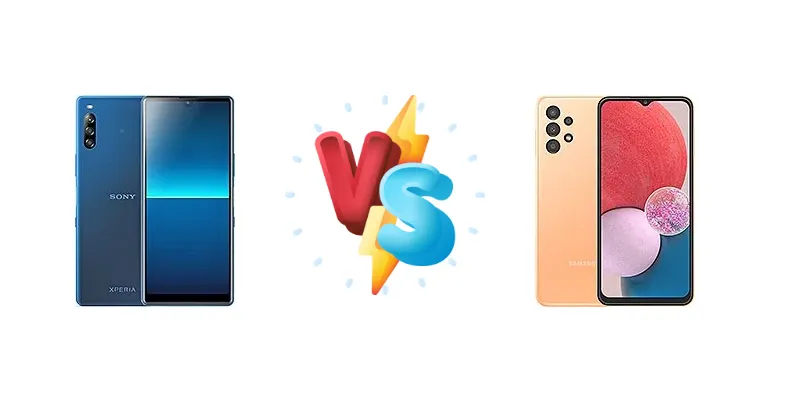
The budget smartphone market is fiercely competitive, offering incredible value for your money. Today, we're pitting two contenders against each other: the Sony Xperia L4 and the Samsung Galaxy A13. Both aim to deliver a solid Android experience without breaking the bank, but which one comes out on top?
🏆 Quick Verdict
The Samsung Galaxy A13 emerges as the stronger choice overall. While the Xperia L4 offers a clean Sony experience, the A13 boasts a superior display, more powerful chipset, and longer software support, making it a more compelling value proposition for most users.
| Network |
|---|
| 2G bands | GSM 850 / 900 / 1800 / 1900 | GSM 850 / 900 / 1800 / 1900 |
| 3G bands | HSDPA 850 / 900 / 1900 / 2100 | HSDPA 850 / 900 / 2100 |
| 4G bands | 1, 2, 3, 5, 7, 8, 20, 40 | 1, 3, 5, 7, 8, 20, 28, 38, 40, 41 |
| Speed | HSPA 42.2/5.76 Mbps, LTE (2CA) Cat6 300/50 Mbps | HSPA, LTE |
| Technology | GSM / HSPA / LTE | GSM / HSPA / LTE |
| Launch |
|---|
| Announced | 2020, February 20. Released 2020, April 28 | 2022, March 04 |
| Status | Discontinued | Available. Released 2022, March 23 |
| Body |
|---|
| Build | Glass front, plastic back, plastic frame | Glass front (Gorilla Glass 5), plastic frame, plastic back |
| Dimensions | 159 x 71 x 8.7 mm (6.26 x 2.80 x 0.34 in) | 165.1 x 76.4 x 8.8 mm (6.5 x 3.01 x 0.35 in) |
| SIM | · Nano-SIM· Nano-SIM + Nano-SIM | · Nano-SIM· Nano-SIM + Nano-SIM |
| Weight | 178 g (6.28 oz) | 195 g (6.88 oz) |
| Display |
|---|
| Protection | - | Corning Gorilla Glass 5 |
| Resolution | 720 x 1680 pixels, 21:9 ratio (~295 ppi density) | 1080 x 2408 pixels, 20:9 ratio (~400 ppi density) |
| Size | 6.2 inches, 89.8 cm2 (~79.5% screen-to-body ratio) | 6.6 inches, 104.9 cm2 (~83.2% screen-to-body ratio) |
| Type | IPS LCD | PLS LCD |
| Platform |
|---|
| CPU | Octa-core 2.0 GHz Cortex-A53 | Octa-core (4x2.0 GHz Cortex-A55 & 4x2.0 GHz Cortex-A55) |
| Chipset | Mediatek MT6762 Helio P22 (12 nm) | Exynos 850 (8 nm) |
| GPU | PowerVR GE8320 | Mali-G52 |
| OS | Android 9.0 (Pie) | Android 12, upgradable to Android 14, One UI 6.1 |
| Memory |
|---|
| Card slot | microSDXC (uses shared SIM slot) | microSDXC (dedicated slot) |
| Internal | 64GB 3GB RAM | 32GB 3GB RAM, 32GB 4GB RAM, 64GB 4GB RAM, 128GB 3GB RAM, 128GB 4GB RAM, 128GB 6GB RAM |
| | eMMC 5.1 | eMMC 5.1 |
| Main Camera |
|---|
| Features | LED flash, HDR, panorama | LED flash, panorama, HDR |
| Quad | - | 50 MP, f/1.8, (wide), PDAF
5 MP, f/2.2, 123˚ (ultrawide), 1/5.0", 1.12µm
2 MP (macro)
Auxiliary lens |
| Single | - | 8 MP, f/2.2, (wide) |
| Triple | 13 MP, f/2.0, 26mm (wide), 1/3.0", PDAF
5 MP, f/2.2, 17mm (ultrawide), 1/5.0", 1.12µm
Auxiliary lens | - |
| Video | 1080p@30fps | 1080p@30fps |
| Selfie camera |
|---|
| Single | 8 MP, f/2.0, 27mm (wide), 1/4.0", 1.12µm | 8 MP, f/2.2, (wide) |
| Video | 1080p@30fps | 1080p@30fps |
| Sound |
|---|
| 3.5mm jack | Yes | Yes |
| 35mm jack | Yes | Yes |
| Loudspeaker | Yes | Yes |
| Comms |
|---|
| Bluetooth | 5.0, A2DP, LE | 5.0, A2DP, LE |
| NFC | Yes | Yes (market/region dependent) |
| Positioning | GPS, GLONASS | GPS, GLONASS, GALILEO, BDS |
| Radio | FM radio | No |
| USB | USB Type-C 2.0 | USB Type-C 2.0, OTG |
| WLAN | Wi-Fi 802.11 a/b/g/n, dual-band, Wi-Fi Direct | Wi-Fi 802.11 a/b/g/n/ac, dual-band, Wi-Fi Direct |
| Features |
|---|
| Sensors | Fingerprint (side-mounted), accelerometer, proximity, compass | Fingerprint (side-mounted), accelerometer, compass |
| | - | Virtual proximity sensing |
| Battery |
|---|
| Charging | USB Power Delivery | 15W wired |
| Type | Li-Ion 3580 mAh | Li-Po 5000 mAh |
| Misc |
|---|
| Colors | Black, Blue | Black, White, Peach, Blue |
| Models | XQ-AD52, XQ-AD51 | SM-A135F, SM-A135F/DS, SM-A135M, SM-A135U, SM-A135U1, SM-A135N |
| Price | About 200 EUR | € 94.99 / $ 129.99 / £ 89.00 |
| SAR | - | 0.49 W/kg (head) |
| SAR EU | - | 0.37 W/kg (head) 1.39 W/kg (body) |
| Tests |
|---|
| Battery life | - |
Endurance rating 114h
|
| Camera | - |
Photo / Video |
| Display | - |
Contrast ratio: 1324:1 (nominal) |
| Loudspeaker | - |
-29.7 LUFS (Average)
|
| Performance | - |
AnTuTu: 122822 (v8), 136286 (v9)
GeekBench: 588 (v5.1)
GFXBench: 5.2fps (ES 3.1 onscreen) |
Sony Xperia L4
- Clean Android experience
- Compact size
- USB Power Delivery charging
- Lower performance
- Dimmer display
- Less powerful camera
- Limited software updates
Samsung Galaxy A13
- Brighter display
- Better performance (Exynos 850)
- Longer software support
- Impressive battery life
- Larger size
- Samsung's One UI (preference-based)
- 15W wired charging
Display Comparison
The Samsung Galaxy A13 takes a clear lead in the display department. Its 587 nits of peak brightness significantly outshines the Xperia L4, offering better visibility in sunlight. The contrast ratio is comparable, but the A13's brightness makes a noticeable difference in everyday use. The L4's display is adequate but lacks the vibrancy and clarity of the A13.
Camera Comparison
Camera performance is generally better on the Galaxy A13. While specific megapixel counts are not provided, Samsung's image processing typically delivers more vibrant and detailed photos. The L4's camera is serviceable but lacks the dynamic range and low-light capabilities of the A13. Both offer Photo/Video capabilities.
Performance
The Exynos 850 in the Galaxy A13 provides a noticeable performance boost over the Helio P22 in the Xperia L4. While both are octa-core processors, the Exynos 850's 8nm process and different core configuration result in smoother multitasking and faster app loading times. The L4 can feel sluggish at times, especially with demanding apps.
Battery Life
Both phones boast impressive battery life, with the Galaxy A13 achieving an endurance rating of 114 hours. The Xperia L4's battery life is also good, though specific figures are not available. However, the A13's more efficient chipset likely contributes to its superior endurance.
Buying Guide
Who should buy the Sony Xperia L4? Users prioritizing a clean, stock Android experience and a compact form factor might find the L4 appealing. Who should buy the Samsung Galaxy A13? Those seeking a brighter display, better performance, and longer software updates will benefit from the A13's strengths.
Frequently Asked Questions
❓ Which phone has better software support?
The Samsung Galaxy A13 typically receives longer software updates and security patches compared to the Sony Xperia L4.
❓ Is the Xperia L4 worth considering if I prefer a smaller phone?
Yes, the Xperia L4's compact size can be a significant advantage for those who prefer a more pocketable device, but be prepared for compromises in performance and display quality.