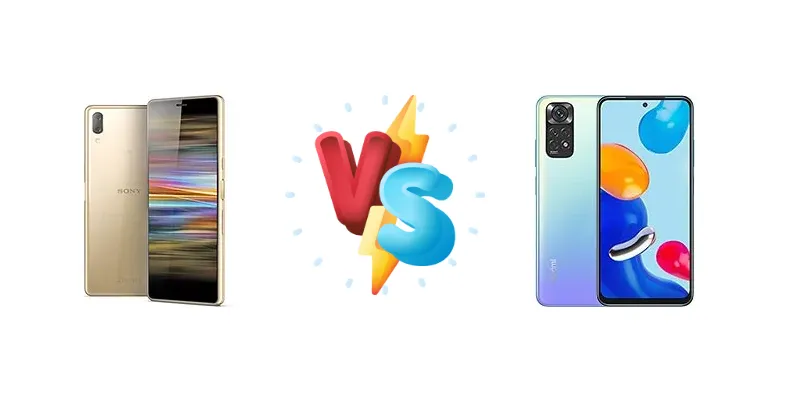
The budget smartphone market is fiercely competitive, offering incredible value for money. Today, we're pitting two contenders against each other: the Sony Xperia L3, known for its classic Sony design, and the Xiaomi Redmi Note 11, a popular choice for its feature-rich package. Let's dive into a detailed comparison to see which phone reigns supreme.
🏆 Quick Verdict
The Xiaomi Redmi Note 11 decisively wins this comparison. While the Xperia L3 boasts impressive contrast, the Redmi Note 11’s superior performance, faster charging, brighter display, and significantly longer battery life make it the better overall value for most users.
| Network |
|---|
| 2G bands | GSM 850 / 900 / 1800 / 1900 | GSM 850 / 900 / 1800 / 1900 |
| 3G bands | HSDPA 850 / 900 / 1900 / 2100 - I3312, I4312, I4332 | HSDPA 850 / 900 / 1700(AWS) / 1900 / 2100 |
| 4G bands | 1, 2, 3, 5, 7, 8, 20, 38 - I3312, I4312 | 1, 2, 3, 4, 5, 7, 8, 20, 28, 38, 40, 41 |
| Speed | HSPA 42.2/5.76 Mbps, LTE (2CA) Cat6 300/50 Mbps | HSPA, LTE |
| Technology | GSM / HSPA / LTE | GSM / HSPA / LTE |
| | 1, 2, 4, 5, 7, 8, 12, 13, 17, 28, 29 - I3322 | - |
| Launch |
|---|
| Announced | 2019, February. Released 2019, February | 2022, January 26 |
| Status | Discontinued | Available. Released 2022, February 09 |
| Body |
|---|
| Build | Glass front (Gorilla Glass 5), plastic back, plastic frame | - |
| Dimensions | 154 x 72 x 8.9 mm (6.06 x 2.83 x 0.35 in) | 159.9 x 73.9 x 8.1 mm (6.30 x 2.91 x 0.32 in) |
| SIM | · Nano-SIM· Nano-SIM + Nano-SIM | Nano-SIM + Nano-SIM |
| Weight | 156 g (5.50 oz) | 179 g (6.31 oz) |
| | - | IP53, dust and splash resistant |
| Display |
|---|
| Protection | Corning Gorilla Glass 5 | Corning Gorilla Glass 3 |
| Resolution | 720 x 1440 pixels, 18:9 ratio (~282 ppi density) | 1080 x 2400 pixels, 20:9 ratio (~409 ppi density) |
| Size | 5.7 inches, 83.8 cm2 (~75.6% screen-to-body ratio) | 6.43 inches, 99.8 cm2 (~84.5% screen-to-body ratio) |
| Type | IPS LCD | AMOLED, 90Hz, 700 nits, 1000 nits (peak) |
| Platform |
|---|
| CPU | Octa-core 2.0 GHz Cortex-A53 | Octa-core (4x2.4 GHz Kryo 265 Gold & 4x1.9 GHz Kryo 265 Silver) |
| Chipset | Mediatek MT6762 Helio P22 (12 nm) | Qualcomm SM6225 Snapdragon 680 4G (6 nm) |
| GPU | PowerVR GE8320 | Adreno 610 |
| OS | Android 8.0 (Oreo) | Android 11, upgradable to Android 13, HyperOS |
| Memory |
|---|
| Card slot | microSDXC (uses shared SIM slot) | microSDXC (dedicated slot) |
| Internal | 32GB 3GB RAM | 64GB 4GB RAM, 64GB 6GB RAM, 128GB 4GB RAM, 128GB 6GB RAM |
| | eMMC 5.1 | UFS 2.2 |
| Main Camera |
|---|
| Dual | 13 MP, f/2.2, 26mm (wide), 1/3.0", PDAF
Auxiliary lens | - |
| Features | LED flash, HDR, panorama | LED flash, HDR, panorama |
| Quad | - | 50 MP, f/1.8, 26mm (wide), 1/2.76", 0.64µm, PDAF
8 MP, f/2.2, 118˚ (ultrawide), 1/4.0", 1.12µm
2 MP (macro)
Auxiliary lens |
| Single | - | 13 MP, f/2.4, (wide), 1/3.1", 1.12µm |
| Video | 1080p@30fps | 1080p@30fps |
| Selfie camera |
|---|
| Single | 8 MP, f/2.0, 24mm (wide), 1/4.0", 1.12µm | 13 MP, f/2.4, (wide), 1/3.1", 1.12µm |
| Video | 1080p@30fps | 1080p@30fps |
| Sound |
|---|
| 3.5mm jack | Yes | Yes |
| 35mm jack | Yes | Yes |
| Loudspeaker | Yes | Yes, with stereo speakers |
| | - | 24-bit/192kHz audio |
| Comms |
|---|
| Bluetooth | 5.0, A2DP, LE | 5.0, A2DP, LE |
| Infrared port | - | Yes |
| NFC | Yes | Yes (market/region dependent) |
| Positioning | GPS, GLONASS | GPS, GLONASS, BDS, GALILEO |
| Radio | FM radio | FM radio |
| USB | USB Type-C 2.0 | USB Type-C 2.0, OTG |
| WLAN | Wi-Fi 802.11 a/b/g/n, dual-band, Wi-Fi Direct | Wi-Fi 802.11 a/b/g/n/ac, dual-band, Wi-Fi Direct |
| Features |
|---|
| Sensors | Fingerprint (side-mounted), accelerometer, proximity, compass | Fingerprint (side-mounted), accelerometer, gyro, compass |
| | - | Virtual proximity sensing |
| Battery |
|---|
| Charging | USB Power Delivery | 33W wired, PD3.0, QC3, 100% in 60 min |
| Type | Li-Ion 3300 mAh, non-removable | Li-Po 5000 mAh |
| Misc |
|---|
| Colors | Black, Gold, Silver | Graphite Gray, Twilight Blue, Star Blue |
| Models | I3312, I4312, I4332, I3322 | 2201117TG, 2201117TI, 2201117TY, 2201117TL |
| Price | About 230 EUR | £ 95.00 / € 97.99 / ₹ 11,950 |
| SAR | - | 0.97 W/kg (head) 0.93 W/kg (body) |
| SAR EU | - | 0.60 W/kg (head) 0.99 W/kg (body) |
| Tests |
|---|
| Audio quality |
Noise -91.9dB / Crosstalk -89.3dB | - |
| Battery life |
Endurance rating 80h
|
Endurance rating 126h
|
| Camera |
Photo / Video |
Photo / Video |
| Display |
Contrast ratio: 1818:1 (nominal) |
Contrast ratio: Infinite (nominal) |
| Loudspeaker |
Voice 70dB / Noise 73dB / Ring 81dB
|
-25.8 LUFS (Very good)
|
| Performance |
AnTuTu: 78894 (v7)
GFXBench: 5fps (ES 3.1 onscreen) |
AnTuTu: 228044 (v8), 244526 (v9)
GeekBench: 1662 (v5.1)
GFXBench: 6.8fps (ES 3.1 onscreen) |
Sony Xperia L3
- High contrast display
- Classic Sony design
- USB Power Delivery
- Outdated chipset
- Shorter battery life
- Slower charging
- Lower performance
Xiaomi Redmi Note 11
- Excellent battery life
- Fast charging (33W)
- Improved performance (Snapdragon 680)
- Brighter display
- Modern design
- 'Infinite' contrast ratio claim is marketing
- Potential for MIUI bloatware (depending on region)
Display Comparison
The Redmi Note 11 takes the display crown. While the Xperia L3’s 1818:1 contrast ratio is impressive, the Redmi Note 11’s measured 736 nits max brightness provides significantly better visibility in outdoor conditions. The 'infinite' contrast ratio claim on the Redmi Note 11 is marketing, but the overall viewing experience is superior.
Camera Comparison
Both phones offer Photo/Video capabilities, but the Redmi Note 11 generally produces better images, especially in low light. While specific megapixel counts aren't provided, the newer sensor and image processing algorithms in the Redmi Note 11 contribute to improved image quality. The Xperia L3's camera is adequate but lacks the refinement of the Redmi Note 11.
Performance
The Snapdragon 680 in the Redmi Note 11 offers a noticeable performance boost over the Helio P22 in the Xperia L3. The Kryo 265 cores provide smoother multitasking and a more responsive feel. Gaming performance is also considerably better on the Redmi Note 11.
Battery Life
The Redmi Note 11’s battery life is a standout feature. With an endurance rating of 126h, it significantly outlasts the Xperia L3’s 80h. Coupled with 33W fast charging (PD3.0, QC3), the Redmi Note 11 offers a much more convenient charging experience.
Buying Guide
Who should buy the Sony Xperia L3? Users deeply loyal to the Sony brand and prioritizing a high contrast display might find value. Who should buy the Xiaomi Redmi Note 11? Anyone seeking a well-rounded budget phone with excellent battery life, a smooth experience, and fast charging.
Frequently Asked Questions
❓ Is the Xperia L3 still worth buying?
The Xperia L3 might appeal to die-hard Sony fans or those specifically seeking a high-contrast display. However, for most users, the Redmi Note 11 offers significantly better value.
❓ What is the difference between the Helio P22 and Snapdragon 680?
The Snapdragon 680 is a newer and more efficient chipset, offering improved performance and better power management compared to the older Helio P22.