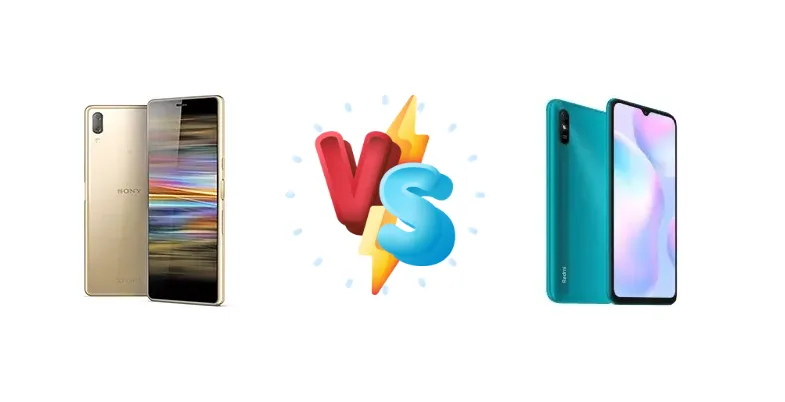
The budget smartphone market is fiercely competitive, offering incredible value for money. Today, we pit two contenders against each other: the Sony Xperia L3 and the Xiaomi Redmi 9A. Both aim to deliver a solid experience without breaking the bank, but which one comes out on top?
🏆 Quick Verdict
The Xperia L3 boasts a significantly better display and potentially longer battery life, while the Redmi 9A offers a more modern chipset and generally better value. The L3's contrast ratio is a major advantage, but the Redmi 9A's price point makes it a compelling choice for budget-conscious buyers.
| Network |
|---|
| 2G bands | GSM 850 / 900 / 1800 / 1900 | GSM 850 / 900 / 1800 / 1900 |
| 3G bands | HSDPA 850 / 900 / 1900 / 2100 - I3312, I4312, I4332 | HSDPA 850 / 900 / 1700(AWS) / 1900 / 2100 - International |
| 4G bands | 1, 2, 3, 5, 7, 8, 20, 38 - I3312, I4312 | 1, 2, 3, 4, 5, 7, 8, 20, 28, 38, 40, 41 - International |
| Speed | HSPA 42.2/5.76 Mbps, LTE (2CA) Cat6 300/50 Mbps | HSPA, LTE |
| Technology | GSM / HSPA / LTE | GSM / HSPA / LTE |
| | 1, 2, 4, 5, 7, 8, 12, 13, 17, 28, 29 - I3322 | 1, 3, 5, 8, 40, 41 - India |
| Launch |
|---|
| Announced | 2019, February. Released 2019, February | 2020, June 30. Released 2020, July 07 |
| Status | Discontinued | Discontinued |
| Body |
|---|
| Build | Glass front (Gorilla Glass 5), plastic back, plastic frame | - |
| Dimensions | 154 x 72 x 8.9 mm (6.06 x 2.83 x 0.35 in) | 164.9 x 77.1 x 9 mm (6.49 x 3.04 x 0.35 in) |
| SIM | · Nano-SIM· Nano-SIM + Nano-SIM | Nano-SIM + Nano-SIM |
| Weight | 156 g (5.50 oz) | 196 g (6.91 oz) |
| Display |
|---|
| Protection | Corning Gorilla Glass 5 | - |
| Resolution | 720 x 1440 pixels, 18:9 ratio (~282 ppi density) | 720 x 1600 pixels, 20:9 ratio (~269 ppi density) |
| Size | 5.7 inches, 83.8 cm2 (~75.6% screen-to-body ratio) | 6.53 inches, 102.9 cm2 (~81.0% screen-to-body ratio) |
| Type | IPS LCD | IPS LCD, 400 nits (typ) |
| Platform |
|---|
| CPU | Octa-core 2.0 GHz Cortex-A53 | Octa-core (4x2.0 GHz Cortex-A53 & 4x1.5 GHz Cortex-A53) |
| Chipset | Mediatek MT6762 Helio P22 (12 nm) | Mediatek MT6762G Helio G25 (12 nm) |
| GPU | PowerVR GE8320 | PowerVR GE8320 |
| OS | Android 8.0 (Oreo) | Android 10, upgradable to Android 11, MIUI 12 |
| Memory |
|---|
| Card slot | microSDXC (uses shared SIM slot) | microSDXC (dedicated slot) |
| Internal | 32GB 3GB RAM | 32GB 2GB RAM, 32GB 3GB RAM, 64GB 4GB RAM, 128GB 4GB RAM, 128GB 6GB RAM |
| | eMMC 5.1 | eMMC 5.1 |
| Main Camera |
|---|
| Dual | 13 MP, f/2.2, 26mm (wide), 1/3.0", PDAF
Auxiliary lens | - |
| Features | LED flash, HDR, panorama | LED flash, HDR |
| Single | - | 13 MP, f/2.2, 28mm (wide), 1.0µm, PDAF |
| Video | 1080p@30fps | 1080p@30/60fps |
| Selfie camera |
|---|
| Features | - | HDR |
| Single | 8 MP, f/2.0, 24mm (wide), 1/4.0", 1.12µm | 5 MP, f/2.2, (wide), 1.12µm |
| Video | 1080p@30fps | 1080p@30fps |
| Sound |
|---|
| 3.5mm jack | Yes | Yes |
| 35mm jack | Yes | Yes |
| Loudspeaker | Yes | Yes |
| Comms |
|---|
| Bluetooth | 5.0, A2DP, LE | 5.0, A2DP, LE |
| NFC | Yes | No |
| Positioning | GPS, GLONASS | GPS, GLONASS, BDS |
| Radio | FM radio | FM radio |
| USB | USB Type-C 2.0 | microUSB 2.0, OTG |
| WLAN | Wi-Fi 802.11 a/b/g/n, dual-band, Wi-Fi Direct | Wi-Fi 802.11 b/g/n, Wi-Fi Direct |
| Features |
|---|
| Sensors | Fingerprint (side-mounted), accelerometer, proximity, compass | Accelerometer, proximity |
| Battery |
|---|
| Charging | USB Power Delivery | 10W wired |
| Type | Li-Ion 3300 mAh, non-removable | Li-Po 5000 mAh |
| Misc |
|---|
| Colors | Black, Gold, Silver | Carbon Gray (Midnight Black), Sky Blue (Sea Blue), Ocean Green (Nature Green) |
| Models | I3312, I4312, I4332, I3322 | M2006C3LG, M2006C3LI, M2006C3LC, M2004C3L |
| Price | About 230 EUR | € 64.30 / $ 56.50 / £ 95.56 |
| SAR | - | 0.90 W/kg (head) 0.65 W/kg (body) |
| SAR EU | - | 0.40 W/kg (head) 1.19 W/kg (body) |
| Tests |
|---|
| Audio quality |
Noise -91.9dB / Crosstalk -89.3dB | - |
| Battery life |
Endurance rating 80h
| - |
| Camera |
Photo / Video | - |
| Display |
Contrast ratio: 1818:1 (nominal) | - |
| Loudspeaker |
Voice 70dB / Noise 73dB / Ring 81dB
| - |
| Performance |
AnTuTu: 78894 (v7)
GFXBench: 5fps (ES 3.1 onscreen) | - |
Sony Xperia L3
- Excellent contrast ratio display
- Potentially longer battery life
- Sony's image processing
- Older chipset
- May lack modern features
- Charging speed likely slow
Xiaomi Redmi 9A
- More modern chipset (Helio G25)
- Better value for money
- Reliable everyday performance
- Less impressive display
- Potentially shorter battery life
- 10W charging is slow
Display Comparison
The Xperia L3's standout feature is its exceptional contrast ratio of 1818:1, promising deep blacks and vibrant colors. The Redmi 9A's display is adequate but lacks the same level of visual pop. Resolution and size are likely similar, but the L3's contrast gives it a clear edge in image quality.
Camera Comparison
Camera performance is likely comparable given both phones are in the budget category. Both offer photo and video capabilities, but image quality will depend heavily on lighting conditions and software processing. The Xperia L3 might have slightly better image processing due to Sony's expertise, but the Redmi 9A could offer more features.
Performance
The Redmi 9A's Mediatek Helio G25, while still entry-level, offers a slightly more modern architecture than the L3's Helio P22. Expect marginally smoother performance in everyday tasks and potentially better gaming capabilities on the Redmi 9A. However, both phones are unlikely to handle demanding games or multitasking flawlessly.
Battery Life
The Xperia L3 claims an impressive 80-hour endurance rating, suggesting exceptional battery life. The Redmi 9A's battery capacity is likely similar, but the less efficient chipset could result in shorter real-world usage. This is a key area where the L3 potentially shines.
Buying Guide
The Sony Xperia L3 is ideal for users prioritizing a high-quality display and a potentially longer battery life, even if it means sacrificing some processing power. The Xiaomi Redmi 9A is perfect for those seeking the best possible value, a more recent chipset, and a reliable everyday smartphone experience.
Frequently Asked Questions
❓ Which phone is better for gaming?
The Xiaomi Redmi 9A's slightly more modern chipset gives it a marginal advantage for gaming, although neither phone is a gaming powerhouse.
❓ Does the Xperia L3 support 5G?
No, neither the Sony Xperia L3 nor the Xiaomi Redmi 9A support 5G connectivity. They both rely on 4G LTE.