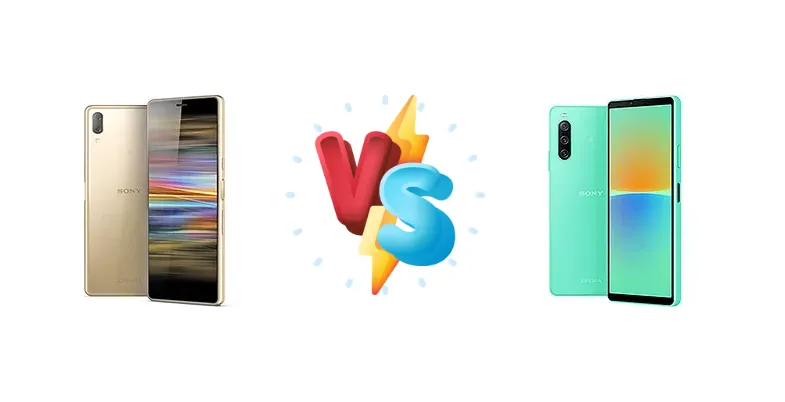
Sony offers a range of smartphones catering to different budgets and needs. The Xperia L3, an older model, provides a budget-friendly option, while the Xperia 10 IV represents a more modern and feature-rich experience. Let's dive into a detailed comparison to help you decide which one is right for you.
🏆 Quick Verdict
The Xperia 10 IV is the clear winner, offering significantly better performance, a brighter display, and vastly improved battery life. While the L3 is cheaper, the 10 IV's upgrades make it a worthwhile investment for most users seeking a reliable and modern smartphone experience.
| Network |
|---|
| 2G bands | GSM 850 / 900 / 1800 / 1900 | GSM 850 / 900 / 1800 / 1900 |
| 3G bands | HSDPA 850 / 900 / 1900 / 2100 - I3312, I4312, I4332 | HSDPA 850 / 900 / 1700(AWS) / 2100 |
| 4G bands | 1, 2, 3, 5, 7, 8, 20, 38 - I3312, I4312 | 1, 3, 4, 5, 7, 8, 20, 28, 38, 39, 40, 41 |
| 5G bands | - | 1, 3, 7, 8, 28, 38, 41, 77, 78, 79 SA/NSA |
| Speed | HSPA 42.2/5.76 Mbps, LTE (2CA) Cat6 300/50 Mbps | HSPA, LTE, 5G |
| Technology | GSM / HSPA / LTE | GSM / HSPA / LTE / 5G |
| | 1, 2, 4, 5, 7, 8, 12, 13, 17, 28, 29 - I3322 | - |
| Launch |
|---|
| Announced | 2019, February. Released 2019, February | 2022, May 11 |
| Status | Discontinued | Available. Released 2022, June 30 |
| Body |
|---|
| Build | Glass front (Gorilla Glass 5), plastic back, plastic frame | Glass front (Gorilla Glass Victus), plastic frame, plastic back |
| Dimensions | 154 x 72 x 8.9 mm (6.06 x 2.83 x 0.35 in) | 153 x 67 x 8.3 mm (6.02 x 2.64 x 0.33 in) |
| SIM | · Nano-SIM· Nano-SIM + Nano-SIM | · Nano-SIM + eSIM· Nano-SIM + Nano-SIM |
| Weight | 156 g (5.50 oz) | 161 g (5.68 oz) |
| | - | IP65/IP68 dust/water resistant (up to 1.5m for 30 min) |
| Display |
|---|
| Protection | Corning Gorilla Glass 5 | Corning Gorilla Glass Victus |
| Resolution | 720 x 1440 pixels, 18:9 ratio (~282 ppi density) | 1080 x 2520 pixels, 21:9 ratio (~457 ppi density) |
| Size | 5.7 inches, 83.8 cm2 (~75.6% screen-to-body ratio) | 6.0 inches, 84.1 cm2 (~82.0% screen-to-body ratio) |
| Type | IPS LCD | OLED, 1B colors, HDR |
| | - | Triluminos display |
| Platform |
|---|
| CPU | Octa-core 2.0 GHz Cortex-A53 | Octa-core (2x2.2 GHz Kryo 660 Gold & 6x1.7 GHz Kryo 660 Silver) |
| Chipset | Mediatek MT6762 Helio P22 (12 nm) | Qualcomm SM6375 Snapdragon 695 5G (6 nm) |
| GPU | PowerVR GE8320 | Adreno 619 |
| OS | Android 8.0 (Oreo) | Android 12, upgradable to Android 14 |
| Memory |
|---|
| Card slot | microSDXC (uses shared SIM slot) | microSDXC (uses shared SIM slot) |
| Internal | 32GB 3GB RAM | 128GB 6GB RAM |
| | eMMC 5.1 | UFS |
| Main Camera |
|---|
| Dual | 13 MP, f/2.2, 26mm (wide), 1/3.0", PDAF
Auxiliary lens | - |
| Features | LED flash, HDR, panorama | LED flash, HDR, panorama |
| Single | - | 8 MP, f/2.0, 27mm (wide), 1/4.0" |
| Triple | - | 12 MP, f/1.8, 27mm (wide), 1/2.8", PDAF, OIS
8 MP, f/2.2, 54mm (telephoto), 1/4.4", PDAF, 2x optical zoom
8 MP, f/2.2, 120˚, 16mm (ultrawide), 1/4.0" |
| Video | 1080p@30fps | 1080p@30fps |
| Selfie camera |
|---|
| Features | - | HDR |
| Single | 8 MP, f/2.0, 24mm (wide), 1/4.0", 1.12µm | 8 MP, f/2.0, 27mm (wide), 1/4.0" |
| Video | 1080p@30fps | 1080p@30fps |
| Sound |
|---|
| 3.5mm jack | Yes | Yes |
| 35mm jack | Yes | Yes |
| Loudspeaker | Yes | Yes |
| | - | 24-bit/192kHz audio
|
| Comms |
|---|
| Bluetooth | 5.0, A2DP, LE | 5.1, A2DP, LE, aptX HD, aptX Adaptive |
| NFC | Yes | Yes |
| Positioning | GPS, GLONASS | GPS, GLONASS, GALILEO, BDS, QZSS |
| Radio | FM radio | No |
| USB | USB Type-C 2.0 | USB Type-C 2.0, OTG |
| WLAN | Wi-Fi 802.11 a/b/g/n, dual-band, Wi-Fi Direct | Wi-Fi 802.11 a/b/g/n/ac, dual-band, Wi-Fi Direct |
| Features |
|---|
| Sensors | Fingerprint (side-mounted), accelerometer, proximity, compass | Fingerprint (side-mounted), accelerometer, proximity, compass |
| Battery |
|---|
| Charging | USB Power Delivery | 21W wired (unofficial rating), PD, QC |
| Type | Li-Ion 3300 mAh, non-removable | Li-Po 5000 mAh |
| Misc |
|---|
| Colors | Black, Gold, Silver | Black, White, Mint, Lavender |
| Models | I3312, I4312, I4332, I3322 | XQ-CC54, XQ-CC72, SOG07 |
| Price | About 230 EUR | £ 99.99 / € 112.89 |
| Tests |
|---|
| Audio quality |
Noise -91.9dB / Crosstalk -89.3dB | - |
| Battery life |
Endurance rating 80h
|
Endurance rating 163h
|
| Camera |
Photo / Video |
Photo / Video |
| Display |
Contrast ratio: 1818:1 (nominal) |
Contrast ratio: Infinite (nominal) |
| Loudspeaker |
Voice 70dB / Noise 73dB / Ring 81dB
|
-30.6 LUFS (Below average)
|
| Performance |
AnTuTu: 78894 (v7)
GFXBench: 5fps (ES 3.1 onscreen) |
AnTuTu: 396008 (v9)
GeekBench: 1908 (v5.1)
GFXBench: 16fps (ES 3.1 onscreen) |
Sony Xperia L3
- Very affordable
- Long battery life (80h)
- Compact size
- Outdated chipset
- Lower performance
- Basic camera
- No 5G
Sony Xperia 10 IV
- Improved performance (Snapdragon 695 5G)
- Brighter display (683 nits)
- Excellent battery life (163h)
- 5G connectivity
- Modern design
- Higher price than L3
- Charging speed could be faster
Display Comparison
The Xperia 10 IV boasts a significantly brighter display at 683 nits (measured) compared to the L3. While both offer a nominal contrast ratio of 1818:1 and 'infinite' respectively, the 10 IV's brightness makes it much more usable outdoors. The 10 IV also likely has better color accuracy and viewing angles due to its more modern panel technology.
Camera Comparison
While both phones have 'Photo / Video' capabilities listed, the Xperia 10 IV is expected to have a superior camera system. It likely features better image processing, improved low-light performance, and potentially more versatile lens options. The L3's camera is likely adequate for basic photography but won't match the 10 IV's capabilities.
Performance
The Xperia 10 IV's Snapdragon 695 5G chipset and Kryo 660 CPU provide a substantial performance boost over the L3's Mediatek Helio P22. Expect smoother multitasking, faster app loading times, and a more responsive user experience on the 10 IV. The 10 IV also supports 5G connectivity, a feature absent in the L3.
Battery Life
The Xperia 10 IV's endurance rating of 163h significantly surpasses the L3's 80h. This translates to considerably longer battery life on a single charge, making the 10 IV a more practical choice for users who rely on their phones throughout the day.
Buying Guide
The Sony Xperia L3 is a good choice for users on a very tight budget who prioritize long battery life and don't need high-end performance. The Sony Xperia 10 IV is ideal for those seeking a modern smartphone with a good camera, a vibrant display, and excellent battery endurance, all at a mid-range price point.
Frequently Asked Questions
❓ Is the Xperia L3 still worth buying in 2024?
Only if you're on an extremely tight budget and primarily need a phone for basic calling and texting. Otherwise, the Xperia 10 IV offers significantly better value.
❓ What is the main difference between the Xperia L3 and Xperia 10 IV?
The main differences are performance, display quality, camera capabilities, and battery life. The Xperia 10 IV is a much more modern and capable device overall.