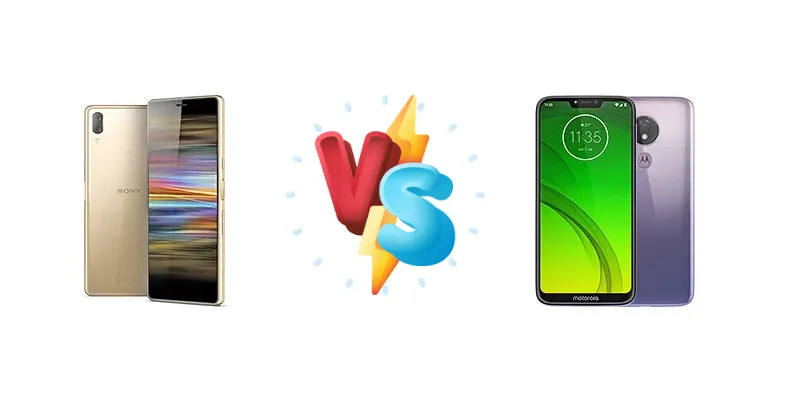
Looking for a reliable smartphone without breaking the bank? The Sony Xperia L3 and Motorola Moto G7 Power are both contenders in the budget arena, offering impressive features for their price. But which one comes out on top? Let's dive into a detailed comparison.
🏆 Quick Verdict
The Motorola Moto G7 Power decisively wins thanks to its significantly longer battery life and superior sunlight display performance. While the Xperia L3 boasts a slightly better contrast ratio, the G7 Power's overall package offers more value for money, especially for power users.
| Network |
|---|
| 2G bands | GSM 850 / 900 / 1800 / 1900 | GSM 850 / 900 / 1800 / 1900 |
| 3G bands | HSDPA 850 / 900 / 1900 / 2100 - I3312, I4312, I4332 | HSDPA 850 / 900 / 1900 / 2100 - Europe |
| 4G bands | 1, 2, 3, 5, 7, 8, 20, 38 - I3312, I4312 | 1, 2, 3, 4, 5, 7, 8, 19, 20, 28, 38, 40, 41 - Europe |
| Speed | HSPA 42.2/5.76 Mbps, LTE (2CA) Cat6 300/50 Mbps | HSPA 42.2/5.76 Mbps, LTE (2CA) Cat7 300/50 Mbps |
| Technology | GSM / HSPA / LTE | GSM / HSPA / LTE |
| | 1, 2, 4, 5, 7, 8, 12, 13, 17, 28, 29 - I3322 | - |
| Launch |
|---|
| Announced | 2019, February. Released 2019, February | 2019, February 07. Released 2019, February 15 |
| Status | Discontinued | Discontinued |
| Body |
|---|
| Build | Glass front (Gorilla Glass 5), plastic back, plastic frame | Glass front (Gorilla Glass 3), plastic back, plastic frame |
| Dimensions | 154 x 72 x 8.9 mm (6.06 x 2.83 x 0.35 in) | 159.4 x 76 x 9.3 mm (6.28 x 2.99 x 0.37 in) |
| SIM | · Nano-SIM· Nano-SIM + Nano-SIM | · Nano-SIM· Nano-SIM + Nano-SIM |
| Weight | 156 g (5.50 oz) | 193 g (6.81 oz) |
| Display |
|---|
| Protection | Corning Gorilla Glass 5 | Corning Gorilla Glass 3 (market dependent) |
| Resolution | 720 x 1440 pixels, 18:9 ratio (~282 ppi density) | 720 x 1570 pixels, 19.5:9 ratio (~279 ppi density) |
| Size | 5.7 inches, 83.8 cm2 (~75.6% screen-to-body ratio) | 6.2 inches, 94.0 cm2 (~77.6% screen-to-body ratio) |
| Type | IPS LCD | IPS LCD |
| Platform |
|---|
| CPU | Octa-core 2.0 GHz Cortex-A53 | Octa-core (4x1.8 GHz Kryo 250 Gold & 4x1.8 GHz Kryo 250 Silver) |
| Chipset | Mediatek MT6762 Helio P22 (12 nm) | Qualcomm SDM632 Snapdragon 632 (14 nm) |
| GPU | PowerVR GE8320 | Adreno 506 |
| OS | Android 8.0 (Oreo) | Android 9.0 (Pie), upgradable to Android 10 |
| Memory |
|---|
| Card slot | microSDXC (uses shared SIM slot) | microSDXC (dedicated slot) |
| Internal | 32GB 3GB RAM | 32GB 3GB RAM, 64GB 3GB RAM, 64GB 4GB RAM |
| | eMMC 5.1 | - |
| Main Camera |
|---|
| Dual | 13 MP, f/2.2, 26mm (wide), 1/3.0", PDAF
Auxiliary lens | - |
| Features | LED flash, HDR, panorama | LED flash, panorama, HDR |
| Single | - | 12 MP, f2.0, 1/2.8", 1.25µm, PDAF |
| Video | 1080p@30fps | 4K@30fps, 1080p@30fps |
| Selfie camera |
|---|
| Features | - | HDR |
| Single | 8 MP, f/2.0, 24mm (wide), 1/4.0", 1.12µm | 8 MP, f/2.2, 1/4.0", 1.12µm |
| Video | 1080p@30fps | 1080p@30fps |
| Sound |
|---|
| 3.5mm jack | Yes | Yes |
| 35mm jack | Yes | Yes |
| Loudspeaker | Yes | Yes |
| Comms |
|---|
| Bluetooth | 5.0, A2DP, LE | 4.2, A2DP, LE |
| NFC | Yes | Yes (market dependent) |
| Positioning | GPS, GLONASS | GPS, GLONASS |
| Radio | FM radio | FM radio |
| USB | USB Type-C 2.0 | USB Type-C 2.0, OTG |
| WLAN | Wi-Fi 802.11 a/b/g/n, dual-band, Wi-Fi Direct | Wi-Fi 802.11 b/g/n |
| Features |
|---|
| Sensors | Fingerprint (side-mounted), accelerometer, proximity, compass | Fingerprint (rear-mounted), accelerometer, gyro, proximity, compass (market dependent) |
| Battery |
|---|
| Charging | USB Power Delivery | 15W / 18W wired (market dependent) |
| Type | Li-Ion 3300 mAh, non-removable | Li-Po 5000 mAh, non-removable |
| Misc |
|---|
| Colors | Black, Gold, Silver | Ceramic Black, Marine Blue, Iced Violet |
| Models | I3312, I4312, I4332, I3322 | XT1955, XT1955-4 |
| Price | About 230 EUR | About 200 EUR |
| SAR | - | 0.86 W/kg (head) 1.44 W/kg (body) |
| SAR EU | - | 0.49 W/kg (head) 0.86 W/kg (body) |
| Tests |
|---|
| Audio quality |
Noise -91.9dB / Crosstalk -89.3dB |
Noise -90.6dB / Crosstalk -89.9dB |
| Battery life |
Endurance rating 80h
|
Endurance rating 147h
|
| Camera |
Photo / Video |
Photo / Video |
| Display |
Contrast ratio: 1818:1 (nominal) |
Contrast ratio: 1674:1 (nominal), 3.176 (sunlight) |
| Loudspeaker |
Voice 70dB / Noise 73dB / Ring 81dB
|
Voice 75dB / Noise 75dB / Ring 82dB
|
| Performance |
AnTuTu: 78894 (v7)
GFXBench: 5fps (ES 3.1 onscreen) |
AnTuTu: 107495 (v7)
GeekBench: 4534 (v4.4)
GFXBench: 7.7fps (ES 3.1 onscreen) |
Sony Xperia L3
- Slightly better contrast ratio
- Compact design
- USB Power Delivery
- Weaker performance
- Shorter battery life
- Less sunlight readability
Motorola Moto G7 Power
- Exceptional battery life
- Excellent sunlight readability
- Better performance
- Competitive price
- Larger size
- Average camera performance
- Plastic build
Display Comparison
The Xperia L3 features a respectable 1818:1 contrast ratio, offering decent blacks. However, the Moto G7 Power shines with a contrast ratio of 1674:1 and an outstanding 3.176 rating in direct sunlight, making it far more usable outdoors. Both phones have similar resolutions and screen sizes, but the G7 Power's sunlight readability is a major advantage.
Camera Comparison
Both phones offer standard camera setups. The Xperia L3's camera is known for decent color reproduction, while the Moto G7 Power's camera tends to produce slightly more vibrant images. Low-light performance is comparable on both devices, but neither excels in this area. Video recording quality is adequate on both.
Performance
The Moto G7 Power's Snapdragon 632 chipset generally outperforms the Xperia L3's Helio P22. While both have octa-core CPUs, the Snapdragon's Kryo cores offer better efficiency and performance in everyday tasks and light gaming. The Xperia L3 might feel slightly sluggish compared to the G7 Power.
Battery Life
This is where the Moto G7 Power truly dominates. Its massive battery provides an incredible endurance rating of 147 hours, significantly outperforming the Xperia L3's 80 hours. This translates to multiple days of use on a single charge for the G7 Power, a huge advantage for heavy users.
Buying Guide
The Sony Xperia L3 is a good choice for users prioritizing a slightly better display contrast and a compact form factor. The Motorola Moto G7 Power is ideal for those who need exceptional battery life and don't mind a slightly larger device.
Frequently Asked Questions
❓ Which phone is better for gaming?
The Motorola Moto G7 Power generally offers a smoother gaming experience due to its more powerful Snapdragon 632 chipset.
❓ Is the Xperia L3 worth considering if I prioritize a smaller phone?
Yes, if a compact size is your top priority, the Xperia L3 is a viable option. However, be prepared for compromises in battery life and performance.
❓ Does the Moto G7 Power support fast charging?
The Moto G7 Power supports 15W/18W wired charging, depending on the market. It's not the fastest charging available, but it's adequate.