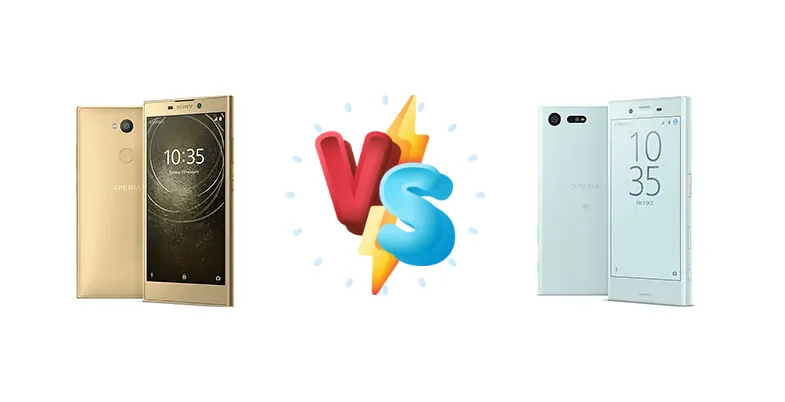
Sony's Xperia line has long catered to those seeking a more refined Android experience. The Xperia X Compact, released as a flagship-lite, aimed to deliver premium features in a smaller package. The Xperia L2, positioned as a more affordable option, prioritized endurance and essential functionality. This comparison dissects the key differences between these two Sony devices, helping you determine which best suits your needs.
🏆 Quick Verdict
For most users, the Sony Xperia X Compact is the superior choice. Its more powerful Snapdragon 650 chipset and significantly better display contrast ratio translate to a smoother, more enjoyable user experience. While the L2 boasts respectable battery life, the X Compact’s Quick Charge 3.0 support mitigates any endurance concerns.
| Network |
|---|
| 2G bands | GSM 850 / 900 / 1800 / 1900 - SIM 1 & SIM 2 (dual-SIM model only) | GSM 850 / 900 / 1800 / 1900 |
| 3G bands | HSDPA 850 / 900 / 1900 / 2100 - H3311, H4311, H4331 | HSDPA 800 / 850 / 900 / 1700(AWS) / 1900 / 2100 - F5321 |
| 4G bands | 1, 2, 3, 5, 7, 8, 20, 38 - H3311, H4311 | 1, 2, 3, 4, 5, 7, 8, 12, 17, 19, 20, 26, 28, 38, 39, 40, 41 - F5321 |
| Speed | HSPA 42.2/5.76 Mbps, LTE Cat4 150/50 Mbps | HSPA 42.2/5.76 Mbps, LTE Cat6 300/50 Mbps |
| Technology | GSM / HSPA / LTE | GSM / HSPA / LTE |
| | 1, 2, 3, 5, 7, 8, 28, 38, 39, 40, 41 - H4331 | - |
| Launch |
|---|
| Announced | 2018, January. Released 2018, January | 2016, September 01. Released 2016, September 08 |
| Status | Discontinued | Discontinued |
| Body |
|---|
| Build | Glass front (Gorilla Glass 4), plastic back, plastic frame | Glass front (Gorilla Glass 4), plastic back, plastic frame |
| Dimensions | 150 x 78 x 9.8 mm (5.91 x 3.07 x 0.39 in) | 129 x 65 x 9.5 mm (5.08 x 2.56 x 0.37 in) |
| SIM | · Nano-SIM· Nano-SIM + Nano-SIM | Nano-SIM |
| Weight | 178 g (6.28 oz) | 135 g (4.76 oz) |
| Display |
|---|
| Protection | Corning Gorilla Glass 4 | Corning Gorilla Glass 4 |
| Resolution | 720 x 1280 pixels, 16:9 ratio (~267 ppi density) | 720 x 1280 pixels, 16:9 ratio (~319 ppi density) |
| Size | 5.5 inches, 83.4 cm2 (~71.3% screen-to-body ratio) | 4.6 inches, 58.3 cm2 (~69.6% screen-to-body ratio) |
| Type | IPS LCD | IPS LCD |
| | - | Triluminos display
X-Reality Engine |
| Platform |
|---|
| CPU | Quad-core 1.5 GHz Cortex-A53 | Hexa-core (4x1.4 GHz Cortex-A53 & 2x1.8 GHz Cortex-A72) |
| Chipset | Mediatek MT6737T (28 nm) | Qualcomm MSM8956 Snapdragon 650 |
| GPU | Mali-T720MP2 | Adreno 510 |
| OS | Android 7.1.1 (Nougat) | Android 6.0.1 (Marshmallow), upgradable to Android 8.0 (Oreo) |
| Memory |
|---|
| Card slot | microSDXC (dedicated slot) | microSDXC (dedicated slot) |
| Internal | 32GB 3GB RAM | 32GB 3GB RAM |
| | eMMC 5.0 | eMMC 4.5 |
| Main Camera |
|---|
| Features | LED flash, HDR | Color spectrum sensor, LED flash, HDR, panorama |
| Single | 13 MP, f/2.0, 1/3.1", AF | 23 MP, f/2.0, 24mm (wide), 1/2.3", PDAF |
| Video | 1080p@30fps | 1080p@30fps, 1080p@60fps |
| Selfie camera |
|---|
| Single | 8 MP, f/2.4, 1/4.0" | 5 MP |
| Video | 1080p@30fps | 1080p@30fps |
| Sound |
|---|
| 3.5mm jack | Yes | Yes |
| 35mm jack | Yes | Yes |
| Loudspeaker | Yes | Yes, with stereo speakers |
| | - | 24-bit/192kHz audio
|
| Comms |
|---|
| Bluetooth | 4.2, A2DP, LE, aptX | 4.2, A2DP, aptX, LE |
| NFC | Yes | Yes |
| Positioning | GPS, GLONASS | GPS, GLONASS/ BDS (region dependent) |
| Radio | FM radio | FM radio, RDS |
| USB | USB Type-C 2.0 | USB Type-C 2.0, OTG |
| WLAN | Wi-Fi 802.11 a/b/g/n, Wi-Fi Direct | Wi-Fi 802.11 a/b/g/n/ac, dual-band, Wi-Fi Direct, DLNA |
| Features |
|---|
| Sensors | Fingerprint (rear-mounted), accelerometer, proximity, compass | Fingerprint (side-mounted), accelerometer, gyro, proximity, barometer, compass |
| Battery |
|---|
| Charging | - | 18W wired, QC3 |
| Stand-by | - | Up to 710 h (2G) / Up to 750 h (3G) |
| Talk time | - | Up to 11 h (2G) / Up to 14 h (3G) |
| Type | Li-Ion 3300 mAh, non-removable | Li-Ion 2700 mAh, non-removable |
| Misc |
|---|
| Colors | Black, Gold, Pink | White, Universe black, Mist blue |
| Models | H4311, H3311, H4331, H3321 | SO-02J, F5321 |
| Price | About 140 EUR | About 220 EUR |
| SAR | - | 0.66 W/kg (head) 0.72 W/kg (body) |
| SAR EU | - | 1.08 W/kg (head) 1.25 W/kg (body) |
| Tests |
|---|
| Audio quality |
Noise -92.0dB / Crosstalk -89.7dB |
Noise -95.1dB / Crosstalk -90.8dB |
| Battery life |
Endurance rating 65h
| Endurance rating 73h |
| Camera |
Photo / Video |
Photo / Video |
| Display |
Contrast ratio: 1130:1 (nominal), 2.266 (sunlight) |
Contrast ratio: 1225 (nominal), 3.694 (sunlight) |
| Loudspeaker |
Voice 67dB / Noise 72dB / Ring 91dB
|
Voice 64dB / Noise 65dB / Ring 69dB |
| Performance |
AnTuTu: 45023 (v7)
GeekBench: 1932 (v4.4) |
Basemark OS II 2.0: 1738Basemark X: 15415 |
Sony Xperia L2
- Longer battery endurance (73h)
- More affordable price point
- Solid build quality for its price range
- Significantly weaker processor
- Lower display contrast ratio
- No fast charging support
Sony Xperia X Compact
- Faster and more responsive performance
- Superior display contrast for better viewing
- Quick Charge 3.0 support for faster charging
- Slightly shorter battery endurance
- Higher price compared to the L2
- May experience more heat under heavy load
Display Comparison
The Xperia X Compact’s display demonstrably outperforms the L2’s. While both utilize similar display technologies, the X Compact achieves a contrast ratio of 1225:1 (nominal) and a remarkable 3.694:1 in sunlight, compared to the L2’s 1130:1 and 2.266 respectively. This means deeper blacks, brighter whites, and significantly improved visibility outdoors. The higher contrast ratio on the X Compact will be particularly noticeable when viewing photos and videos, offering a more vibrant and immersive experience.
Camera Comparison
Both devices feature photo and video capabilities, but the context data doesn’t provide enough detail for a meaningful comparison beyond that. Given the X Compact’s positioning as a slightly more premium device, it likely benefits from more sophisticated image processing algorithms and potentially a better sensor, though specific sensor sizes are unknown. The L2’s camera is likely geared towards casual snapshots, while the X Compact may offer more control and better image quality in challenging lighting conditions.
Performance
The core difference between these two phones lies in their chipsets. The Xperia X Compact’s Qualcomm MSM8956 Snapdragon 650, a hexa-core processor with a combination of Cortex-A53 and Cortex-A72 cores, provides a substantial performance advantage over the Xperia L2’s Mediatek MT6737T. The Snapdragon 650’s Cortex-A72 cores, clocked at 1.8 GHz, deliver significantly faster processing speeds for demanding tasks. The L2’s quad-core Cortex-A53 processor, clocked at 1.5 GHz, is adequate for basic usage but will struggle with multitasking and graphically intensive applications. This translates to smoother app launches, faster web browsing, and a more responsive overall experience on the X Compact.
Battery Life
The Xperia X Compact boasts an endurance rating of 73 hours, slightly exceeding the Xperia L2’s 65 hours. However, this difference is partially offset by the X Compact’s more powerful processor. Crucially, the X Compact supports 18W wired charging with Quick Charge 3.0, allowing for significantly faster charging times compared to the L2, which lacks fast charging capabilities. This means the X Compact can quickly top up its battery, minimizing downtime despite its slightly lower endurance rating.
Buying Guide
Buy the Sony Xperia L2 if you prioritize maximum battery life above all else and operate on a very tight budget. It’s a solid choice for basic smartphone tasks and extended use between charges. Buy the Sony Xperia X Compact if you value performance, a superior viewing experience, and faster charging. It’s ideal for users who multitask, enjoy media consumption, and appreciate a more responsive device.
Frequently Asked Questions
❓ Does the Mediatek MT6737T in the Xperia L2 struggle with modern mobile games?
Yes, the Mediatek MT6737T is a relatively low-end chipset. While it can handle basic games, you'll likely experience noticeable lag and reduced frame rates in more demanding titles. The Xperia X Compact’s Snapdragon 650 offers a much smoother gaming experience.
❓ Is the difference in display contrast between the two phones noticeable in everyday use?
Absolutely. The Xperia X Compact’s significantly higher contrast ratio (especially in sunlight) results in a more vibrant and readable display. Colors will appear richer, and the screen will be much easier to see outdoors. The L2’s display will appear washed out in comparison.
❓ How much faster is the charging speed on the Xperia X Compact with Quick Charge 3.0?
The Xperia X Compact’s 18W Quick Charge 3.0 support can significantly reduce charging times. While exact figures depend on the charger used, you can expect a much faster 0-100% charge compared to the Xperia L2, which lacks fast charging capabilities. The L2 will take considerably longer to fully recharge.