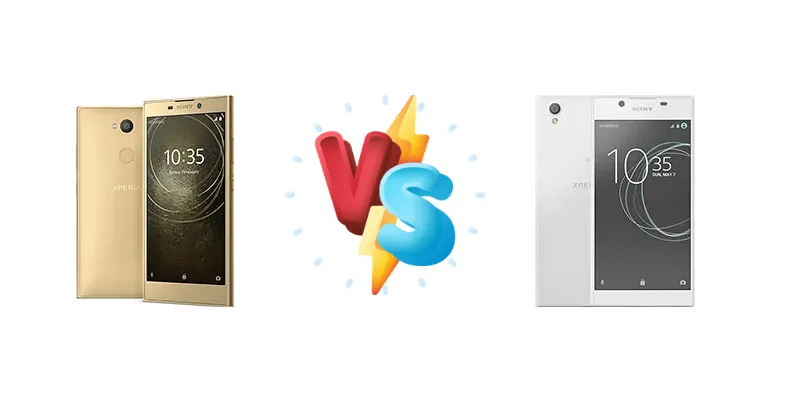
The Sony Xperia L1 and L2 represent Sony’s attempts to deliver affordable smartphones without completely sacrificing brand recognition. Released relatively close together, these devices share a core chipset and many fundamental features. This comparison dissects the subtle differences – primarily in display quality and battery endurance – to determine which offers the better value in today’s market.
🏆 Quick Verdict
For the average user, the Sony Xperia L2 is the slightly better choice. While both phones utilize the same Mediatek MT6737T chipset, the L2’s improved display contrast ratio, particularly in sunlight (2.266 vs 2.994), and marginally longer battery life (65h vs 63h) provide a more pleasant user experience.
| Network |
|---|
| 2G bands | GSM 850 / 900 / 1800 / 1900 - SIM 1 & SIM 2 (dual-SIM model only) | GSM 850 / 900 / 1800 / 1900 - SIM 1 & SIM 2 (dual-SIM model only) |
| 3G bands | HSDPA 850 / 900 / 1900 / 2100 - H3311, H4311, H4331 | HSDPA 850 / 900 / 1900 / 2100 |
| 4G bands | 1, 2, 3, 5, 7, 8, 20, 38 - H3311, H4311 | 1, 2, 3, 5, 7, 8, 20 |
| Speed | HSPA 42.2/5.76 Mbps, LTE Cat4 150/50 Mbps | HSPA 42.2/5.76 Mbps, LTE Cat4 150/50 Mbps |
| Technology | GSM / HSPA / LTE | GSM / HSPA / LTE |
| | 1, 2, 3, 5, 7, 8, 28, 38, 39, 40, 41 - H4331 | - |
| Launch |
|---|
| Announced | 2018, January. Released 2018, January | 2017, March. Released 2017, June |
| Status | Discontinued | Discontinued |
| Body |
|---|
| Build | Glass front (Gorilla Glass 4), plastic back, plastic frame | Glass front, plastic back, plastic frame |
| Dimensions | 150 x 78 x 9.8 mm (5.91 x 3.07 x 0.39 in) | 151 x 74 x 8.7 mm (5.94 x 2.91 x 0.34 in) |
| SIM | · Nano-SIM· Nano-SIM + Nano-SIM | · Nano-SIM· Nano-SIM + Nano-SIM |
| Weight | 178 g (6.28 oz) | 180 g (6.35 oz) |
| Display |
|---|
| Protection | Corning Gorilla Glass 4 | Scratch-resistant glass (> 6H) |
| Resolution | 720 x 1280 pixels, 16:9 ratio (~267 ppi density) | 720 x 1280 pixels, 16:9 ratio (~267 ppi density) |
| Size | 5.5 inches, 83.4 cm2 (~71.3% screen-to-body ratio) | 5.5 inches, 83.4 cm2 (~74.6% screen-to-body ratio) |
| Type | IPS LCD | IPS LCD |
| Platform |
|---|
| CPU | Quad-core 1.5 GHz Cortex-A53 | Quad-core 1.45 GHz Cortex-A53 |
| Chipset | Mediatek MT6737T (28 nm) | Mediatek MT6737T (28 nm) |
| GPU | Mali-T720MP2 | Mali-T720MP2 |
| OS | Android 7.1.1 (Nougat) | Android 7.0 (Nougat) |
| Memory |
|---|
| Card slot | microSDXC (dedicated slot) | microSDXC (uses shared SIM slot) |
| Internal | 32GB 3GB RAM | 16GB 2GB RAM |
| | eMMC 5.0 | eMMC 5.0 |
| Main Camera |
|---|
| Features | LED flash, HDR | LED flash, HDR |
| Single | 13 MP, f/2.0, 1/3.1", AF | 13 MP, f/2.2, AF |
| Video | 1080p@30fps | 1080p@30fps |
| Selfie camera |
|---|
| Single | 8 MP, f/2.4, 1/4.0" | 5 MP, f/2.2, 24mm (wide) |
| Video | 1080p@30fps | 1080p@30fps |
| Sound |
|---|
| 3.5mm jack | Yes | Yes |
| 35mm jack | Yes | Yes |
| Loudspeaker | Yes | Yes |
| Comms |
|---|
| Bluetooth | 4.2, A2DP, LE, aptX | 4.2, A2DP, LE, aptX |
| NFC | Yes | Yes |
| Positioning | GPS, GLONASS | GPS, GLONASS, BDS |
| Radio | FM radio | FM radio |
| USB | USB Type-C 2.0 | USB Type-C 2.0 |
| WLAN | Wi-Fi 802.11 a/b/g/n, Wi-Fi Direct | Wi-Fi 802.11 a/b/g/n, Wi-Fi Direct |
| Features |
|---|
| Sensors | Fingerprint (rear-mounted), accelerometer, proximity, compass | Accelerometer, proximity, compass |
| Battery |
|---|
| Music play | - | Up to 63 h |
| Stand-by | - | Up to 639 h (2G) / Up to 687 h (3G) |
| Talk time | - | Up to 13 h (2G) / Up to 11 h 30 min (3G) |
| Type | Li-Ion 3300 mAh, non-removable | Li-Ion 2620 mAh, non-removable |
| Misc |
|---|
| Colors | Black, Gold, Pink | Black, White, Pink |
| Models | H4311, H3311, H4331, H3321 | G3312, G3311, G3313 |
| Price | About 140 EUR | About 110 EUR |
| Tests |
|---|
| Audio quality |
Noise -92.0dB / Crosstalk -89.7dB |
Noise -93.6dB / Crosstalk -93.8dB |
| Battery life |
Endurance rating 65h
|
Endurance rating 63h
|
| Camera |
Photo / Video |
Photo / Video |
| Display |
Contrast ratio: 1130:1 (nominal), 2.266 (sunlight) |
Contrast ratio: 957:1 (nominal), 2.994 (sunlight) |
| Loudspeaker |
Voice 67dB / Noise 72dB / Ring 91dB
|
Voice 91dB / Noise 74dB / Ring 83dB
|
| Performance |
AnTuTu: 45023 (v7)
GeekBench: 1932 (v4.4) |
GeekBench: 1890 (v4.4) |
Sony Xperia L2
- Slightly better display contrast, especially in sunlight.
- Marginally longer battery life.
- Potentially more refined software optimizations.
- Shares the same underpowered Mediatek MT6737T chipset.
- Likely similar camera performance to the L1.
Sony Xperia L1
- Potentially lower price point.
- Shares the same core functionality as the L2.
- Similar battery life to the L2.
- Inferior display contrast, particularly in sunlight.
- Slightly lower endurance rating.
Display Comparison
Both the Xperia L2 and L1 feature displays with a similar overall aesthetic, but the key difference lies in contrast. The L2 boasts a nominal contrast ratio of 1130:1, improving to 2.266:1 in direct sunlight, compared to the L1’s 957:1 and 2.994:1 respectively. This means blacks appear deeper and the screen is more readable outdoors with the L2. While neither phone is likely to deliver vibrant colors or wide viewing angles, the L2’s superior sunlight contrast is a tangible benefit for outdoor users. We can infer both use IPS LCD panels, common in this price bracket, but lack features like high refresh rates or HDR support.
Camera Comparison
Both the Xperia L2 and L1 are equipped with photo/video capabilities, but detailed camera specifications are absent. Given their market positioning, we can assume both feature basic camera sensors, likely around 8-13 megapixels for the main camera. The inclusion of a 'photo/video' designation suggests a standard camera app with typical shooting modes. It’s highly probable that both phones lack advanced features like optical image stabilization (OIS) or sophisticated image processing algorithms. The absence of detail suggests the camera performance is not a key differentiating factor between these models.
Performance
At the heart of both devices lies the Mediatek MT6737T, a 28nm chipset featuring a quad-core 1.5 GHz Cortex-A53 CPU. The L2’s CPU is clocked slightly higher at 1.5 GHz versus the L1’s 1.45 GHz, but this 0.05 GHz difference is unlikely to translate into a noticeable performance boost in everyday tasks. Both phones will struggle with demanding games or heavy multitasking. The shared chipset implies similar thermal characteristics; neither device is expected to excel in sustained performance due to the limitations of the MT6737T and its 28nm manufacturing process. RAM configurations are not specified, but likely hover around 2-3GB, further limiting multitasking capabilities.
Battery Life
The Xperia L2 offers a slightly better endurance rating of 65 hours compared to the L1’s 63 hours. This difference, while small, suggests the L2 can last marginally longer on a single charge. Both phones likely house batteries in the 2500-3000 mAh range, typical for this class of device. Charging speeds are not specified, but are likely to be relatively slow, utilizing standard micro-USB charging. The L2’s slightly improved endurance is likely a result of minor software optimizations or more efficient power management, rather than a significantly larger battery capacity.
Buying Guide
Buy the Sony Xperia L2 if you prioritize outdoor visibility and a slightly longer-lasting battery. Its improved display contrast makes it more usable in bright conditions. Buy the Sony Xperia L1 if you find it at a significantly lower price point; the core functionality remains largely identical, and the cost savings may outweigh the minor improvements in the L2.
Frequently Asked Questions
❓ Will the Mediatek MT6737T struggle with modern apps?
Yes, the Mediatek MT6737T is a relatively old and low-end chipset. Expect noticeable slowdowns when running demanding applications or multitasking with several apps open. These phones are best suited for basic tasks like calling, texting, and light web browsing.
❓ Is the difference in sunlight readability between the L1 and L2 significant enough to justify the upgrade?
The difference in sunlight contrast (2.994 vs 2.266) is noticeable, making the L2 a better choice if you frequently use your phone outdoors. While not a dramatic improvement, it will make the screen easier to see in bright conditions.
❓ Can either of these phones handle popular mobile games like PUBG or Call of Duty?
While technically capable of running these games, the Mediatek MT6737T will likely struggle to provide a smooth gaming experience. Expect low frame rates and potential lag, even on the lowest graphics settings. These phones are not ideal for gaming.