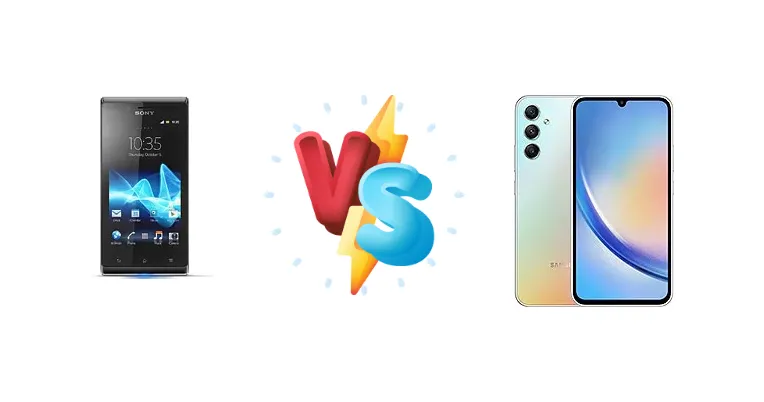
The Sony Xperia J, a relic of a bygone era, faces off against the modern Samsung Galaxy A34. This comparison explores how far smartphone technology has advanced, and which device offers the best value for today's user. Prepare for a stark contrast in features and performance.
🏆 Quick Verdict
The Samsung Galaxy A34 utterly dominates the Xperia J. While the Xperia J boasts surprisingly good endurance for its age, the A34's superior display, vastly improved performance, modern camera capabilities, and charging speed make it the clear winner for almost any user.
| Network |
|---|
| 2G bands | GSM 850 / 900 / 1800 / 1900 | GSM 850 / 900 / 1800 / 1900 |
| 3G bands | HSDPA 900 / 2100 - ST26i | HSDPA 850 / 900 / 1700(AWS) / 1900 / 2100 |
| 4G bands | - | 1, 2, 3, 4, 5, 7, 8, 12, 17, 20, 26, 28, 32, 38, 40, 41, 66 |
| 5G bands | - | 1, 3, 7, 8, 20, 28, 38, 40, 41, 77, 78 SA/NSA/Sub6 |
| EDGE | Class 10 | - |
| GPRS | Class 10 | - |
| Speed | HSPA 7.2/5.76 Mbps | HSPA, LTE, 5G |
| Technology | GSM / HSPA | GSM / HSPA / LTE / 5G |
| | HSDPA 850 / 1900 / 2100 - ST26a | - |
| Launch |
|---|
| Announced | 2012, August. Released 2012, October | 2023, March 14 |
| Status | Discontinued | Available. Released 2023, March 24 |
| Body |
|---|
| Build | - | Glass front (Gorilla Glass 5), plastic frame, plastic back |
| Dimensions | 124.3 x 61.2 x 9.2 mm (4.89 x 2.41 x 0.36 in) | 161.3 x 78.1 x 8.2 mm (6.35 x 3.07 x 0.32 in) |
| SIM | Mini-SIM | · Nano-SIM· Nano-SIM + Nano-SIM |
| Weight | 124 g (4.37 oz) | 199 g (7.02 oz) |
| | - | IP67 dust/water resistant (up to 1m for 30 min) |
| Display |
|---|
| Protection | Corning Gorilla Glass | Corning Gorilla Glass 5 |
| Resolution | 480 x 854 pixels, 16:9 ratio (~245 ppi density) | 1080 x 2340 pixels, 19.5:9 ratio (~390 ppi density) |
| Size | 4.0 inches, 44.1 cm2 (~58.0% screen-to-body ratio) | 6.6 inches, 106.9 cm2 (~84.9% screen-to-body ratio) |
| Type | TFT | Super AMOLED, 120Hz, 1000 nits (HBM) |
| Platform |
|---|
| CPU | 1.0 GHz Cortex-A5 | Octa-core (2x2.6 GHz Cortex-A78 & 6x2.0 GHz Cortex-A55) |
| Chipset | Qualcomm MSM7227A Snapdragon S1 | Mediatek Dimensity 1080 (6 nm) |
| GPU | Adreno 200 | Mali-G68 MC4 |
| OS | Android 4.0.4 (Ice Cream Sandwich), upgradable to 4.1.2 (Jelly Bean) | Android 13, up to 4 major Android upgrades, One UI 6.1 |
| Memory |
|---|
| Call records | 20 dialed, 20 received, 20 missed calls | - |
| Card slot | microSDHC (dedicated slot) | microSDXC (uses shared SIM slot) |
| Internal | 4GB (2GB user available), 512MB RAM | 128GB 4GB RAM, 128GB 6GB RAM, 128GB 8GB RAM, 256GB 6GB RAM, 256GB 8GB RAM |
| Phonebook | 1000 entries | - |
| Main Camera |
|---|
| Features | LED flash | LED flash, panorama, HDR |
| Single | 5 MP, AF | - |
| Triple | - | 48 MP, f/1.8, 26mm (wide), 1/2.0", 0.8µm, PDAF, OIS
8 MP, f/2.2, 123˚, (ultrawide), 1/4.0", 1.12µm
5 MP (macro) |
| Video | 480p | 4K@30fps, 1080p@30/60fps, 720p@480fps |
| Selfie camera |
|---|
| Single | VGA | 13 MP, f/2.2, 26mm (wide), 1/3.1", 1.12µm |
| Video | - | 4K@30fps, 1080p@30fps |
| Sound |
|---|
| 3.5mm jack | Yes | No |
| 35mm jack | Yes | No |
| Alert types | Vibration; Downloadable polyphonic, MP3, AAC ringtones | - |
| Loudspeaker | Yes | Yes, with stereo speakers |
| Comms |
|---|
| Bluetooth | 2.1, A2DP, EDR | 5.3, A2DP, LE |
| NFC | - | Yes (market/region dependent) |
| Positioning | GPS, A-GPS | GPS, GLONASS, GALILEO, BDS |
| Radio | Stereo FM radio, RDS | No |
| USB | microUSB 2.0 | USB Type-C 2.0, OTG |
| WLAN | Wi-Fi 802.11 b/g/n, DLNA, hotspot | Wi-Fi 802.11 a/b/g/n/ac, dual-band, Wi-Fi Direct |
| Features |
|---|
| Browser | WAP 2.0/xHTML | - |
| Games | Yes | - |
| Java | Yes, MIDP 2.0 | - |
| Messaging | SMS, MMS | - |
| Sensors | Accelerometer, proximity, compass | Fingerprint (under display, optical), accelerometer, gyro, compass |
| | - | Virtual proximity sensing |
| Battery |
|---|
| Charging | - | 25W wired |
| Stand-by | Up to 607 h (2G) / Up to 618 h (3G) | - |
| Talk time | Up to 5 h 36 min (2G) / Up to 7 h 18 min (3G) | - |
| Type | Removable Li-Ion 1750 mAh battery | Li-Ion 5000 mAh |
| Misc |
|---|
| Colors | Black, White, Gold, Pink | Lime, Graphite, Violet, Silver |
| Models | ST26i | SM-A346E, SM-A346B, SM-A346B/DS, SM-A346B/DSN, SM-A346E/DS, SM-A346E/DSN, SM-A346M, SM-A346M/N, SM-A346M/DSN, SM-A3460 |
| Price | About 140 EUR | € 169.99 / $ 175.00 / £ 164.99 / ₹ 23,999 |
| SAR | 0.63 W/kg (head) 0.50 W/kg (body) | - |
| SAR EU | 0.73 W/kg (head) | 0.55 W/kg (head) 1.49 W/kg (body) |
| Tests |
|---|
| Audio quality |
Noise -80.8dB / Crosstalk -80.8dB | - |
| Battery life |
Endurance rating 50h
|
Endurance rating 133h
|
| Camera |
Photo |
Photo / Video |
| Display |
Contrast ratio: 1359:1 (nominal) / 1.932:1 (sunlight) |
Contrast ratio: Infinite (nominal) |
| Loudspeaker |
Voice 66dB / Noise 61dB / Ring 72dB
|
-26.1 LUFS (Good)
|
| Performance | - |
AnTuTu: 472126 (v9)
GeekBench: 2316 (v5.5), 2518 (v6)
GFXBench: 23fps (ES 3.1 onscreen) |
Sony Xperia J
- Excellent battery life (for its time)
- Good sunlight contrast ratio
- Compact size
- Outdated chipset
- Limited features
- No video recording
- Poor performance by modern standards
- Low screen brightness
Samsung Galaxy A34
- Bright and vibrant display
- Powerful processor
- Versatile camera (photo & video)
- Long battery life
- Fast charging
- Plastic build (typical for its price range)
- Software updates may eventually cease
Display Comparison
The Galaxy A34's display is a significant upgrade. Its 1009 nits max brightness ensures excellent visibility even in direct sunlight, a feature the Xperia J lacks. The 'infinite' contrast ratio of the A34 suggests deeper blacks and richer colors compared to the Xperia J's 1359:1 ratio. The Xperia J's sunlight rating of 1.932:1 is decent, but doesn't match the A34's overall display quality.
Camera Comparison
The Galaxy A34 offers both photo and video capabilities, a substantial advantage over the Xperia J's photo-only camera. The A34's newer sensor and image processing will deliver far superior image quality, especially in low light. Video recording is a non-starter on the Xperia J.
Performance
The A34's Mediatek Dimensity 1080 chipset and Octa-core CPU are worlds ahead of the Xperia J's Qualcomm MSM7227A Snapdragon S1 and single-core Cortex-A5. Expect significantly faster app loading, smoother multitasking, and a more responsive user experience on the A34. The Xperia J will struggle with modern apps and demanding tasks.
Battery Life
While the Xperia J's endurance rating of 50h is impressive for its age and limited features, the Galaxy A34's 133h rating is still very good, especially considering its more powerful hardware and brighter display. The A34 also supports 25W wired charging, a feature absent on the Xperia J.
Buying Guide
The Sony Xperia J is only suitable for users seeking a very basic, ultra-budget phone for calls and simple tasks, or those with a nostalgic interest. The Samsung Galaxy A34 is ideal for anyone wanting a reliable, feature-rich smartphone with a good camera, vibrant display, and long battery life at a reasonable price.
Frequently Asked Questions
❓ Is the Xperia J still usable in 2024?
It can be used for basic tasks like calls and messaging, but its outdated hardware limits its functionality. Don't expect it to run modern apps smoothly.
❓ Why is the Galaxy A34 so much better?
The A34 represents a significant advancement in smartphone technology. It has a faster processor, a better display, a more capable camera, and modern features like fast charging that the Xperia J lacks.