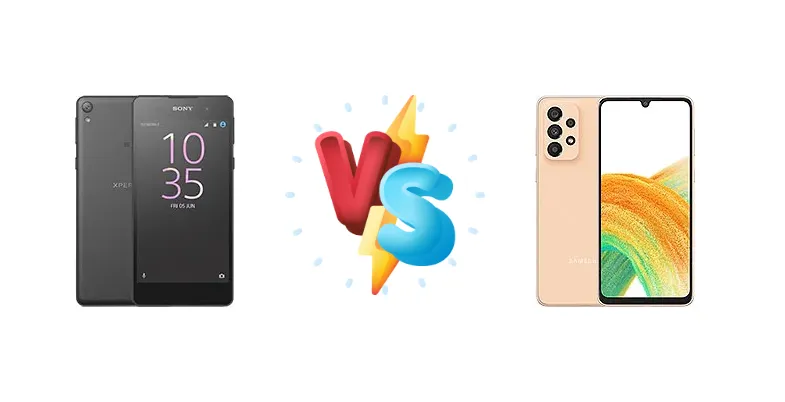
The smartphone market is brimming with options, especially in the budget-friendly range. Today, we're pitting two contenders against each other: the older Sony Xperia E5 and the newer Samsung Galaxy A33 5G. Let's dive into a comprehensive comparison to see which phone reigns supreme.
🏆 Quick Verdict
The Samsung Galaxy A33 5G is the clear winner. Its significantly longer battery life, vastly superior performance thanks to the 5G chipset, brighter display, and modern features make it a much better choice despite the Xperia E5's impressive endurance rating.
| Network |
|---|
| 2G bands | GSM 850 / 900 / 1800 / 1900 - SIM 1 & SIM 2 (dual-SIM model only) | GSM 850 / 900 / 1800 / 1900 |
| 3G bands | HSDPA 850 / 900 / 1900 / 2100 - F3311 | HSDPA 850 / 900 / 1700(AWS) / 1900 / 2100 |
| 4G bands | 1, 2, 3, 5, 7, 8, 20 - F3311 | 1, 2, 3, 4, 5, 7, 8, 12, 17, 20, 26, 28, 32, 38, 40, 41, 66 |
| 5G bands | - | 1, 3, 5, 7, 8, 20, 28, 38, 40, 41, 66, 78 SA/NSA/Sub6 |
| Speed | HSPA 42.2/5.76 Mbps, LTE Cat4 150/50 Mbps | HSPA, LTE, 5G |
| Technology | GSM / HSPA / LTE | GSM / HSPA / LTE / 5G |
| | 2, 4, 5, 7, 12, 17, 28 - F3313 | - |
| Launch |
|---|
| Announced | 2016, May. Released 2016, June | 2022, March 17 |
| Status | Discontinued | Available. Released 2022, April 20 |
| Body |
|---|
| Build | - | Glass front (Gorilla Glass 5), plastic frame, plastic back |
| Dimensions | 144 x 69 x 8.2 mm (5.67 x 2.72 x 0.32 in) | 159.7 x 74 x 8.1 mm (6.29 x 2.91 x 0.32 in) |
| SIM | · Nano-SIM· Nano-SIM + Nano-SIM | · Nano-SIM· Nano-SIM + Nano-SIM |
| Weight | 147 g (5.19 oz) | 186 g (6.56 oz) |
| | - | IP67 dust/water resistant (up to 1m for 30 min) |
| Display |
|---|
| Protection | Scratch-resistant glass | Corning Gorilla Glass 5 |
| Resolution | 720 x 1280 pixels, 16:9 ratio (~294 ppi density) | 1080 x 2400 pixels, 20:9 ratio (~411 ppi density) |
| Size | 5.0 inches, 68.9 cm2 (~69.4% screen-to-body ratio) | 6.4 inches, 98.9 cm2 (~83.7% screen-to-body ratio) |
| Type | IPS LCD | Super AMOLED, 90Hz |
| Platform |
|---|
| CPU | Quad-core 1.3 GHz Cortex-A53 | Octa-core (2x2.4 GHz Cortex-A78 & 6x2.0 GHz Cortex-A55) |
| Chipset | Mediatek MT6735 (28 nm) | Exynos 1280 (5 nm) |
| GPU | Mali-T720MP2 | Mali-G68 |
| OS | Android 6.0 (Marshmallow) | Android 12, up to 4 major Android upgrades, One UI 8 |
| Memory |
|---|
| Card slot | microSDXC (dedicated slot) | microSDXC (uses shared SIM slot) |
| Internal | 16GB 1.5GB RAM | 128GB 4GB RAM, 128GB 6GB RAM, 128GB 8GB RAM, 256GB 8GB RAM |
| Main Camera |
|---|
| Features | LED flash, HDR, panorama | LED flash, panorama, HDR |
| Quad | - | 48 MP, f/1.8, 26mm (wide), 1/2.0", 0.8µm, PDAF, OIS
8 MP, f/2.2, 123˚, (ultrawide), 1/4.0", 1.12µm
5 MP (macro)
Auxiliary lens |
| Single | 13 MP, f/2.0, AF | 13 MP, f/2.2, (wide), 1/3.1", 1.12µm |
| Video | 1080p@30fps | 4K@30fps, 1080p@30/60fps |
| Selfie camera |
|---|
| Single | 5 MP, f/2.4 | 13 MP, f/2.2, (wide), 1/3.1", 1.12µm |
| Video | - | 4K@30fps, 1080p@30fps |
| Sound |
|---|
| 3.5mm jack | Yes | No |
| 35mm jack | Yes | No |
| Loudspeaker | Yes | Yes, with stereo speakers |
| Comms |
|---|
| Bluetooth | 4.1, A2DP, aptX | 5.1, A2DP, LE |
| NFC | Yes | Yes (market/region dependent) |
| Positioning | GPS | GPS, GLONASS, GALILEO, BDS |
| Radio | FM radio | No |
| USB | microUSB 2.0 | USB Type-C 2.0, OTG |
| WLAN | Wi-Fi 802.11 a/b/g/n, Wi-Fi Direct | Wi-Fi 802.11 a/b/g/n/ac, dual-band, Wi-Fi Direct |
| Features |
|---|
| Sensors | Accelerometer, proximity, compass | Fingerprint (under display, optical), accelerometer, gyro, compass |
| | - | Virtual proximity sensing |
| Battery |
|---|
| Charging | - | 25W wired |
| Music play | Up to 65 h | - |
| Stand-by | Up to 511 h (2G) / Up to 518 h (3G) | - |
| Talk time | Up to 11 h 30 min (2G) / Up to 9 h 30 min (3G) | - |
| Type | Li-Po 2300 mAh, non-removable | Li-Po 5000 mAh |
| Misc |
|---|
| Colors | Graphite Black, White | Black, White, Blue, Peach |
| Models | F3311, F3313, C1604 | SM-A336E, SM-A336B, SM-A336B/DS, SM-A336B/DSN, SM-A336E/DS, SM-A336M, SM-A3360 |
| Price | About 120 EUR | £ 174.99 / € 187.50 / ₹ 21,999 |
| SAR | 1.08 W/kg (head) 1.34 W/kg (body) | 0.35 W/kg (head) |
| SAR EU | 0.46 W/kg (head) 0.46 W/kg (body) | 0.57 W/kg (head) 1.59 W/kg (body) |
| Tests |
|---|
| Audio quality |
Noise -92.3dB / Crosstalk -91.9dB | - |
| Battery life |
Endurance rating 47h
|
Endurance rating 104h
|
| Camera |
Photo / Video |
Photo / Video |
| Display |
Contrast ratio: 1243 (nominal), 2.386 (sunlight) |
Contrast ratio: Infinite (nominal) |
| Loudspeaker |
Voice 62dB / Noise 67dB / Ring 69dB
|
-26.5 LUFS (Good)
|
| Performance |
Basemark OS II 2.0: 575 |
AnTuTu: 354420 (v8), 394918 (v9)
GeekBench: 1900 (v5.1)
GFXBench: 20fps (ES 3.1 onscreen) |
Sony Xperia E5
- Excellent battery life (47h)
- Compact size
- Relatively affordable
- Outdated chipset
- Low performance
- Basic camera
- No 5G connectivity
- Dim display
Samsung Galaxy A33 5G
- Long battery life (104h)
- Powerful processor (Exynos 1280)
- 5G connectivity
- Bright and vibrant display
- Good camera system
- 25W fast charging
- Can be slightly more expensive than the Xperia E5
- Samsung's One UI can be polarizing
Display Comparison
The Galaxy A33 5G boasts a significantly brighter display (728 nits) compared to the Xperia E5. While the Xperia E5 has a respectable contrast ratio of 1243 (nominal), the A33 5G's 'infinite' contrast ratio suggests superior image quality. The A33 5G's display is also likely to offer better color accuracy and viewing angles.
Camera Comparison
While both phones offer 'Photo / Video' capabilities, the Galaxy A33 5G is expected to have a superior camera system. Modern Samsung phones generally offer better image processing, more features, and higher resolution sensors. The Xperia E5's camera is likely to be adequate but lacks the advanced features and image quality of the A33 5G.
Performance
The Exynos 1280 chipset in the Galaxy A33 5G is a generational leap over the Mediatek MT6735 in the Xperia E5. The A33 5G's octa-core CPU and 5nm process offer significantly faster performance, smoother multitasking, and better gaming capabilities. The Xperia E5's quad-core Cortex-A53 CPU will feel sluggish by comparison.
Battery Life
Both phones have an endurance rating of 47h/104h respectively. While the Xperia E5's 47h rating is impressive, the Galaxy A33 5G's 104h rating is a substantial improvement, indicating significantly longer real-world battery life. The A33 5G also supports 25W wired charging, a feature absent in the Xperia E5.
Buying Guide
The Sony Xperia E5 is best suited for users on an extremely tight budget who prioritize long battery life above all else and don't need 5G connectivity. The Samsung Galaxy A33 5G is ideal for those seeking a modern, reliable smartphone with 5G, a good camera, and a vibrant display, offering excellent value for money.
Frequently Asked Questions
❓ Is the Xperia E5 still worth buying in 2024?
Only if you're on an extremely tight budget and absolutely need long battery life. Otherwise, the Galaxy A33 5G offers a much better overall experience.
❓ Does the Galaxy A33 5G support fast charging?
Yes, the Galaxy A33 5G supports 25W wired charging, allowing for quicker top-ups.