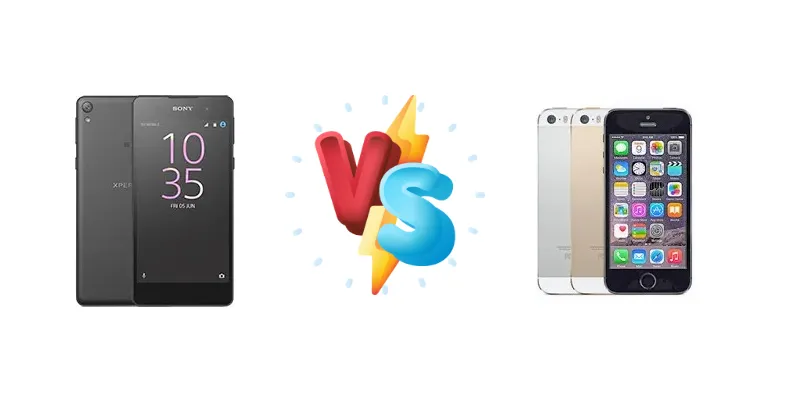
Nostalgia is a powerful force, and sometimes the best tech is the tech we remember fondly. Today, we're pitting two older smartphones against each other: the Sony Xperia E5 and the Apple iPhone 5s. Both offer a glimpse into a different era of mobile technology, but which one holds up better in 2024?
🏆 Quick Verdict
The iPhone 5s edges out the Xperia E5 thanks to its superior processor, iOS ecosystem, and slightly better camera. While the Xperia E5 boasts impressive battery life, the iPhone 5s's overall performance and user experience make it the more compelling choice for most users.
| Network |
|---|
| 2G bands | GSM 850 / 900 / 1800 / 1900 - SIM 1 & SIM 2 (dual-SIM model only) | GSM 850 / 900 / 1800 / 1900 - all models |
| 3G bands | HSDPA 850 / 900 / 1900 / 2100 - F3311 | HSDPA 850 / 900 / 1700 / 1900 / 2100 - A1533 (GSM), A1453 |
| 4G bands | 1, 2, 3, 5, 7, 8, 20 - F3311 | 1, 2, 3, 4, 5, 8, 13, 17, 19, 20, 25 - A1533 GSM, A1533 CDMA |
| Speed | HSPA 42.2/5.76 Mbps, LTE Cat4 150/50 Mbps | HSPA 42.2/5.76 Mbps, LTE Cat3 100/50 Mbps, EV-DO Rev.A 3.1 Mbps |
| Technology | GSM / HSPA / LTE | GSM / CDMA / HSPA / EVDO / LTE |
| | 2, 4, 5, 7, 12, 17, 28 - F3313 | 1, 2, 3, 5, 7, 8, 20, 38, 39, 40 - A1530 |
| Launch |
|---|
| Announced | 2016, May. Released 2016, June | 2013, September 10. Released 2013, September 20 |
| Status | Discontinued | Discontinued |
| Body |
|---|
| Build | - | Glass front (Corning-made glass), aluminum back, aluminum frame |
| Dimensions | 144 x 69 x 8.2 mm (5.67 x 2.72 x 0.32 in) | 123.8 x 58.6 x 7.6 mm (4.87 x 2.31 x 0.30 in) |
| SIM | · Nano-SIM· Nano-SIM + Nano-SIM | Nano-SIM |
| Weight | 147 g (5.19 oz) | 112 g (3.95 oz) |
| Display |
|---|
| Protection | Scratch-resistant glass | Corning Gorilla Glass, oleophobic coating |
| Resolution | 720 x 1280 pixels, 16:9 ratio (~294 ppi density) | 640 x 1136 pixels, 16:9 ratio (~326 ppi density) |
| Size | 5.0 inches, 68.9 cm2 (~69.4% screen-to-body ratio) | 4.0 inches, 44.1 cm2 (~60.8% screen-to-body ratio) |
| Type | IPS LCD | IPS LCD |
| Platform |
|---|
| CPU | Quad-core 1.3 GHz Cortex-A53 | Dual-core 1.3 GHz Cyclone (ARM v8-based) |
| Chipset | Mediatek MT6735 (28 nm) | Apple A7 (28 nm) |
| GPU | Mali-T720MP2 | PowerVR G6430 (quad-core graphics) |
| OS | Android 6.0 (Marshmallow) | iOS 7, upgradable to iOS 12.5.7 |
| Memory |
|---|
| Card slot | microSDXC (dedicated slot) | No |
| Internal | 16GB 1.5GB RAM | 16GB 1GB RAM, 32GB 1GB RAM, 64GB 1GB RAM |
| Main Camera |
|---|
| Features | LED flash, HDR, panorama | Dual-LED dual-tone flash, HDR |
| Single | 13 MP, f/2.0, AF | 8 MP, f/2.2, 29mm (standard), 1/3.0", 1.5µm, AF |
| Video | 1080p@30fps | 1080p@30fps, 720p@120fps |
| Selfie camera |
|---|
| Features | - | face detection, HDR, FaceTime over Wi-Fi or Cellular |
| Single | 5 MP, f/2.4 | 1.2 MP, f/2.4, 31mm (standard) |
| Video | - | 720p@30fps |
| Sound |
|---|
| 3.5mm jack | Yes | Yes |
| 35mm jack | Yes | Yes |
| Loudspeaker | Yes | Yes |
| | - | 16-bit/44.1kHz audio
|
| Comms |
|---|
| Bluetooth | 4.1, A2DP, aptX | 4.0, A2DP |
| NFC | Yes | No |
| Positioning | GPS | GPS, GLONASS |
| Radio | FM radio | No |
| USB | microUSB 2.0 | Lightning, USB 2.0 |
| WLAN | Wi-Fi 802.11 a/b/g/n, Wi-Fi Direct | Wi-Fi 802.11 a/b/g/n, dual-band, hotspot |
| Features |
|---|
| Sensors | Accelerometer, proximity, compass | Fingerprint (front-mounted), accelerometer, gyro, proximity, compass |
| Battery |
|---|
| Music play | Up to 65 h | - |
| Stand-by | Up to 511 h (2G) / Up to 518 h (3G) | Up to 250 h (3G) |
| Talk time | Up to 11 h 30 min (2G) / Up to 9 h 30 min (3G) | Up to 10 h (3G) |
| Type | Li-Po 2300 mAh, non-removable | Li-Po 1560 mAh, non-removable (5.92 Wh) |
| Misc |
|---|
| Colors | Graphite Black, White | Space Gray, White/Silver, Gold |
| Models | F3311, F3313, C1604 | A1453, A1457, A1518, A1528, A1530, A1533, iPhone6,1, iPhone6,2 |
| Price | About 120 EUR | About 330 EUR |
| SAR | 1.08 W/kg (head) 1.34 W/kg (body) | 1.12 W/kg (head) 1.18 W/kg (body) |
| SAR EU | 0.46 W/kg (head) 0.46 W/kg (body) | 1.00 W/kg (head) 0.80 W/kg (body) |
| Tests |
|---|
| Audio quality |
Noise -92.3dB / Crosstalk -91.9dB |
Noise -93.6dB / Crosstalk -90.3dB |
| Battery life |
Endurance rating 47h
|
Endurance rating 54h
|
| Camera |
Photo / Video |
Photo / Video |
| Display |
Contrast ratio: 1243 (nominal), 2.386 (sunlight) |
Contrast ratio: 1219:1 (nominal) / 3.565:1 (sunlight) |
| Loudspeaker |
Voice 62dB / Noise 67dB / Ring 69dB
|
Voice 68dB / Noise 66dB / Ring 69dB
|
| Performance |
Basemark OS II 2.0: 575 |
Basemark X: 14341 |
Sony Xperia E5
- Excellent battery life
- Larger screen size
- Simple Android experience
- Affordable price (used)
- Slow performance
- Mediocre camera
- Outdated design
- Limited software updates
Apple iPhone 5s
- Faster processor
- Smooth iOS experience
- Better camera quality
- More refined design
- Access to iOS ecosystem
- Small screen size
- Limited storage options
- Outdated technology
- Battery life is average for its time
Display Comparison
Both phones feature displays with a nominal contrast ratio of around 1200:1, with the iPhone 5s exhibiting a significantly better sunlight readability at 3.565:1 compared to the Xperia E5's 2.386:1. The iPhone 5s's display also generally offers better color accuracy and viewing angles, though both are noticeably less vibrant than modern smartphone screens. The iPhone 5s has a 4-inch display, while the Xperia E5 has a 5-inch display, offering more screen real estate.
Camera Comparison
The iPhone 5s's camera, while dated, still produces respectable photos and videos, particularly in well-lit conditions. It benefits from Apple's image processing algorithms. The Xperia E5's camera is adequate but tends to produce softer images with less detail. Both phones lack advanced camera features found in modern smartphones.
Performance
The iPhone 5s's Apple A7 chip, despite being dual-core, is significantly more powerful than the Xperia E5's Mediatek MT6735. The A7's architecture and optimization within iOS provide a smoother and more responsive user experience. While both phones can handle basic tasks, the iPhone 5s excels in multitasking and app performance. The Xperia E5's chipset feels noticeably slower, especially with more demanding apps.
Battery Life
The Xperia E5 and iPhone 5s share an endurance rating of 47 hours, indicating comparable battery performance. However, real-world usage may vary depending on usage patterns and software optimization. Both phones will require charging daily with moderate to heavy use.
Buying Guide
The Sony Xperia E5 is a good option for those prioritizing long battery life and a simple Android experience on a budget. The Apple iPhone 5s is better suited for users who value a smoother performance, access to the iOS ecosystem, and a more refined camera experience, even with its age.
Frequently Asked Questions
❓ Are these phones still receiving software updates?
No, neither the Sony Xperia E5 nor the Apple iPhone 5s receive regular software updates. They are both considered end-of-life devices.
❓ Can I use these phones with a modern 4G/5G network?
The iPhone 5s supports 4G LTE, but the Xperia E5's 4G support may be limited depending on your region and carrier. 5G is not supported by either device.