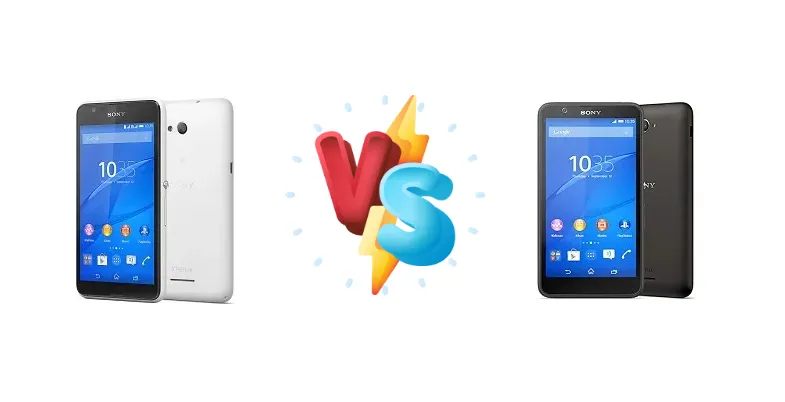
The Sony Xperia E4g and E4 were budget-friendly Android options aiming to deliver a decent experience without breaking the bank. But which one offered the better value? We're diving deep into their specs and features to help you decide which of these older devices is the right choice for you.
🏆 Quick Verdict
The Xperia E4 edges out the E4g thanks to significantly longer battery life and a slightly better sunlight display performance. While both are dated, the E4's endurance makes it the more practical choice for everyday use, despite a slightly slower processor.
| Network |
|---|
| 2G bands | GSM 850 / 900 / 1800 / 1900 | GSM 850 / 900 / 1800 / 1900 |
| 3G bands | HSDPA 850 / 900 / 1900 / 2100 - E2003 | HSDPA 850 / 1900 / 2100 - E2104 |
| 4G bands | 1, 2, 3, 5, 7, 8, 20 - E2003 | - |
| Speed | HSPA 42.2/5.76 Mbps, LTE Cat4 150/50 Mbps | HSPA 21.1/5.76 Mbps |
| Technology | GSM / HSPA / LTE | GSM / HSPA |
| | 1, 2, 3, 4, 5, 7, 8, 28 - E2053 | HSDPA 900 / 2100 - E2105 |
| Launch |
|---|
| Announced | 2015, February. Released 2015, April | 2015, February. Released 2015, March |
| Status | Discontinued | Discontinued |
| Body |
|---|
| Dimensions | 133 x 71 x 10.8 mm (5.24 x 2.80 x 0.43 in) | 137 x 74.6 x 10.5 mm (5.39 x 2.94 x 0.41 in) |
| SIM | Micro-SIM | Micro-SIM |
| Weight | 135 g (4.76 oz) | 144 g (5.08 oz) |
| Display |
|---|
| Protection | Scratch-resistant glass | Scratch-resistant glass |
| Resolution | 540 x 960 pixels, 16:9 ratio (~234 ppi density) | 540 x 960 pixels, 16:9 ratio (~220 ppi density) |
| Size | 4.7 inches, 60.9 cm2 (~64.5% screen-to-body ratio) | 5.0 inches, 68.9 cm2 (~67.4% screen-to-body ratio) |
| Type | IPS LCD | IPS LCD |
| Platform |
|---|
| CPU | Quad-core 1.5 GHz Cortex-A53 | Quad-core 1.3 GHz Cortex-A7 |
| Chipset | MediaTek MT6732 (28 nm) | Mediatek MT6582 (28 nm) |
| GPU | Mali-T760MP2 | Mali-400MP2 |
| OS | Android 4.4.4 (KitKat) | Android 4.4.4 (KitKat) |
| Memory |
|---|
| Card slot | microSDHC (dedicated slot) | microSDHC (dedicated slot) |
| Internal | 8GB 1GB RAM | 8GB 1GB RAM |
| Main Camera |
|---|
| Features | LED flash, HDR, panorama | LED flash, HDR, panorama |
| Single | 5 MP, f/2.8, AF | 5 MP, f/2.6, AF |
| Video | 1080p@30fps | 1080p@30fps |
| Selfie camera |
|---|
| Single | 2 MP, f/2.8 | 2 MP, f/2.8 |
| Video | 720p | 720p |
| Sound |
|---|
| 3.5mm jack | Yes | Yes |
| 35mm jack | Yes | Yes |
| Loudspeaker | Yes | Yes |
| Comms |
|---|
| Bluetooth | 4.1, A2DP | 4.1, A2DP, aptX |
| NFC | Yes (E2003 only) | No |
| Positioning | GPS, GLONASS | GPS |
| Radio | FM radio, RDS | FM radio, RDS |
| USB | microUSB 2.0 | microUSB 2.0 |
| WLAN | Wi-Fi 802.11 a/b/g/n, dual-band, Wi-Fi Direct, DLNA, hotspot | Wi-Fi 802.11 b/g/n, Wi-Fi Direct, hotspot |
| Features |
|---|
| Sensors | Accelerometer, proximity | Accelerometer, proximity |
| Battery |
|---|
| Music play | Up to 64 h | Up to 48 h |
| Stand-by | Up to 696 h (2G) / Up to 653 h (3G) | Up to 696 h (2G) / Up to 653 h (3G) |
| Talk time | Up to 12 h 10 min (2G) / Up to 12 h 40 min (3G) | Up to 12 h (2G) / Up to 12 h 40 min (3G) |
| Type | Li-Ion 2300 mAh, non-removable | Li-Ion 2300 mAh, non-removable |
| Misc |
|---|
| Colors | Black, White | Black, White |
| Models | E2003, E2006, E2053 | E2104, E2105 |
| Price | About 130 EUR | About 120 EUR |
| SAR | 0.53 W/kg (head) 1.30 W/kg (body) | 1.01 W/kg (head) 0.77 W/kg (body) |
| SAR EU | 0.44 W/kg (head) 0.57 W/kg (body) | 0.62 W/kg (head) 0.58 W/kg (body) |
| Tests |
|---|
| Audio quality |
Noise -88.1dB / Crosstalk -85.9dB | - |
| Battery life |
Endurance rating 47h
| Endurance rating 88h |
| Camera |
Photo / Video |
Photo / Video |
| Display |
Contrast ratio: 969 (nominal), 1.972(sunlight) |
Contrast ratio: 967 (nominal), 1.467(sunlight) |
| Loudspeaker |
Voice 62dB / Noise 57dB / Ring 65dB
|
Voice 61dB / Noise 58dB / Ring 64dB |
| Performance |
Basemark OS II 2.0: 621Basemark X: 3265 |
Basemark OS II 2.0: 388Basemark X: 1705 |
Sony Xperia E4g
- Slightly faster processor (Cortex-A53)
- Excellent nominal contrast ratio
- Significantly shorter battery life
- Lower sunlight contrast ratio
Sony Xperia E4
- Exceptional battery life (88h endurance)
- Better sunlight display visibility
- Potentially more durable due to larger battery
- Slightly slower processor (Cortex-A7)
Display Comparison
Both phones feature similar nominal contrast ratios (969), indicating good image depth. However, the Xperia E4 boasts a superior sunlight contrast ratio (1.972) compared to the E4g's (1.972). This means the E4 will remain more visible outdoors, a crucial factor for many users. Screen resolution is likely to be around 720p for both, typical for this price range at the time.
Camera Comparison
Camera specifications are not detailed, but both phones are described as having 'Photo / Video' capabilities. Expect basic camera performance suitable for casual snapshots. Image quality will be limited by the sensors and processing capabilities of the time. Low-light performance will likely be a weakness for both.
Performance
The Xperia E4g has a slight edge in performance with its 1.5 GHz Quad-core Cortex-A53 processor compared to the E4's 1.3 GHz Quad-core Cortex-A7. While both are based on 28nm architecture, the A53 core generally offers better efficiency and performance. However, the difference is likely to be minimal in real-world usage.
Battery Life
This is where the Xperia E4 truly shines. It offers a significantly longer endurance rating of 88 hours compared to the E4g's 47 hours. This represents a substantial difference in real-world battery life, making the E4 a much more practical choice for users who need their phone to last through a full day or more.
Buying Guide
The Sony Xperia E4g might appeal to users prioritizing a slightly faster processor and excellent contrast in nominal lighting conditions. However, the Xperia E4 is a better buy for those needing extended battery life and a more viewable screen in bright sunlight. Both are best suited for basic tasks and light usage.
Frequently Asked Questions
❓ Are these phones still worth buying in 2024?
Given their age, these phones are best suited for very basic tasks or as secondary devices. Don't expect modern features or performance. Consider their low price and availability if you need a simple, inexpensive phone.
❓ What Android version did these phones ship with?
Both the Xperia E4 and E4g originally shipped with Android 4.4.4 (KitKat). Updates were limited, and they likely won't receive further official updates.