
Xiaomi 13T vs Sony Xperia 5: A Detailed Comparison of Performance, Battery, and Value
| Phones Images | |||||
|---|---|---|---|---|---|
|
🏆 Quick Verdict
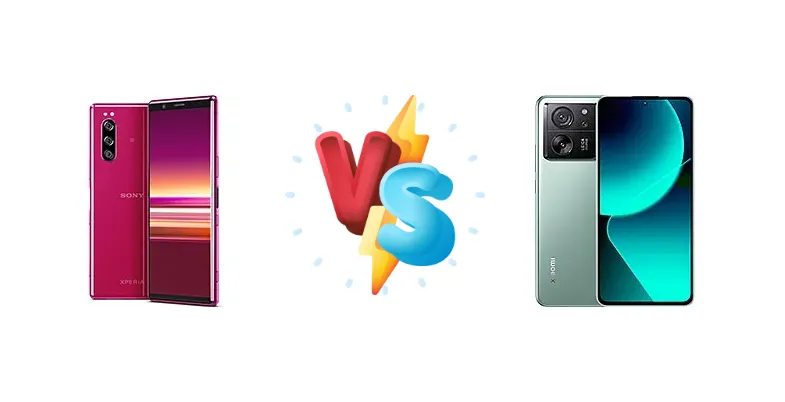
For most users, the Xiaomi 13T emerges as the better buy. Its Mediatek Dimensity 8200 Ultra chipset delivers superior performance and efficiency compared to the Snapdragon 855, coupled with a much faster 67W charging solution. While the Xperia 5 retains a certain appeal for its compact size, the 13T’s overall package is more compelling.
| PHONES | ||
|---|---|---|
| Phone Names | Sony Xperia 5 | Xiaomi 13T |
| Network | ||
|---|---|---|
| 2G bands | GSM 850 / 900 / 1800 / 1900 | GSM 850 / 900 / 1800 / 1900 |
| 3G bands | HSDPA 800 / 850 / 900 / 1700(AWS) / 1900 / 2100 | HSDPA 800 / 850 / 900 / 1700(AWS) / 1900 / 2100 |
| 4G bands | 1, 2, 3, 4, 5, 7, 8, 12, 13, 17, 19, 20, 25, 26, 28, 29, 32, 34, 38, 39, 40, 41, 46, 66 | 1, 2, 3, 4, 5, 7, 8, 12, 13, 17, 18, 19, 20, 26, 28, 32, 38, 40, 41, 66 |
| 5G bands | - | 1, 3, 5, 7, 8, 20, 28, 38, 40, 41, 66, 77, 78 SA/NSA |
| Speed | HSPA 42.2/5.76 Mbps, LTE Cat19 1600/150 Mbps | HSPA, LTE, 5G |
| Technology | GSM / HSPA / LTE | GSM / HSPA / LTE / 5G |
| Launch | ||
|---|---|---|
| Announced | 2019, September 05. Released 2019, October 05 | 2023, September 26 |
| Status | Discontinued | Available. Released 2023, September 26 |
| Body | ||
|---|---|---|
| Build | Glass front (Gorilla Glass 6), glass back (Gorilla Glass 6), aluminum frame | Glass front (Gorilla Glass 5), glass back or silicone polymer back, plastic frame |
| Dimensions | 158 x 68 x 8.2 mm (6.22 x 2.68 x 0.32 in) | 162.2 x 75.7 x 8.5 mm (6.39 x 2.98 x 0.33 in) |
| SIM | · Nano-SIM· Nano-SIM + Nano-SIM | · Nano-SIM + eSIM· Nano-SIM + Nano-SIM |
| Weight | 164 g (5.78 oz) | 193 g or 197 g (6.81 oz) |
| IP65/IP68 dust/water resistant (up to 1.5m for 30 mins) | - | |
| Display | ||
|---|---|---|
| Protection | Corning Gorilla Glass 6 | Corning Gorilla Glass 5 |
| Resolution | 1080 x 2520 pixels, 21:9 ratio (~449 ppi density) | 1220 x 2712 pixels, 20:9 ratio (~446 ppi density) |
| Size | 6.1 inches, 86.9 cm2 (~80.9% screen-to-body ratio) | 6.67 inches, 107.4 cm2 (~87.5% screen-to-body ratio) |
| Type | OLED, HDR BT.2020 | AMOLED, 68B colors, 144Hz, Dolby Vision, HDR10+, 1200 nits (HBM), 2600 nits (peak) |
| Triluminos display X-Reality Engine | - | |
| Platform | ||
|---|---|---|
| CPU | Octa-core (1x2.84 GHz Kryo 485 & 3x2.42 GHz Kryo 485 & 4x1.78 GHz Kryo 485) | Octa-core (1x3.1 GHz Cortex-A78 & 3x3.0 GHz Cortex-A78 & 4x2.0 GHz Cortex-A55) |
| Chipset | Qualcomm SM8150 Snapdragon 855 (7 nm) | Mediatek Dimensity 8200 Ultra (4 nm) |
| GPU | Adreno 640 | Mali-G610 MC6 |
| OS | Android 9.0 (Pie), upgradable to Android 11 | Android 13, up to 4 major Android upgrades, HyperOS |
| Memory | ||
|---|---|---|
| Card slot | microSDXC (uses shared SIM slot) | No |
| Internal | 128GB 6GB RAM | 256GB 8GB RAM, 256GB 12GB RAM |
| UFS 2.1 | - | |
| Main Camera | ||
|---|---|---|
| Features | Color spectrum sensor, LED flash, panorama, HDR, eye tracking | Leica lens, color spectrum sensor, LED flash, HDR, panorama |
| Triple | 12 MP, f/1.6, 26mm (wide), 1/2.55", 1.4µm, predictive dual pixel PDAF, 5-axis OIS 12 MP, f/2.4, 52mm (telephoto), 1/3.4", 1.0µm, predictive PDAF, 2x optical zoom, 5-axis OIS 12 MP, f/2.4, 16mm (ultrawide), 1/3.4", 1.0µm | 50 MP, f/1.9, 24mm (wide), 1/1.28", 1.22µm, PDAF, OIS 50 MP, f/1.9, 50mm (telephoto), 1/2.88", 0.61µm, PDAF, 2x optical zoom 12 MP, f/2.2, 15mm (ultrawide), 1/3.06", 1.12µm |
| Video | 4K@24/30fps HDR, 1080p@60fps, 1080p@30fps (5-axis gyro-EIS) | 4K@30fps (HDR10+), 1080p@30/60/120fps, gyro-EIS |
| Selfie camera | ||
|---|---|---|
| Features | HDR | HDR |
| Single | 8 MP, f/2.0, 24mm (wide), 1/4.0", 1.12µm | 20 MP, f/2.2, (wide), 0.8µm |
| Video | 1080p@30fps (5-axis gyro-EIS) | 1080p@30fps, HDR10+ |
| Sound | ||
|---|---|---|
| 3.5mm jack | No | - |
| 35mm jack | No | No |
| Loudspeaker | Yes, with stereo speakers | Yes, with stereo speakers |
| 24-bit/192kHz audio Dynamic vibration system | - | |
| Comms | ||
|---|---|---|
| Bluetooth | 5.0, A2DP, aptX HD, LE | 5.4, A2DP, LE |
| Infrared port | - | Yes |
| NFC | Yes | Yes (market/region dependent) |
| Positioning | GPS, GLONASS, BDS, GALILEO | GPS (L1+L5), GLONASS (G1), GALILEO (E1+E5a), QZSS (L1+L5), NavIC (L5), BDS |
| Radio | No | No |
| USB | USB Type-C 3.1, OTG | USB Type-C 2.0, OTG |
| WLAN | Wi-Fi 802.11 a/b/g/n/ac, dual-band, Wi-Fi Direct, DLNA | Wi-Fi 802.11 a/b/g/n/ac/6, dual-band |
| Features | ||
|---|---|---|
| Sensors | Fingerprint (side-mounted), accelerometer, gyro, proximity, barometer, compass | Fingerprint (under display, optical), accelerometer, gyro, proximity, compass |
| Battery | ||
|---|---|---|
| Charging | 18W wired, PD2.0 | 67W wired, PD3.0, QC4, 100% in 42 min |
| Type | Li-Ion 3140 mAh, non-removable | Li-Po 5000 mAh |
| Misc | ||
|---|---|---|
| Colors | Blue, Red, Black, Grey | Alpine Blue, Meadow Green, Black |
| Models | J8210, J8270, J9210, SOV41, SO-01M | 2306EPN60G |
| Price | About 500 EUR | $ 255.96 / £ 326.27 / € 204.18 |
| SAR EU | - | 0.99 W/kg (head) 0.99 W/kg (body) |
| Pricing | ||
|---|---|---|
| 128GB 6GB RAM | $ 409.99 | - |
| RENEWED | $ 674.00 | - |
| Tests | ||
|---|---|---|
| Audio quality | Noise -93.0dB / Crosstalk -89.4dB | - |
| Battery life | Endurance rating 96h | - |
| Display | Contrast ratio: Infinite (nominal) | - |
| Loudspeaker | -27.1 LUFS (Good) | - |
| Performance | AnTuTu: 334809 (v7), 416601 (v8) GeekBench: 10941 (v4.4), 2825 (v5.1) GFXBench: 33fps (ES 3.1 onscreen) | - |
Sony Xperia 5
- Compact and pocketable design
- Respectable 96-hour endurance rating
- Lower price point (currently)
- Outdated Snapdragon 855 chipset
- Slow 18W charging
- Dimmer display compared to the 13T
Xiaomi 13T
- Powerful Mediatek Dimensity 8200 Ultra chipset
- Ultra-fast 67W charging (42 minutes to full)
- Bright and vibrant display (1264 nits)
- Larger form factor
- Potentially less appealing to those prioritizing extreme compactness
- May be slightly more expensive
Display Comparison
The Xiaomi 13T boasts a significantly brighter display, reaching 1264 nits compared to the Xperia 5’s 630 nits. This makes the 13T far more usable outdoors under direct sunlight. While both displays have an infinite (nominal) contrast ratio, the brightness difference is the key differentiator. The Xperia 5’s smaller 6.1-inch screen caters to those seeking a truly compact device, but the 13T’s larger screen is better suited for media consumption. Details regarding panel technology (OLED vs LCD, refresh rate) are missing for the Xperia 5, but the 13T’s brightness advantage is undeniable.
Camera Comparison
While both phones feature camera systems, detailed sensor information for the Xperia 5 is lacking. The Xiaomi 13T’s camera is described as having photo/video capabilities, suggesting a versatile setup. Without specific sensor sizes or aperture details for the Xperia 5, it’s difficult to make a direct comparison. However, the 13T’s modern image processing capabilities likely provide superior image quality, especially in challenging lighting conditions. The absence of details regarding OIS on either device makes it hard to assess stabilization performance.
Performance
The Xiaomi 13T’s Mediatek Dimensity 8200 Ultra, built on a 4nm process, represents a substantial leap in performance and efficiency over the Sony Xperia 5’s 7nm Snapdragon 855. The Dimensity 8200 Ultra’s octa-core configuration (1x3.1 GHz Cortex-A78, 3x3.0 GHz Cortex-A78, 4x2.0 GHz Cortex-A55) offers a more modern architecture and higher clock speeds than the Snapdragon 855’s (1x2.84 GHz Kryo 485, 3x2.42 GHz Kryo 485, 4x1.78 GHz Kryo 485). This translates to faster app loading times, smoother multitasking, and improved gaming performance on the 13T. The 13T’s more efficient chipset also contributes to better battery life.
Battery Life
The Xiaomi 13T’s 67W wired charging, supporting PD3.0 and QC4, is a game-changer, achieving a 100% charge in just 42 minutes. This is significantly faster than the Xperia 5’s 18W PD2.0 charging. While the Xperia 5 has an endurance rating of 96 hours, the 13T isn’t far behind with 101 hours, and its active use score of 12:23h suggests excellent real-world battery performance. The 13T’s faster charging mitigates any potential concerns about slightly lower battery capacity (spec not provided).
Buying Guide
Buy the Sony Xperia 5 if you prioritize a genuinely compact, pocketable flagship experience and are willing to accept older hardware. Its 630 nits brightness is sufficient for indoor use, and the 96-hour endurance rating is respectable. Buy the Xiaomi 13T if you value performance, fast charging, and a brighter, more vibrant display. It’s ideal for users who stream a lot of video, game frequently, or simply want a phone that can keep up with a demanding lifestyle.