
Sony Xperia 5 vs. Samsung Galaxy S23 FE: A Detailed Comparison
| Phones Images | |||||
|---|---|---|---|---|---|
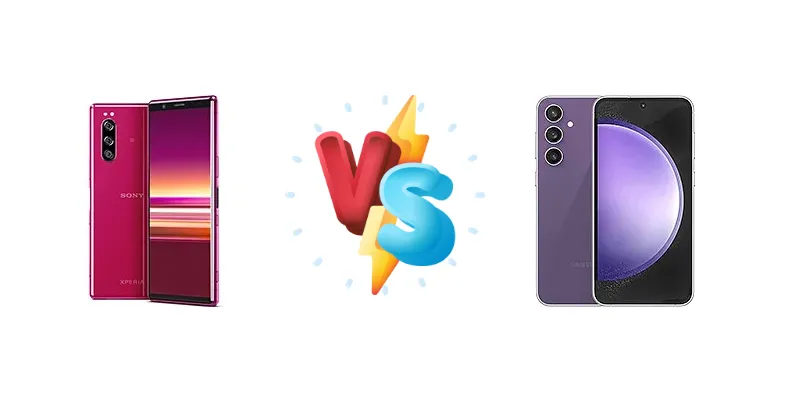
|
🏆 Quick Verdict
For the average user, the Samsung Galaxy S23 FE is the better choice. Its significantly brighter display, more modern chipset (despite regional variations), and versatile camera system outweigh the Xperia 5’s exceptional battery endurance. However, those prioritizing a smaller phone and long-lasting battery will find the Xperia 5 a viable option.
| PHONES | ||
|---|---|---|
| Phone Names | Sony Xperia 5 | Samsung Galaxy S23 FE |
| Network | ||
|---|---|---|
| 2G bands | GSM 850 / 900 / 1800 / 1900 | GSM 850 / 900 / 1800 / 1900 |
| 3G bands | HSDPA 800 / 850 / 900 / 1700(AWS) / 1900 / 2100 | HSDPA 850 / 900 / 1700(AWS) / 1900 / 2100 |
| 4G bands | 1, 2, 3, 4, 5, 7, 8, 12, 13, 17, 19, 20, 25, 26, 28, 29, 32, 34, 38, 39, 40, 41, 46, 66 | 1, 2, 3, 4, 5, 7, 8, 12, 13, 17, 20, 26, 28, 38, 40, 41, 66 - International |
| 5G bands | - | 1, 2, 3, 5, 7, 8, 20, 28, 38, 40, 41, 66, 77, 78 SA/NSA/Sub6 - International |
| Speed | HSPA 42.2/5.76 Mbps, LTE Cat19 1600/150 Mbps | HSPA, LTE, 5G |
| Technology | GSM / HSPA / LTE | GSM / HSPA / LTE / 5G |
| Launch | ||
|---|---|---|
| Announced | 2019, September 05. Released 2019, October 05 | 2023, October 04 |
| Status | Discontinued | Available. Released 2023, October 05 |
| Body | ||
|---|---|---|
| Build | Glass front (Gorilla Glass 6), glass back (Gorilla Glass 6), aluminum frame | Glass front (Gorilla Glass 5), glass back (Gorilla Glass 5), aluminum frame |
| Dimensions | 158 x 68 x 8.2 mm (6.22 x 2.68 x 0.32 in) | 158 x 76.5 x 8.2 mm (6.22 x 3.01 x 0.32 in) |
| SIM | · Nano-SIM· Nano-SIM + Nano-SIM | · Nano-SIM· Nano-SIM + Nano-SIM· Nano-SIM + Nano-SIM + eSIM (max 2 at a time) |
| Weight | 164 g (5.78 oz) | 209 g (7.37 oz) |
| IP65/IP68 dust/water resistant (up to 1.5m for 30 mins) | - | |
| Display | ||
|---|---|---|
| Protection | Corning Gorilla Glass 6 | Corning Gorilla Glass 5 |
| Resolution | 1080 x 2520 pixels, 21:9 ratio (~449 ppi density) | 1080 x 2340 pixels, 19.5:9 ratio (~403 ppi density) |
| Size | 6.1 inches, 86.9 cm2 (~80.9% screen-to-body ratio) | 6.4 inches, 100.5 cm2 (~83.2% screen-to-body ratio) |
| Type | OLED, HDR BT.2020 | Dynamic AMOLED 2X, 120Hz, HDR10+, 1450 nits (peak) |
| Triluminos display X-Reality Engine | - | |
| Platform | ||
|---|---|---|
| CPU | Octa-core (1x2.84 GHz Kryo 485 & 3x2.42 GHz Kryo 485 & 4x1.78 GHz Kryo 485) | Octa-core (1x2.8 GHz Cortex-X2 & 3x2.50 GHz Cortex-A710 & 4x1.8 GHz Cortex-A510) - InternationalOcta-core (1x3.00 GHz Cortex-X2 & 3x2.50 GHz Cortex-A710 & 4x1.80 GHz Cortex-A510) - USA |
| Chipset | Qualcomm SM8150 Snapdragon 855 (7 nm) | Exynos 2200 (4 nm) - InternationalQualcomm SM8450 Snapdragon 8 Gen 1 (4 nm) - USA |
| GPU | Adreno 640 | Xclipse 920 - InternationalAdreno 730 - USA |
| OS | Android 9.0 (Pie), upgradable to Android 11 | Android 13, up to 4 major Android upgrades, One UI 8 |
| Memory | ||
|---|---|---|
| Card slot | microSDXC (uses shared SIM slot) | No |
| Internal | 128GB 6GB RAM | 128GB 8GB RAM, 256GB 8GB RAM |
| UFS 2.1 | - | |
| Main Camera | ||
|---|---|---|
| Features | Color spectrum sensor, LED flash, panorama, HDR, eye tracking | LED flash, HDR, panorama |
| Triple | 12 MP, f/1.6, 26mm (wide), 1/2.55", 1.4µm, predictive dual pixel PDAF, 5-axis OIS 12 MP, f/2.4, 52mm (telephoto), 1/3.4", 1.0µm, predictive PDAF, 2x optical zoom, 5-axis OIS 12 MP, f/2.4, 16mm (ultrawide), 1/3.4", 1.0µm | 50 MP, f/1.8, 23mm (wide), 1/1.57", 1.0µm, dual pixel PDAF, OIS 8 MP, f/2.4, 76mm (telephoto), 1/4.5", 1.0µm, PDAF, OIS, 3x optical zoom 12 MP, f/2.2, 13mm, 123˚ (ultrawide), 1/3.0", 1.12µm |
| Video | 4K@24/30fps HDR, 1080p@60fps, 1080p@30fps (5-axis gyro-EIS) | 8K@24fps, 4K@30/60fps, 1080p@30/60/120/240fps |
| Selfie camera | ||
|---|---|---|
| Features | HDR | - |
| Single | 8 MP, f/2.0, 24mm (wide), 1/4.0", 1.12µm | 10 MP, f/2.4, 25mm (wide), 1/3.0", 1.22µm |
| Video | 1080p@30fps (5-axis gyro-EIS) | 4K@30/60fps, 1080p@30/60fps; gyro-EIS |
| Sound | ||
|---|---|---|
| 3.5mm jack | No | - |
| 35mm jack | No | No |
| Loudspeaker | Yes, with stereo speakers | Yes, with stereo speakers |
| 24-bit/192kHz audio Dynamic vibration system | - | |
| Comms | ||
|---|---|---|
| Bluetooth | 5.0, A2DP, aptX HD, LE | 5.3, A2DP, LE |
| NFC | Yes | Yes |
| Positioning | GPS, GLONASS, BDS, GALILEO | GPS, GLONASS, GALILEO, BDS |
| Radio | No | Unspecified |
| USB | USB Type-C 3.1, OTG | USB Type-C, OTG |
| WLAN | Wi-Fi 802.11 a/b/g/n/ac, dual-band, Wi-Fi Direct, DLNA | Wi-Fi 802.11 a/b/g/n/ac/6e, dual-band, Wi-Fi Direct |
| Features | ||
|---|---|---|
| Sensors | Fingerprint (side-mounted), accelerometer, gyro, proximity, barometer, compass | Fingerprint (under display, optical), accelerometer, gyro, compass |
| Battery | ||
|---|---|---|
| Charging | 18W wired, PD2.0 | 25W wired, PD3.0, 50% in 30 min 15W wireless Reverse wireless |
| Type | Li-Ion 3140 mAh, non-removable | Li-Ion 4500 mAh |
| Misc | ||
|---|---|---|
| Colors | Blue, Red, Black, Grey | Mint, Cream, Graphite, Purple, Indigo, Tangerine |
| Models | J8210, J8270, J9210, SOV41, SO-01M | SM-S711B, SM-S711B/DS, SM-S711U1, SM-S711U, SM-S711W, SM-S7110, SM-S711N |
| Price | About 500 EUR | $ 219.95 / C$ 327.90 / £ 248.99 / € 272.00 / ₹ 34,999 |
| SAR | - | 0.80 W/kg (head) 0.72 W/kg (body) |
| SAR EU | - | 0.76 W/kg (head) 1.04 W/kg (body) |
| Pricing | ||
|---|---|---|
| 128GB 6GB RAM | $ 409.99 | - |
| RENEWED | $ 674.00 | - |
| Tests | ||
|---|---|---|
| Audio quality | Noise -93.0dB / Crosstalk -89.4dB | - |
| Battery life | Endurance rating 96h | - |
| Display | Contrast ratio: Infinite (nominal) | - |
| Loudspeaker | -27.1 LUFS (Good) | - |
| Performance | AnTuTu: 334809 (v7), 416601 (v8) GeekBench: 10941 (v4.4), 2825 (v5.1) GFXBench: 33fps (ES 3.1 onscreen) | - |
Sony Xperia 5
- Exceptional battery life (96h endurance)
- Compact and pocketable design
- Lower price point
- Outdated chipset (Snapdragon 855)
- Dimmer display
- Slower charging
Samsung Galaxy S23 FE
- Brighter and more vibrant display
- More powerful chipset (Exynos 2200/Snapdragon 8 Gen 1)
- Faster charging (25W wired, 15W wireless)
- Shorter battery life
- Larger and heavier design
- Potential for thermal throttling (Exynos variant)
Display Comparison
The Samsung Galaxy S23 FE boasts a significantly brighter display, peaking at 985 nits, compared to the Xperia 5’s 630 nits. This translates to vastly improved visibility outdoors under direct sunlight. While both displays have an infinite (nominal) contrast ratio, the S23 FE’s higher brightness is a clear advantage. The Xperia 5’s display, while adequate, feels dated in comparison. We lack PWM frequency data for both, but the S23 FE’s newer panel tech likely incorporates more advanced flicker mitigation.
Camera Comparison
The context data for the Xperia 5 lacks detailed camera specifications, but based on its market positioning, it likely features a competent but not class-leading camera system. The S23 FE, on the other hand, is marketed for its camera capabilities. While details are limited, the S23 FE’s camera system likely includes a larger main sensor and more advanced image processing algorithms. The inclusion of features like optical image stabilization (OIS) is expected, contributing to sharper images and smoother videos. The 2MP macro camera on the S23 FE is likely a marketing gimmick and won't significantly impact image quality.
Performance
The chipset is where the biggest difference lies. The Xperia 5 utilizes the Qualcomm Snapdragon 855 (7nm), while the S23 FE comes in two variants: the Exynos 2200 (4nm) for international markets and the Snapdragon 8 Gen 1 (4nm) for the USA. The 4nm process node of both S23 FE chipsets offers superior power efficiency and thermal performance compared to the 7nm Snapdragon 855. The Exynos 2200, however, has been known to exhibit thermal throttling under sustained load, a potential issue for gamers. The Snapdragon 8 Gen 1 variant of the S23 FE will likely offer more consistent performance. Both phones feature 6GB of RAM, but the S23 FE likely benefits from faster LPDDR5 memory, further enhancing responsiveness.
Battery Life
The Xperia 5’s 96-hour endurance rating is exceptional, suggesting it can easily last two full days on a single charge. However, this rating is based on older testing methodologies. The S23 FE, with an active use score of 8:28 hours, offers respectable battery life, but falls short of the Xperia 5’s longevity. The S23 FE compensates with faster charging: 25W wired with PD3.0, achieving 50% charge in 30 minutes, plus 15W wireless and reverse wireless charging. The Xperia 5’s 18W wired charging with PD2.0 is considerably slower.
Buying Guide
Buy the Sony Xperia 5 if you need a genuinely compact phone that can last for days on a single charge and prefer a more understated design. Buy the Samsung Galaxy S23 FE if you prefer a larger, brighter display, a more feature-rich camera experience, and the latest software updates, even if it means sacrificing some battery life and dealing with a larger device.