
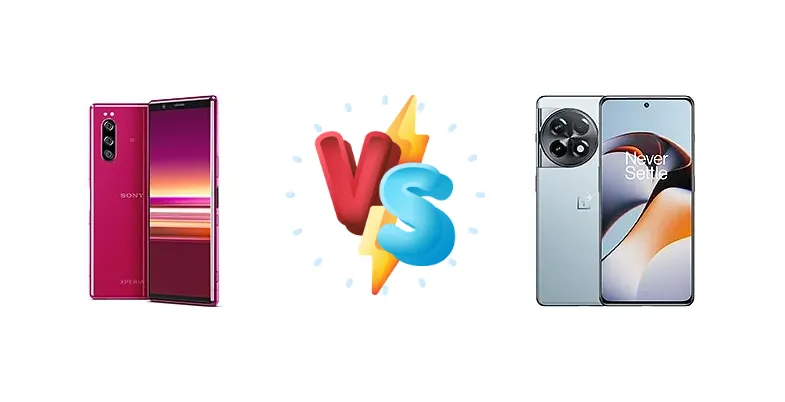
Sony Xperia 5 vs OnePlus 11R: A Detailed Comparison of Performance and Value
| Phones Images | |||||
|---|---|---|---|---|---|
|
🏆 Quick Verdict
For most users, the OnePlus 11R emerges as the superior choice. Its Snapdragon 8+ Gen 1 chipset offers significantly faster performance than the Xperia 5’s Snapdragon 855, and the 100W charging is a game-changer. While the Xperia 5 boasts excellent battery endurance, the 11R’s speed and charging capabilities provide a more modern experience.
| PHONES | ||
|---|---|---|
| Phone Names | Sony Xperia 5 | OnePlus 11R |
| Network | ||
|---|---|---|
| 2G bands | GSM 850 / 900 / 1800 / 1900 | GSM 850 / 900 / 1800 / 1900 |
| 3G bands | HSDPA 800 / 850 / 900 / 1700(AWS) / 1900 / 2100 | HSDPA 850 / 900 / 1700(AWS) / 2100 |
| 4G bands | 1, 2, 3, 4, 5, 7, 8, 12, 13, 17, 19, 20, 25, 26, 28, 29, 32, 34, 38, 39, 40, 41, 46, 66 | 1, 3, 4, 5, 8, 28, 34, 38, 39, 40, 41 |
| 5G bands | - | 1, 3, 5, 8, 28, 40, 41, 77, 78 SA/NSA |
| Speed | HSPA 42.2/5.76 Mbps, LTE Cat19 1600/150 Mbps | HSPA, LTE (3CA), 5G |
| Technology | GSM / HSPA / LTE | GSM / CDMA / HSPA / LTE / 5G |
| - | CDMA 800 | |
| Launch | ||
|---|---|---|
| Announced | 2019, September 05. Released 2019, October 05 | 2023, February 07 |
| Status | Discontinued | Available. Released 2023, February 21 |
| Body | ||
|---|---|---|
| Build | Glass front (Gorilla Glass 6), glass back (Gorilla Glass 6), aluminum frame | Glass front, glass back (Gorilla Glass 5), plastic frame |
| Dimensions | 158 x 68 x 8.2 mm (6.22 x 2.68 x 0.32 in) | 163.4 x 74.3 x 8.7 mm (6.43 x 2.93 x 0.34 in) |
| SIM | · Nano-SIM· Nano-SIM + Nano-SIM | Nano-SIM + Nano-SIM |
| Weight | 164 g (5.78 oz) | 204 g (7.20 oz) |
| IP65/IP68 dust/water resistant (up to 1.5m for 30 mins) | - | |
| Display | ||
|---|---|---|
| Protection | Corning Gorilla Glass 6 | - |
| Resolution | 1080 x 2520 pixels, 21:9 ratio (~449 ppi density) | 1240 x 2772 pixels, 20:9 ratio (~451 ppi density) |
| Size | 6.1 inches, 86.9 cm2 (~80.9% screen-to-body ratio) | 6.74 inches, 109.2 cm2 (~90.0% screen-to-body ratio) |
| Type | OLED, HDR BT.2020 | Fluid AMOLED, 1B colors, 120Hz, HDR10+, 1450 nits (peak) |
| Triluminos display X-Reality Engine | - | |
| Platform | ||
|---|---|---|
| CPU | Octa-core (1x2.84 GHz Kryo 485 & 3x2.42 GHz Kryo 485 & 4x1.78 GHz Kryo 485) | Octa-core (1x3.0 GHz Cortex-X2 & 3x2.5 GHz Cortex-A710 & 4x1.80 GHz Cortex-A510) |
| Chipset | Qualcomm SM8150 Snapdragon 855 (7 nm) | Qualcomm SM8475 Snapdragon 8+ Gen 1 (4 nm) |
| GPU | Adreno 640 | Adreno 730 |
| OS | Android 9.0 (Pie), upgradable to Android 11 | Android 13, upgradable to Android 15, OxygenOS 15 |
| Memory | ||
|---|---|---|
| Card slot | microSDXC (uses shared SIM slot) | No |
| Internal | 128GB 6GB RAM | 128GB 8GB RAM, 256GB 16GB RAM, 512GB 18GB RAM |
| UFS 2.1 | UFS 3.1 | |
| Main Camera | ||
|---|---|---|
| Features | Color spectrum sensor, LED flash, panorama, HDR, eye tracking | Color spectrum sensor, LED flash, HDR, panorama |
| Single | - | 16 MP, f/2.4, 24mm (wide), 1/3.09", 1.0µm |
| Triple | 12 MP, f/1.6, 26mm (wide), 1/2.55", 1.4µm, predictive dual pixel PDAF, 5-axis OIS 12 MP, f/2.4, 52mm (telephoto), 1/3.4", 1.0µm, predictive PDAF, 2x optical zoom, 5-axis OIS 12 MP, f/2.4, 16mm (ultrawide), 1/3.4", 1.0µm | 50 MP, f/1.8, 24mm (wide), 1/1.56", 1.0µm, multi-directional PDAF, OIS 8 MP, f/2.2, 120˚ (ultrawide), 1/4.0", 1.12µm 2 MP (macro) |
| Video | 4K@24/30fps HDR, 1080p@60fps, 1080p@30fps (5-axis gyro-EIS) | 4K@30/60fps, 1080p@30/60/240fps, gyro-EIS |
| Selfie camera | ||
|---|---|---|
| Features | HDR | HDR |
| Single | 8 MP, f/2.0, 24mm (wide), 1/4.0", 1.12µm | 16 MP, f/2.4, 24mm (wide), 1/3.09", 1.0µm |
| Video | 1080p@30fps (5-axis gyro-EIS) | 1080p@30fps |
| Sound | ||
|---|---|---|
| 3.5mm jack | No | No |
| 35mm jack | No | No |
| Loudspeaker | Yes, with stereo speakers | Yes, with stereo speakers |
| 24-bit/192kHz audio Dynamic vibration system | 24-bit/192kHz audio | |
| Comms | ||
|---|---|---|
| Bluetooth | 5.0, A2DP, aptX HD, LE | 5.3, A2DP, LE, aptX HD |
| Infrared port | - | Yes |
| NFC | Yes | Yes |
| Positioning | GPS, GLONASS, BDS, GALILEO | GPS (L1+L5), GLONASS (G1), BDS (B1I+B1c+B2a), GALILEO (E1+E5a), QZSS (L1+L5) |
| Radio | No | No |
| USB | USB Type-C 3.1, OTG | USB Type-C 2.0 |
| WLAN | Wi-Fi 802.11 a/b/g/n/ac, dual-band, Wi-Fi Direct, DLNA | Wi-Fi 802.11 a/b/g/n/ac/6, dual-band |
| Features | ||
|---|---|---|
| Sensors | Fingerprint (side-mounted), accelerometer, gyro, proximity, barometer, compass | Fingerprint (under display, optical), accelerometer, gyro, proximity, compass |
| Battery | ||
|---|---|---|
| Charging | 18W wired, PD2.0 | 100W wired |
| Type | Li-Ion 3140 mAh, non-removable | Li-Po 5000 mAh |
| Misc | ||
|---|---|---|
| Colors | Blue, Red, Black, Grey | Galactic Silver, Sonic Black, Solar Red |
| Models | J8210, J8270, J9210, SOV41, SO-01M | CPH2487 |
| Price | About 500 EUR | About 600 EUR |
| SAR | - | 1.16 W/kg (head) 0.61 W/kg (body) |
| Pricing | ||
|---|---|---|
| 128GB 6GB RAM | $ 409.99 | - |
| RENEWED | $ 674.00 | - |
| Tests | ||
|---|---|---|
| Audio quality | Noise -93.0dB / Crosstalk -89.4dB | - |
| Battery life | Endurance rating 96h | - |
| Display | Contrast ratio: Infinite (nominal) | - |
| Loudspeaker | -27.1 LUFS (Good) | - |
| Performance | AnTuTu: 334809 (v7), 416601 (v8) GeekBench: 10941 (v4.4), 2825 (v5.1) GFXBench: 33fps (ES 3.1 onscreen) | - |
Sony Xperia 5
- Exceptional battery endurance (96h rating)
- Compact and pocketable design
- Potentially superior color accuracy (based on Sony's reputation)
- Outdated Snapdragon 855 chipset
- Slow 18W charging
- Limited RAM (6GB)
OnePlus 11R
- Powerful Snapdragon 8+ Gen 1 chipset
- Ultra-fast 100W charging
- Likely superior gaming performance
- Battery capacity unknown
- Potentially larger and less portable
- Camera specifications not fully available
Display Comparison
The Sony Xperia 5 features a display capable of reaching 630 nits of peak brightness, which is adequate for outdoor visibility but falls short of modern standards. The OnePlus 11R’s display specifications are not provided, but given its market positioning, it likely offers comparable or slightly higher brightness. Both displays have an 'Infinite' (nominal) contrast ratio, typical of OLED panels. The Xperia 5’s smaller 6.1-inch screen contributes to its compact design, while the 11R likely has a larger display, catering to media consumption. Without PWM frequency data for either, it's difficult to assess flicker-related eye strain potential.
Camera Comparison
Detailed camera specifications for the Xperia 5 are unavailable beyond the presence of a camera system. The OnePlus 11R’s camera details are also missing. However, given the Xperia 5’s brand reputation, it likely prioritizes image quality and color accuracy. The 8+ Gen 1’s image signal processor (ISP) in the 11R should offer faster processing and improved noise reduction. Without sensor size or aperture information, a direct comparison is difficult, but the newer chipset generally translates to better computational photography capabilities.
Performance
The core difference lies in the chipsets. The OnePlus 11R’s Snapdragon 8+ Gen 1 (4nm) represents a substantial leap over the Sony Xperia 5’s Snapdragon 855 (7nm). The 8+ Gen 1’s newer architecture, built on a smaller process node, delivers significantly improved performance and power efficiency. The 11R’s CPU configuration – a Cortex-X2 prime core alongside Cortex-A710 and A510 cores – provides a more balanced and powerful processing experience than the Xperia 5’s Kryo 485 setup. While the Xperia 5’s 6GB of RAM is sufficient for basic multitasking, the 11R likely benefits from faster RAM speeds (LPDDR5x is probable), further enhancing responsiveness. The 8+ Gen 1’s Adreno GPU also offers a considerable advantage in graphics performance.
Battery Life
The Sony Xperia 5 boasts an impressive 96-hour endurance rating, indicating exceptional battery life. However, its 18W wired charging with PD2.0 is slow by today’s standards. The OnePlus 11R’s 100W wired charging is a massive advantage, allowing for a full charge in a fraction of the time. While the 11R’s battery capacity isn’t specified, the faster charging mitigates concerns about potentially lower capacity. The 4nm process of the Snapdragon 8+ Gen 1 also contributes to better power efficiency, potentially offsetting the Xperia 5’s endurance advantage in certain usage scenarios.
Buying Guide
Buy the Sony Xperia 5 if you prioritize a compact, pocketable design and exceptional battery life above all else, and are comfortable with a less powerful processor. Buy the OnePlus 11R if you demand faster performance for gaming and demanding applications, and value incredibly fast charging speeds – even if it means sacrificing some portability and battery endurance.