
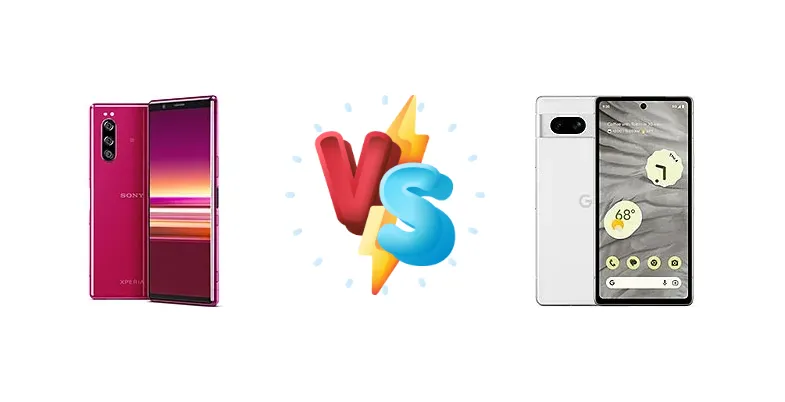
Sony Xperia 5 vs. Google Pixel 7a: A Detailed Comparison of Compact Power and AI Photography
| Phones Images | |||||
|---|---|---|---|---|---|
|
🏆 Quick Verdict
For most users, the Google Pixel 7a emerges as the better buy. Its significantly brighter display, more modern Tensor G2 chipset, and superior camera processing outweigh the Xperia 5’s endurance rating and slightly more compact form factor. However, the Xperia 5 remains a viable option for those prioritizing battery longevity and a traditional flagship feel.
| PHONES | ||
|---|---|---|
| Phone Names | Sony Xperia 5 | Google Pixel 7a |
| Network | ||
|---|---|---|
| 2G bands | GSM 850 / 900 / 1800 / 1900 | GSM 850 / 900 / 1800 / 1900 |
| 3G bands | HSDPA 800 / 850 / 900 / 1700(AWS) / 1900 / 2100 | HSDPA 800 / 850 / 900 / 1700(AWS) / 1900 / 2100 |
| 4G bands | 1, 2, 3, 4, 5, 7, 8, 12, 13, 17, 19, 20, 25, 26, 28, 29, 32, 34, 38, 39, 40, 41, 46, 66 | 1, 2, 3, 4, 5, 7, 8, 12, 13, 14, 17, 20, 25, 26, 28, 29, 30, 38, 40, 41, 48, 66, 71 - GWKK3, G0DZQ |
| 5G bands | - | 1, 2, 3, 5, 7, 8, 12, 14, 20, 25, 28, 30, 38, 41, 48, 66, 71, 77, 78 SA/NSA/Sub6 - GWKK3 |
| Speed | HSPA 42.2/5.76 Mbps, LTE Cat19 1600/150 Mbps | HSPA, LTE, 5G |
| Technology | GSM / HSPA / LTE | GSM / HSPA / LTE / 5G |
| - | 1, 2, 3, 5, 7, 8, 12, 20, 25, 28, 38, 40, 41, 66, 75, 76, 77, 78, 79 SA/NSA/Sub6 - GHL1X, G82U8 | |
| Launch | ||
|---|---|---|
| Announced | 2019, September 05. Released 2019, October 05 | 2023, May 10 |
| Status | Discontinued | Available. Released 2023, May 10 |
| Body | ||
|---|---|---|
| Build | Glass front (Gorilla Glass 6), glass back (Gorilla Glass 6), aluminum frame | Glass front (Gorilla Glass 3), aluminum frame, plastic back |
| Dimensions | 158 x 68 x 8.2 mm (6.22 x 2.68 x 0.32 in) | 152 x 72.9 x 9 mm (5.98 x 2.87 x 0.35 in) |
| SIM | · Nano-SIM· Nano-SIM + Nano-SIM | Nano-SIM + eSIM |
| Weight | 164 g (5.78 oz) | 193.5 g (6.84 oz) |
| IP65/IP68 dust/water resistant (up to 1.5m for 30 mins) | IP67 dust/water resistant (up to 1m for 30 min) | |
| Display | ||
|---|---|---|
| Protection | Corning Gorilla Glass 6 | Corning Gorilla Glass 3 |
| Resolution | 1080 x 2520 pixels, 21:9 ratio (~449 ppi density) | 1080 x 2400 pixels, 20:9 ratio (~429 ppi density) |
| Size | 6.1 inches, 86.9 cm2 (~80.9% screen-to-body ratio) | 6.1 inches, 90.7 cm2 (~81.8% screen-to-body ratio) |
| Type | OLED, HDR BT.2020 | OLED, HDR, 90Hz |
| Triluminos display X-Reality Engine | Always-on display | |
| Platform | ||
|---|---|---|
| CPU | Octa-core (1x2.84 GHz Kryo 485 & 3x2.42 GHz Kryo 485 & 4x1.78 GHz Kryo 485) | Octa-core (2x2.85 GHz Cortex-X1 & 2x2.35 GHz Cortex-A78 & 4x1.80 GHz Cortex-A55) |
| Chipset | Qualcomm SM8150 Snapdragon 855 (7 nm) | Google Tensor G2 (5 nm) |
| GPU | Adreno 640 | Mali-G710 MP7 |
| OS | Android 9.0 (Pie), upgradable to Android 11 | Android 13, upgradable to Android 15, up to 5 major Android upgrades |
| Memory | ||
|---|---|---|
| Card slot | microSDXC (uses shared SIM slot) | No |
| Internal | 128GB 6GB RAM | 128GB 8GB RAM |
| UFS 2.1 | UFS 3.1 | |
| Main Camera | ||
|---|---|---|
| Dual | - | 64 MP, f/1.9, 26mm (wide), 1/1.73", 0.8µm, dual pixel PDAF, OIS 13 MP, f/2.2, 120˚ (ultrawide), 1.12µm |
| Features | Color spectrum sensor, LED flash, panorama, HDR, eye tracking | Dual-LED flash, Pixel Shift, Auto-HDR, panorama |
| Triple | 12 MP, f/1.6, 26mm (wide), 1/2.55", 1.4µm, predictive dual pixel PDAF, 5-axis OIS 12 MP, f/2.4, 52mm (telephoto), 1/3.4", 1.0µm, predictive PDAF, 2x optical zoom, 5-axis OIS 12 MP, f/2.4, 16mm (ultrawide), 1/3.4", 1.0µm | - |
| Video | 4K@24/30fps HDR, 1080p@60fps, 1080p@30fps (5-axis gyro-EIS) | 4K@30/60fps, 1080p@30/60/120/240fps, OIS |
| Selfie camera | ||
|---|---|---|
| Features | HDR | HDR, panorama |
| Single | 8 MP, f/2.0, 24mm (wide), 1/4.0", 1.12µm | 13 MP, f/2.2, 20mm (ultrawide), 1.12µm |
| Video | 1080p@30fps (5-axis gyro-EIS) | 4K@30fps, 1080p@30fps |
| Sound | ||
|---|---|---|
| 3.5mm jack | No | No |
| 35mm jack | No | No |
| Loudspeaker | Yes, with stereo speakers | Yes, with stereo speakers |
| 24-bit/192kHz audio Dynamic vibration system | - | |
| Comms | ||
|---|---|---|
| Bluetooth | 5.0, A2DP, aptX HD, LE | 5.3, A2DP, LE |
| NFC | Yes | Yes |
| Positioning | GPS, GLONASS, BDS, GALILEO | GPS, GLONASS, GALILEO, BDS, QZSS, NavIC |
| Radio | No | No |
| USB | USB Type-C 3.1, OTG | USB Type-C 3.2 |
| WLAN | Wi-Fi 802.11 a/b/g/n/ac, dual-band, Wi-Fi Direct, DLNA | Wi-Fi 802.11 a/b/g/n/ac/6e, tri-band |
| Features | ||
|---|---|---|
| Sensors | Fingerprint (side-mounted), accelerometer, gyro, proximity, barometer, compass | Fingerprint (under display, optical), accelerometer, gyro, proximity, compass, barometer |
| Battery | ||
|---|---|---|
| Charging | 18W wired, PD2.0 | 18W wired, PD3.0 7.5W wireless |
| Type | Li-Ion 3140 mAh, non-removable | Li-Po 4385 mAh |
| Misc | ||
|---|---|---|
| Colors | Blue, Red, Black, Grey | Charcoal, Snow, Sea, Coral |
| Models | J8210, J8270, J9210, SOV41, SO-01M | GWKK3, GHL1X, G0DZQ, G82U8 |
| Price | About 500 EUR | € 179.90 / $ 150.00 / £ 170.00 / ₹ 25,980 |
| Pricing | ||
|---|---|---|
| 128GB 6GB RAM | $ 409.99 | - |
| RENEWED | $ 674.00 | - |
| Tests | ||
|---|---|---|
| Audio quality | Noise -93.0dB / Crosstalk -89.4dB | - |
| Battery life | Endurance rating 96h | - |
| Display | Contrast ratio: Infinite (nominal) | - |
| Loudspeaker | -27.1 LUFS (Good) | - |
| Performance | AnTuTu: 334809 (v7), 416601 (v8) GeekBench: 10941 (v4.4), 2825 (v5.1) GFXBench: 33fps (ES 3.1 onscreen) | - |
Sony Xperia 5
- Exceptional battery endurance (96h rating)
- Compact and comfortable form factor
- Dedicated shutter button for photography
- Dimmer display compared to Pixel 7a
- Older Snapdragon 855 chipset
- Less advanced camera processing
Google Pixel 7a
- Significantly brighter and more vibrant display
- Powerful and efficient Google Tensor G2 chipset
- Superior camera performance with AI enhancements
- Wireless charging support
- Shorter battery endurance (76h rating)
- Larger footprint than Xperia 5
- May experience more software bloat over time
Display Comparison
The Pixel 7a boasts a considerable advantage in display technology, achieving a measured peak brightness of 1070 nits compared to the Xperia 5’s 630 nits. This translates to significantly better outdoor visibility. While both displays have an infinite (nominal) contrast ratio, the Pixel 7a’s higher brightness makes a tangible difference in real-world usage. The Xperia 5’s display, while still capable, feels dated in comparison, particularly for media consumption in bright environments. We lack PWM frequency data for both, but the Pixel 7a’s OLED panel is generally known for efficient power usage.
Camera Comparison
The Pixel 7a’s camera system is where it truly shines. While specific sensor sizes aren’t provided, Google’s computational photography prowess elevates image quality significantly. The Tensor G2’s image signal processor (ISP) excels at noise reduction, dynamic range optimization, and detail preservation. The Pixel 7a’s video capabilities are also superior, benefiting from Google’s advanced stabilization and processing algorithms. The Xperia 5, while capable, relies more on hardware and less on software trickery, resulting in images that may appear less polished in challenging lighting conditions. The absence of detailed camera specs for the Xperia 5 makes a direct sensor comparison difficult, but the Pixel 7a’s software advantage is undeniable.
Performance
The chipset difference is substantial. The Pixel 7a’s Google Tensor G2 (5nm) represents a significant leap in efficiency and processing power over the Xperia 5’s Qualcomm Snapdragon 855 (7nm). While both CPUs are octa-core, the Tensor G2’s Cortex-X1 prime core provides a noticeable performance boost in demanding tasks. The 5nm fabrication process of the Tensor G2 also contributes to better thermal management, potentially reducing throttling during extended gaming sessions. The Xperia 5’s 6GB of RAM is matched by the Pixel 7a, but the Tensor G2’s architecture is optimized for Google’s AI and machine learning features, offering a smoother and more responsive user experience.
Battery Life
The Xperia 5’s endurance rating of 96 hours is impressive, exceeding the Pixel 7a’s 76 hours. However, this doesn’t tell the whole story. The Pixel 7a’s more efficient chipset and software optimization partially offset the smaller battery capacity. Both phones support 18W wired charging with PD standards (PD2.0 for Xperia 5, PD3.0 for Pixel 7a), but the Pixel 7a adds 7.5W wireless charging, offering added convenience. The Xperia 5’s longer endurance is beneficial for users who prioritize minimizing charging frequency, but the Pixel 7a’s faster charging and wireless capabilities provide more flexibility.
Buying Guide
Buy the Sony Xperia 5 if you prioritize exceptional battery life, a more traditional flagship form factor, and value a dedicated shutter button for photography. Buy the Google Pixel 7a if you prefer a brighter, more vibrant display, cutting-edge AI-powered camera features, and a more streamlined software experience with guaranteed updates.