
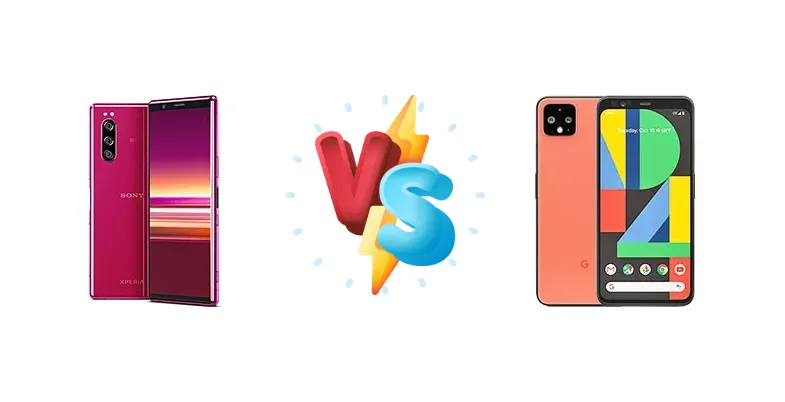
Sony Xperia 5 vs Google Pixel 4: A Head-to-Head Showdown
| Phones Images | |||||
|---|---|---|---|---|---|
|
🏆 Quick Verdict
The Xperia 5 takes the crown for battery life and display brightness, while the Pixel 4 boasts a superior camera experience and cleaner software. Ultimately, the best choice depends on your priorities: photography and software simplicity favor the Pixel 4, while power users and those valuing battery life will appreciate the Xperia 5.
| PHONES | ||
|---|---|---|
| Phone Names | Sony Xperia 5 | Google Pixel 4 |
| Network | ||
|---|---|---|
| 2G bands | GSM 850 / 900 / 1800 / 1900 | GSM 850 / 900 / 1800 / 1900 |
| 3G bands | HSDPA 800 / 850 / 900 / 1700(AWS) / 1900 / 2100 | HSDPA 850 / 900 / 1700(AWS) / 1900 / 2100 |
| 4G bands | 1, 2, 3, 4, 5, 7, 8, 12, 13, 17, 19, 20, 25, 26, 28, 29, 32, 34, 38, 39, 40, 41, 46, 66 | 1, 2, 3, 4, 5, 7, 8, 12, 13, 17, 20, 25, 26, 28, 32, 38, 39, 40, 41, 66, 71 - Global |
| Speed | HSPA 42.2/5.76 Mbps, LTE Cat19 1600/150 Mbps | HSPA 42.2/5.76 Mbps, LTE (5CA) Cat18 1200/150 Mbps |
| Technology | GSM / HSPA / LTE | GSM / CDMA / HSPA / EVDO / LTE |
| - | 1, 2, 3, 4, 5, 7, 8, 12, 13, 14, 17, 18, 19, 20, 25, 26, 28, 29, 30, 38, 39, 40, 41, 46, 48, 66, 71 - USA | |
| Launch | ||
|---|---|---|
| Announced | 2019, September 05. Released 2019, October 05 | 2019, October 15 |
| Status | Discontinued | Available. Released 2019, October 22 |
| Body | ||
|---|---|---|
| Build | Glass front (Gorilla Glass 6), glass back (Gorilla Glass 6), aluminum frame | Glass front (Gorilla Glass 5), glass back (Gorilla Glass 5), aluminum frame |
| Dimensions | 158 x 68 x 8.2 mm (6.22 x 2.68 x 0.32 in) | 147.1 x 68.8 x 8.2 mm (5.79 x 2.71 x 0.32 in) |
| SIM | · Nano-SIM· Nano-SIM + Nano-SIM | Nano-SIM + eSIM |
| Weight | 164 g (5.78 oz) | 162 g (5.71 oz) |
| IP65/IP68 dust/water resistant (up to 1.5m for 30 mins) | IP68 dust/water resistant (up to 1.5m for 30 min) | |
| Display | ||
|---|---|---|
| Protection | Corning Gorilla Glass 6 | Corning Gorilla Glass 5 |
| Resolution | 1080 x 2520 pixels, 21:9 ratio (~449 ppi density) | 1080 x 2280 pixels, 19:9 ratio (~444 ppi density) |
| Size | 6.1 inches, 86.9 cm2 (~80.9% screen-to-body ratio) | 5.7 inches, 80.7 cm2 (~79.8% screen-to-body ratio) |
| Type | OLED, HDR BT.2020 | P-OLED, 90Hz, HDR |
| Triluminos display X-Reality Engine | Always-on display | |
| Platform | ||
|---|---|---|
| CPU | Octa-core (1x2.84 GHz Kryo 485 & 3x2.42 GHz Kryo 485 & 4x1.78 GHz Kryo 485) | Octa-core (1x2.84 GHz Kryo 485 & 3x2.42 GHz Kryo 485 & 4x1.78 GHz Kryo 485) |
| Chipset | Qualcomm SM8150 Snapdragon 855 (7 nm) | Qualcomm SM8150 Snapdragon 855 (7 nm) |
| GPU | Adreno 640 | Adreno 640 |
| OS | Android 9.0 (Pie), upgradable to Android 11 | Android 10, upgradable to Android 13 |
| Memory | ||
|---|---|---|
| Card slot | microSDXC (uses shared SIM slot) | No |
| Internal | 128GB 6GB RAM | 64GB 6GB RAM, 128GB 6GB RAM |
| UFS 2.1 | UFS 2.1 | |
| Main Camera | ||
|---|---|---|
| Dual | - | 12.2 MP, f/1.7, 27mm (wide), 1/2.55", 1.4µm, dual pixel PDAF, OIS 16 MP, f/2.4, 50mm (telephoto), 1/3.6", 1.0µm, PDAF, OIS, 2x optical zoom |
| Features | Color spectrum sensor, LED flash, panorama, HDR, eye tracking | Dual-LED flash, Pixel Shift, Auto-HDR, panorama |
| Triple | 12 MP, f/1.6, 26mm (wide), 1/2.55", 1.4µm, predictive dual pixel PDAF, 5-axis OIS 12 MP, f/2.4, 52mm (telephoto), 1/3.4", 1.0µm, predictive PDAF, 2x optical zoom, 5-axis OIS 12 MP, f/2.4, 16mm (ultrawide), 1/3.4", 1.0µm | - |
| Video | 4K@24/30fps HDR, 1080p@60fps, 1080p@30fps (5-axis gyro-EIS) | 4K@30fps, 1080p@30/60/120fps, 1080p@30fps (gyro-EIS) |
| Selfie camera | ||
|---|---|---|
| Features | HDR | HDR |
| Single | 8 MP, f/2.0, 24mm (wide), 1/4.0", 1.12µm | 8 MP, f/2.0, 22mm (wide), 1.22µm, no AF TOF 3D, (depth/biometrics sensor) |
| Video | 1080p@30fps (5-axis gyro-EIS) | 1080p@30fps |
| Sound | ||
|---|---|---|
| 3.5mm jack | No | No |
| 35mm jack | No | No |
| Loudspeaker | Yes, with stereo speakers | Yes, with stereo speakers |
| 24-bit/192kHz audio Dynamic vibration system | - | |
| Comms | ||
|---|---|---|
| Bluetooth | 5.0, A2DP, aptX HD, LE | 5.0, A2DP, LE, aptX HD |
| NFC | Yes | Yes |
| Positioning | GPS, GLONASS, BDS, GALILEO | GPS, GLONASS, BDS, GALILEO |
| Radio | No | No |
| USB | USB Type-C 3.1, OTG | USB Type-C 3.1 |
| WLAN | Wi-Fi 802.11 a/b/g/n/ac, dual-band, Wi-Fi Direct, DLNA | Wi-Fi 802.11 a/b/g/n/ac, dual-band, Wi-Fi Direct, DLNA |
| Features | ||
|---|---|---|
| Sensors | Fingerprint (side-mounted), accelerometer, gyro, proximity, barometer, compass | Face ID, accelerometer, gyro, proximity, compass, barometer |
| Battery | ||
|---|---|---|
| Charging | 18W wired, PD2.0 | 18W wired, PD2.0 Wireless |
| Type | Li-Ion 3140 mAh, non-removable | Li-Po 2800 mAh, non-removable |
| Misc | ||
|---|---|---|
| Colors | Blue, Red, Black, Grey | Clearly White, Just Black, Oh So Orange |
| Models | J8210, J8270, J9210, SOV41, SO-01M | G020M, G020I, GA01188-US, GA01187-US, GA01189-US, GA01191-US, GA01189-US |
| Price | About 500 EUR | About 200 EUR |
| Pricing | ||
|---|---|---|
| 128GB 6GB RAM | $ 409.99 | - |
| RENEWED | $ 674.00 | - |
| Tests | ||
|---|---|---|
| Audio quality | Noise -93.0dB / Crosstalk -89.4dB | Noise -71.5dB / Crosstalk -69.8dB |
| Battery life | Endurance rating 96h | Endurance rating 62h |
| Camera | - | Photo / Video |
| Display | Contrast ratio: Infinite (nominal) | Contrast ratio: Infinite (nominal) |
| Loudspeaker | -27.1 LUFS (Good) | Voice 79dB / Noise 71dB / Ring 83dB |
| Performance | AnTuTu: 334809 (v7), 416601 (v8) GeekBench: 10941 (v4.4), 2825 (v5.1) GFXBench: 33fps (ES 3.1 onscreen) | AnTuTu: 395351 (v8) GeekBench: 2542 (v5.1) GFXBench: 31fps (ES 3.1 onscreen) |
Sony Xperia 5
- Exceptional battery life
- Brighter display
- Versatile camera system
- Customizable Android experience
- Headphone jack
- Less refined camera processing than Pixel 4
- Design can feel a bit dated
- Slower software updates compared to Pixel
Google Pixel 4
- Superior camera quality (especially in low light)
- Clean and intuitive Android software
- Fast software updates (though less frequent now)
- Wireless charging
- Shorter battery life
- Lower display brightness
- No headphone jack
- Less customizable than Xperia 5
Display Comparison
The Xperia 5's display shines with a measured 630 nits of peak brightness, significantly outperforming the Pixel 4's 423 nits. Both offer excellent contrast ratios (infinite nominal), but the Xperia 5 provides a noticeably brighter and more vibrant viewing experience, especially outdoors. The Xperia 5 also has a slightly taller aspect ratio, which some users may prefer for media consumption.
Camera Comparison
This is where the Pixel 4 truly excels. Google's computational photography is renowned, delivering consistently excellent image quality, particularly in challenging lighting conditions. The Xperia 5 offers a versatile triple-lens setup, but its image processing isn't as refined as the Pixel 4's. The Pixel 4 also has features like Night Sight that the Xperia 5 lacks.
Performance
Both phones share the same Snapdragon 855 chipset and CPU configuration, meaning raw performance is largely comparable. Day-to-day tasks and most games will run smoothly on either device. However, the Pixel 4's software optimization might offer a slightly snappier feel in some scenarios, though this difference is minimal.
Battery Life
The Xperia 5 dominates in battery life, boasting an impressive endurance rating of 96 hours compared to the Pixel 4's 62 hours. This translates to significantly longer usage between charges, making the Xperia 5 a clear winner for those who prioritize longevity.
Buying Guide
The Sony Xperia 5 is ideal for users who prioritize long battery life, a bright display, and a more customizable Android experience. The Google Pixel 4 is a great fit for photography enthusiasts who value Google's software features, clean Android, and timely updates (though updates are now less frequent).