
Sony Xperia 5 vs. iPhone 14 Plus: A Detailed Comparison of Two Distinct Approaches
| Phones Images | |||||
|---|---|---|---|---|---|
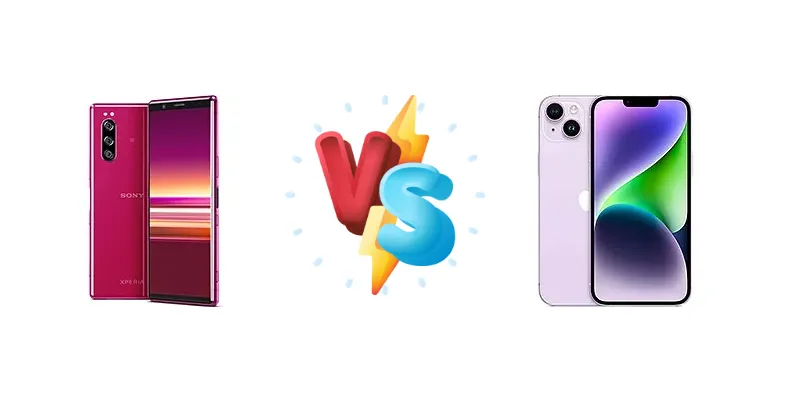
|
🏆 Quick Verdict
For the average user prioritizing battery life and a brighter display, the iPhone 14 Plus is the better choice. However, the Sony Xperia 5 offers a compelling value proposition for those seeking a more compact device with a focus on manual camera controls and a lower price point.
| PHONES | ||
|---|---|---|
| Phone Names | Sony Xperia 5 | Apple iPhone 14 Plus |
| Network | ||
|---|---|---|
| 2G bands | GSM 850 / 900 / 1800 / 1900 | GSM 850 / 900 / 1800 / 1900 |
| 3G bands | HSDPA 800 / 850 / 900 / 1700(AWS) / 1900 / 2100 | HSDPA 850 / 900 / 1700(AWS) / 1900 / 2100 |
| 4G bands | 1, 2, 3, 4, 5, 7, 8, 12, 13, 17, 19, 20, 25, 26, 28, 29, 32, 34, 38, 39, 40, 41, 46, 66 | 1, 2, 3, 4, 5, 7, 8, 12, 13, 17, 18, 19, 20, 25, 26, 28, 30, 32, 34, 38, 39, 40, 41, 42, 46, 48, 66 - A2886, A2888 |
| 5G bands | - | 1, 2, 3, 5, 7, 8, 12, 20, 25, 26, 28, 30, 38, 40, 41, 48, 66, 70, 77, 78, 79 SA/NSA/Sub6 - A2886, A2888 |
| Speed | HSPA 42.2/5.76 Mbps, LTE Cat19 1600/150 Mbps | HSPA, LTE, 5G, EV-DO Rev.A 3.1 Mbps |
| Technology | GSM / HSPA / LTE | GSM / CDMA / HSPA / EVDO / LTE / 5G |
| - | 1, 2, 3, 5, 7, 8, 12, 20, 25, 26, 28, 30, 38, 40, 41, 48, 66, 70, 77, 78, 79 SA/NSA/Sub6 - A2887 | |
| Launch | ||
|---|---|---|
| Announced | 2019, September 05. Released 2019, October 05 | 2022, September 07 |
| Status | Discontinued | Available. Released 2022, October 07 |
| Body | ||
|---|---|---|
| Build | Glass front (Gorilla Glass 6), glass back (Gorilla Glass 6), aluminum frame | Glass front, glass back, aluminum frame |
| Dimensions | 158 x 68 x 8.2 mm (6.22 x 2.68 x 0.32 in) | 160.8 x 78.1 x 7.8 mm (6.33 x 3.07 x 0.31 in) |
| SIM | · Nano-SIM· Nano-SIM + Nano-SIM | · Nano-SIM + eSIM + eSIM (max 2 at a time; International)· eSIM + eSIM (8 or more, max 2 at a time; USA)· Nano-SIM + Nano-SIM (China) |
| Weight | 164 g (5.78 oz) | 203 g (7.16 oz) |
| IP65/IP68 dust/water resistant (up to 1.5m for 30 mins) | IP68 dust/water resistant (up to 6m for 30 min) Apple Pay (Visa, MasterCard, AMEX certified) | |
| Display | ||
|---|---|---|
| Protection | Corning Gorilla Glass 6 | Ceramic Shield glass |
| Resolution | 1080 x 2520 pixels, 21:9 ratio (~449 ppi density) | 1284 x 2778 pixels, 19.5:9 ratio (~458 ppi density) |
| Size | 6.1 inches, 86.9 cm2 (~80.9% screen-to-body ratio) | 6.7 inches, 109.8 cm2 (~87.4% screen-to-body ratio) |
| Type | OLED, HDR BT.2020 | Super Retina XDR OLED, HDR10, Dolby Vision, 800 nits (HBM), 1200 nits (peak) |
| Triluminos display X-Reality Engine | - | |
| Platform | ||
|---|---|---|
| CPU | Octa-core (1x2.84 GHz Kryo 485 & 3x2.42 GHz Kryo 485 & 4x1.78 GHz Kryo 485) | Hexa-core (2x3.23 GHz Avalanche + 4x1.82 GHz Blizzard) |
| Chipset | Qualcomm SM8150 Snapdragon 855 (7 nm) | Apple A15 Bionic (5 nm) |
| GPU | Adreno 640 | Apple GPU (5-core graphics) |
| OS | Android 9.0 (Pie), upgradable to Android 11 | iOS 16, upgradable to iOS 26.1 |
| Memory | ||
|---|---|---|
| Card slot | microSDXC (uses shared SIM slot) | No |
| Internal | 128GB 6GB RAM | 128GB 6GB RAM, 256GB 6GB RAM, 512GB 6GB RAM |
| UFS 2.1 | NVMe | |
| Main Camera | ||
|---|---|---|
| Dual | - | 12 MP, f/1.5, 26mm (wide), 1/1.7", 1.9µm, dual pixel PDAF, sensor-shift OIS 12 MP, f/2.4, 13mm, 120˚ (ultrawide) |
| Features | Color spectrum sensor, LED flash, panorama, HDR, eye tracking | Dual-LED dual-tone flash, HDR (photo/panorama) |
| Single | - | 12 MP, f/1.9, 23mm (wide), 1/3.6", PDAF SL 3D, (depth/biometrics sensor) |
| Triple | 12 MP, f/1.6, 26mm (wide), 1/2.55", 1.4µm, predictive dual pixel PDAF, 5-axis OIS 12 MP, f/2.4, 52mm (telephoto), 1/3.4", 1.0µm, predictive PDAF, 2x optical zoom, 5-axis OIS 12 MP, f/2.4, 16mm (ultrawide), 1/3.4", 1.0µm | - |
| Video | 4K@24/30fps HDR, 1080p@60fps, 1080p@30fps (5-axis gyro-EIS) | 4K@24/25/30/60fps, 1080p@25/30/60/120/240fps, HDR, Dolby Vision HDR (up to 60fps), stereo sound rec. |
| Selfie camera | ||
|---|---|---|
| Features | HDR | HDR |
| Single | 8 MP, f/2.0, 24mm (wide), 1/4.0", 1.12µm | 12 MP, f/1.9, 23mm (wide), 1/3.6", 1.0µm, PDAF SL 3D, (depth/biometrics sensor) |
| Video | 1080p@30fps (5-axis gyro-EIS) | 4K@24/25/30/60fps, 1080p@25/30/60/120fps, gyro-EIS |
| Sound | ||
|---|---|---|
| 3.5mm jack | No | No |
| 35mm jack | No | No |
| Loudspeaker | Yes, with stereo speakers | Yes, with stereo speakers |
| 24-bit/192kHz audio Dynamic vibration system | - | |
| Comms | ||
|---|---|---|
| Bluetooth | 5.0, A2DP, aptX HD, LE | 5.3, A2DP, LE |
| NFC | Yes | Yes |
| Positioning | GPS, GLONASS, BDS, GALILEO | GPS, GLONASS, GALILEO, BDS, QZSS |
| Radio | No | No |
| USB | USB Type-C 3.1, OTG | Lightning, USB 2.0 |
| WLAN | Wi-Fi 802.11 a/b/g/n/ac, dual-band, Wi-Fi Direct, DLNA | Wi-Fi 802.11 a/b/g/n/ac/6, dual-band, hotspot |
| Features | ||
|---|---|---|
| Sensors | Fingerprint (side-mounted), accelerometer, gyro, proximity, barometer, compass | Face ID, accelerometer, gyro, proximity, compass, barometer |
| - | Ultra Wideband (UWB) support Emergency SOS via satellite (SMS sending/receiving) | |
| Battery | ||
|---|---|---|
| Charging | 18W wired, PD2.0 | Wired, PD2.0, 50% in 30 min 15W wireless (MagSafe) 15W wireless (Qi2) - requires iOS 17.2 update |
| Type | Li-Ion 3140 mAh, non-removable | Li-Ion 4323 mAh (16.68 Wh) |
| Misc | ||
|---|---|---|
| Colors | Blue, Red, Black, Grey | Midnight, Purple, Starlight, Blue, Red, Yellow |
| Models | J8210, J8270, J9210, SOV41, SO-01M | A2886, A2632, A2885, A2888, A2887, iphone14,8 |
| Price | About 500 EUR | € 391.58 / $ 329.97 / £ 335.00 |
| SAR | - | 1.14 W/kg (head) 1.15 W/kg (body) |
| SAR EU | - | 0.99 W/kg (head) 0.98 W/kg (body) |
| Pricing | ||
|---|---|---|
| 128GB 6GB RAM | $ 409.99 | - |
| RENEWED | $ 674.00 | - |
| Tests | ||
|---|---|---|
| Audio quality | Noise -93.0dB / Crosstalk -89.4dB | - |
| Battery life | Endurance rating 96h | Endurance rating 102h |
| Camera | - | Photo / Video |
| Display | Contrast ratio: Infinite (nominal) | Contrast ratio: Infinite (nominal) |
| Loudspeaker | -27.1 LUFS (Good) | -24.7 LUFS (Very good) |
| Performance | AnTuTu: 334809 (v7), 416601 (v8) GeekBench: 10941 (v4.4), 2825 (v5.1) GFXBench: 33fps (ES 3.1 onscreen) | AnTuTu: 797976 (v9) GeekBench: 4582 (v5.1) GFXBench: 60fps (ES 3.1 onscreen) |
Sony Xperia 5
- Compact and pocketable design
- Dedicated camera shutter button
- Manual camera controls for enthusiasts
- Significantly lower price point
- Older Snapdragon 855 chipset
- Slower charging speeds
- Less bright display
- Shorter battery life compared to iPhone 14 Plus
Apple iPhone 14 Plus
- Excellent battery life
- Bright and vibrant display
- Powerful A15 Bionic chip
- Seamless Apple ecosystem integration
- Larger and less pocketable design
- Higher price point
- Less manual control in camera app
- May be overkill for basic users
Display Comparison
The iPhone 14 Plus boasts a substantial advantage in display brightness, achieving a measured 797 nits compared to the Xperia 5’s 630 nits. This translates to significantly better visibility under direct sunlight. Both displays share an infinite (nominal) contrast ratio, typical of OLED panels. However, the Xperia 5’s smaller 6.1-inch screen offers a higher pixel density, potentially resulting in a sharper image, though the difference is likely subtle to the naked eye. The iPhone 14 Plus’s larger size is better suited for media consumption and multitasking, while the Xperia 5’s compact form factor enhances one-handed usability.
Camera Comparison
Both devices offer capable camera systems, but approach photography differently. The iPhone 14 Plus excels in computational photography, delivering consistently good results with minimal user input. While specific sensor details are not provided, Apple’s image processing pipeline is renowned for its natural-looking colors and excellent dynamic range. The Xperia 5, on the other hand, caters to photography enthusiasts with its manual controls and dedicated shutter button. While sensor sizes aren’t specified, the Xperia 5’s focus on manual control allows for greater creative flexibility. The iPhone 14 Plus’s video capabilities are also generally considered superior, benefiting from Apple’s advanced video stabilization and codecs.
Performance
The Apple A15 Bionic in the iPhone 14 Plus, fabricated on a 5nm process, demonstrably outperforms the Qualcomm Snapdragon 855 (7nm) found in the Xperia 5. The A15’s hexa-core architecture (2x3.23 GHz Avalanche + 4x1.82 GHz Blizzard) delivers superior single-core and multi-core performance. While the Xperia 5’s octa-core CPU is capable, it lags behind in raw processing power. The iPhone 14 Plus’s 6GB of RAM is comparable to the Xperia 5, but the A15’s memory controller and software optimization contribute to smoother multitasking and faster app loading times. The older Snapdragon 855 may show its age in demanding games and applications.
Battery Life
The iPhone 14 Plus edges out the Xperia 5 in battery endurance, achieving a rating of 102 hours versus 96 hours. This difference, while not massive, is noticeable in real-world usage. The iPhone 14 Plus supports 20W wired charging (50% in 30 minutes) and 15W wireless charging (MagSafe/Qi2), offering greater charging flexibility. The Xperia 5 is limited to 18W wired charging with PD2.0, resulting in slower charging speeds. The larger battery capacity of the iPhone 14 Plus, combined with the efficiency of the A15 Bionic chip, provides a significant advantage for users who heavily rely on their smartphones throughout the day.
Buying Guide
Buy the Sony Xperia 5 if you need a pocketable flagship with a dedicated camera shutter button, manual camera controls, and don't mind an older chipset. It's ideal for photography enthusiasts and those who prefer a smaller phone. Buy the Apple iPhone 14 Plus if you prioritize all-day battery life, a significantly brighter display for outdoor visibility, and seamless integration with the Apple ecosystem. It’s best for users who consume a lot of media and value simplicity.