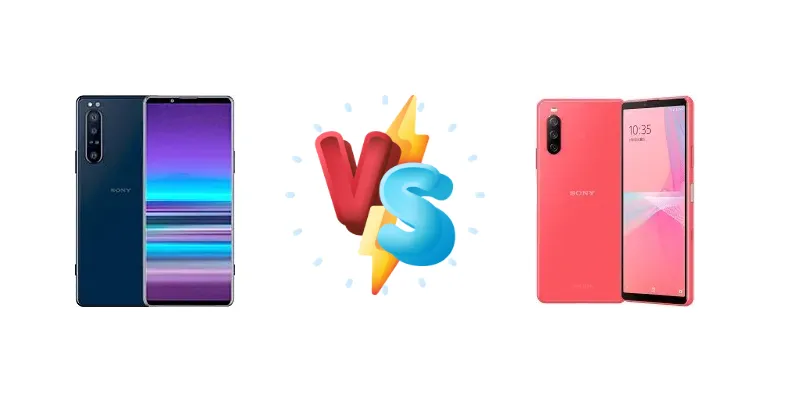
The Sony Xperia 5 Plus, released as a compact flagship, now faces competition from Sony’s own mid-range offering, the Xperia 10 III Lite. This comparison dissects the core differences between these two devices, focusing on the impact of their respective chipsets and feature sets on the user experience. We'll determine if the older flagship still holds value against a newer, more affordable 5G option.
🏆 Quick Verdict
For users prioritizing raw performance and a more refined experience, the Sony Xperia 5 Plus remains the superior choice, despite its age. However, the Xperia 10 III Lite offers a compelling package with faster charging and 5G connectivity at a significantly lower price point, making it ideal for budget-conscious consumers.
| Network |
|---|
| 2G bands | GSM 850 / 900 / 1800 / 1900 | GSM 850 / 900 / 1800 / 1900 |
| 3G bands | HSDPA 800 / 850 / 900 / 1700(AWS) / 1900 / 2100 | HSDPA 850 / 1900 |
| 4G bands | LTE | 1, 3, 4, 12, 18, 19, 38, 41 |
| 5G bands | SA/NSA | 77, 78 SA/NSA |
| Speed | HSPA, LTE, 5G (2+ Gbps DL) | HSPA, LTE, 5G |
| Technology | GSM / HSPA / LTE / 5G | GSM / HSPA / LTE / 5G |
| Launch |
|---|
| Announced | Not announced yet | 2021, August 20 |
| Status | Cancelled | Available. Released 2021, August 27 |
| Body |
|---|
| Build | Glass front (Gorilla Glass 6), glass back (Gorilla Glass 6), aluminum frame | Glass front (Gorilla Glass 6), glass back (Gorilla Glass 6), plastic frame |
| Dimensions | 168.2 x 71.6 x 8.1 mm (6.62 x 2.82 x 0.32 in) | 154 x 68 x 8.3 mm (6.06 x 2.68 x 0.33 in) |
| SIM | · Nano-SIM· Nano-SIM + Nano-SIM | Nano-SIM + eSIM |
| Weight | - | 169 g (5.96 oz) |
| | IP65/IP68 dust/water resistant (up to 1.5m for 30 mins) | - |
| Display |
|---|
| Protection | Corning Gorilla Glass 6 | Corning Gorilla Glass 6 |
| Resolution | 1080 x 2520 pixels, 21:9 ratio (~415 ppi density) | 1080 x 2520 pixels, 21:9 ratio (~457 ppi density) |
| Size | 6.6 inches, 101.8 cm2 (~84.5% screen-to-body ratio) | 6.0 inches, 84.1 cm2 (~80.3% screen-to-body ratio) |
| Type | OLED, HDR BT.2020 | OLED, 1B colors, HDR |
| | Triluminos display
X-Reality Engine | - |
| Platform |
|---|
| CPU | Octa-core (1x2.84 GHz Kryo 485 & 3x2.42 GHz Kryo 485 & 4x1.78 GHz Kryo 485) | Octa-core (2x2.0 GHz Kryo 560 Gold & 6x1.7 GHz Kryo 560 Silver) |
| Chipset | Qualcomm SM8150 Snapdragon 855 (7 nm) | Qualcomm SM6350 Snapdragon 690 5G (8 nm) |
| GPU | Adreno 640 | Adreno 619 |
| OS | Android 10 | Android 11 |
| Memory |
|---|
| Card slot | microSDXC (uses shared SIM slot) - dual SIM model only | microSDXC (uses shared SIM slot) |
| Internal | 128GB 6GB RAM, 256GB 8GB RAM | 64GB 6GB RAM |
| Main Camera |
|---|
| Features | Color spectrum sensor, LED flash, panorama, HDR, eye tracking | LED flash, HDR, panorama |
| Quad | 12 MP, (wide), 1/1.5", predictive dual pixel PDAF, 5-axis OIS
8 MP, (periscope telephoto), PDAF, OIS, 5x optical zoom
64 MP, f/1.7, (wide), 1/1.72", 0.8µm, PDAF, OIS
12 MP, 16mm (ultrawide), 1/3.4", 1.0µm
2 MP, TOF 3D, (depth) | - |
| Triple | - | 12 MP, f/1.8, 27mm (wide), 1/2.8", PDAF
8 MP, f/2.4, 54mm (telephoto), 1/4.0", PDAF, 2x optical zoom
8 MP, f/2.2, 16mm, 120˚ (ultrawide), 1/4.0" |
| Video | 4K@24/30/60fps HDR, 1080p@60fps, 1080p@30fps (5-axis gyro-EIS) | 4K@30fps, 1080p@30fps |
| Selfie camera |
|---|
| Features | HDR | HDR |
| Single | 8 MP, f/2.0, 24mm (wide), 1/4.0", 1.12µm | 8 MP, f/2.0, 24mm (wide), 1/4.0" |
| Video | 1080p@30fps (5-axis gyro-EIS) | 1080p@30fps |
| Sound |
|---|
| 3.5mm jack | Yes | Yes |
| 35mm jack | Yes | Yes |
| Loudspeaker | Yes, with stereo speakers | Yes |
| | 24-bit/192kHz audio
Dynamic vibration system | - |
| Comms |
|---|
| Bluetooth | 5.0, A2DP, aptX HD, LE | 5.1, A2DP, LE, aptX HD |
| NFC | Yes | Yes |
| Positioning | GPS, GLONASS, BDS, GALILEO | GPS, GLONASS, GALILEO, BDS, QZSS |
| Radio | No | No |
| USB | USB Type-C 3.1, OTG | USB Type-C 3.1, OTG, video output |
| WLAN | Wi-Fi 802.11 a/b/g/n/ac, dual-band, Wi-Fi Direct, DLNA | Wi-Fi 802.11 a/b/g/n/ac, dual-band, Wi-Fi Direct |
| Features |
|---|
| Sensors | Fingerprint (side-mounted), accelerometer, gyro, proximity, barometer, compass | Fingerprint (side-mounted), accelerometer, proximity, compass |
| Battery |
|---|
| Charging | 18W wired, PD2.0 | 30W wired, PD, QC |
| Type | Li-Ion 4000 mAh | Li-Po 4500 mAh |
| Misc |
|---|
| Colors | Blue, Red, Black, Grey | Black, White, Blue, Pink |
| Models | - | XQ-BT44 |
| Price | - | About 370 EUR |
Sony Xperia 5 Plus
- Superior processing power with Snapdragon 855
- Likely better camera performance
- Potentially higher quality display
- Slower charging speed (18W)
- Older chipset technology
- Likely higher price
Sony Xperia 10 III Lite
- Faster 30W charging with PD and QC
- 5G connectivity
- More affordable price
- Less powerful Snapdragon 690 processor
- Likely lower camera quality
- Potentially less refined display
Display Comparison
While both devices share Sony’s commitment to a 21:9 aspect ratio, detailed display specs are missing. However, given the Xperia 5 Plus’s flagship status, it likely features a higher peak brightness and potentially a more accurate color calibration than the 10 III Lite. The 10 III Lite’s display, while adequate, is likely tuned for efficiency rather than visual fidelity. Bezels are expected to be slightly slimmer on the 5 Plus, contributing to its more premium feel.
Camera Comparison
Detailed camera specs are unavailable, but the Xperia 5 Plus, as a flagship, likely features a larger main sensor and more sophisticated image processing algorithms. While the 10 III Lite benefits from Qualcomm’s image signal processor, the 855’s ISP in the 5 Plus is more powerful. The 5 Plus likely excels in low-light photography and offers more dynamic range. The presence of OIS (Optical Image Stabilization) is probable on the 5 Plus, further enhancing image quality. We can assume the 10 III Lite will have a more basic camera setup, focusing on practicality rather than advanced features.
Performance
The core difference lies in the chipsets. The Xperia 5 Plus boasts the Qualcomm Snapdragon 855 (7nm), an octa-core processor designed for flagship performance. Its Kryo 485 cores, clocked up to 2.84 GHz, deliver significantly more processing power than the Snapdragon 690 (8nm) in the Xperia 10 III Lite. The 690, with its Kryo 560 cores peaking at 2.0 GHz, prioritizes efficiency and 5G connectivity. This translates to smoother multitasking, faster app loading times, and superior gaming performance on the 5 Plus. The 8nm process node of the 690 is more efficient than the 7nm of the 855, but the architectural advantages of the 855 outweigh this.
Battery Life
Battery capacity is not specified, but the Xperia 10 III Lite’s 30W wired charging with PD and QC support is a significant advantage over the 5 Plus’s 18W PD2.0 charging. This means the 10 III Lite will charge considerably faster, minimizing downtime. While the 5 Plus might have a slightly larger battery, the 10 III Lite’s faster charging mitigates any potential capacity difference, offering a more convenient user experience.
Buying Guide
Buy the Sony Xperia 5 Plus if you need a phone capable of handling demanding tasks like video editing or graphically intensive games, and appreciate a more premium build quality. Buy the Sony Xperia 10 III Lite if you prioritize 5G connectivity, faster charging speeds, and a lower upfront cost, and your usage primarily revolves around everyday tasks and media consumption.
Frequently Asked Questions
❓ Will the Snapdragon 690 in the Xperia 10 III Lite struggle with demanding games like Genshin Impact?
The Snapdragon 690 is capable of running many games, but you'll likely need to lower graphics settings for a smooth experience in demanding titles like Genshin Impact. The Xperia 5 Plus, with its Snapdragon 855, will handle these games at higher settings without significant performance drops.
❓ Does the faster charging of the Xperia 10 III Lite compensate for a potentially smaller battery capacity?
Yes, the 30W charging on the 10 III Lite significantly reduces charging time. Even if the battery capacity is slightly smaller than the 5 Plus, you'll spend less time tethered to a charger, making it more convenient for daily use.
❓ Is the 5G connectivity of the Xperia 10 III Lite a significant advantage if I don't have 5G coverage in my area?
Currently, 5G coverage is still limited. However, purchasing the Xperia 10 III Lite future-proofs your device for when 5G becomes more widely available. It also supports 4G LTE, so you'll still get fast data speeds in areas without 5G.