
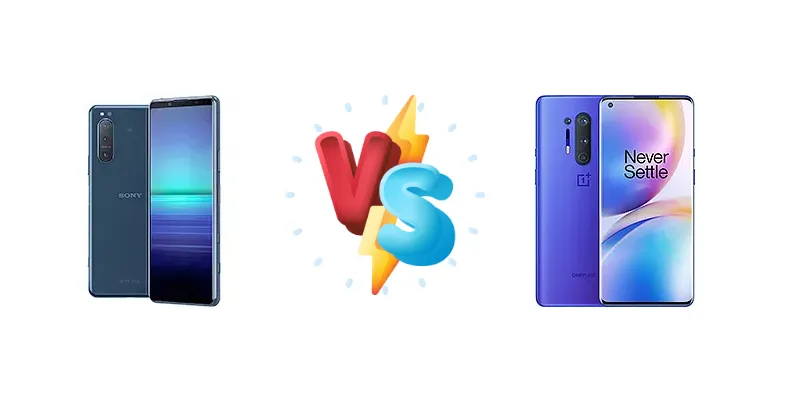
Sony Xperia 5 II vs OnePlus 8 Pro: A Deep Dive into Two 2020 Flagships
| Phones Images | |||||
|---|---|---|---|---|---|
|
🏆 Quick Verdict
For most users, the OnePlus 8 Pro emerges as the stronger choice. Its faster 30W wired and wireless charging, coupled with the availability of a larger 12GB/256GB configuration, provides a more convenient and future-proof experience. However, the Xperia 5 II remains compelling for those prioritizing a pocketable design.
| PHONES | ||
|---|---|---|
| Phone Names | Sony Xperia 5 II | OnePlus 8 Pro |
| Network | ||
|---|---|---|
| 2G bands | GSM 850 / 900 / 1800 / 1900 | GSM 850 / 900 / 1800 / 1900 |
| 3G bands | HSDPA 800 / 850 / 900 / 1700(AWS) / 1900 / 2100 | HSDPA 800 / 850 / 900 / 1700(AWS) / 1800 / 1900 / 2100 |
| 4G bands | 1, 2, 3, 4, 5, 7, 8, 12, 13, 17, 19, 20, 25, 26, 28, 29, 32, 34, 38, 39, 40, 41, 46, 48, 66 | 1, 2, 3, 4, 5, 7, 8, 12, 13, 17, 18, 19, 20, 25, 26, 28, 32, 34, 38, 39, 40, 41, 42, 46, 66 - EU |
| 5G bands | 1, 3, 8, 28, 77, 78 SA/NSA | 1, 3, 7, 28, 78 SA/NSA - EU |
| Speed | HSPA 42.2/5.76 Mbps, LTE Cat18 1200/150 Mbps, 5G | HSPA 42.2/5.76 Mbps, LTE (5CA) Cat18 1200/150 Mbps, 5G 7.5 Gbps DL |
| Technology | GSM / HSPA / LTE / 5G | GSM / CDMA / HSPA / LTE / 5G |
| - | 78 SA/NSA - IN | |
| Launch | ||
|---|---|---|
| Announced | 2020, September 17 | 2020, April 14 |
| Status | Available. Released 2020, October 12 | Available. Released 2020, April 21 |
| Body | ||
|---|---|---|
| Build | Glass front (Gorilla Glass 6), glass back (Gorilla Glass 6), aluminum frame | Glass front (Gorilla Glass 5), glass back (Gorilla Glass 5), aluminum frame |
| Dimensions | 158 x 68 x 8 mm (6.22 x 2.68 x 0.31 in) | 165.3 x 74.4 x 8.5 mm (6.51 x 2.93 x 0.33 in) |
| SIM | · Nano-SIM· Nano-SIM + Nano-SIM | Nano-SIM + Nano-SIM |
| Weight | 163 g (5.75 oz) | 199 g (7.02 oz) |
| IP65/IP68 dust/water resistant (up to 1.5m for 30 mins) | IP68 dust/water resistant | |
| Display | ||
|---|---|---|
| Protection | Corning Gorilla Glass 6 | Corning Gorilla Glass 5 |
| Resolution | 1080 x 2520 pixels, 21:9 ratio (~449 ppi density) | 1440 x 3168 pixels (~513 ppi density) |
| Size | 6.1 inches, 86.9 cm2 (~80.9% screen-to-body ratio) | 6.78 inches, 111.7 cm2 (~90.8% screen-to-body ratio) |
| Type | OLED, 120Hz, HDR BT.2020 | Fluid AMOLED, 1B colors, 120Hz, HDR10+ |
| Triluminos display X-Reality Engine | - | |
| Platform | ||
|---|---|---|
| CPU | Octa-core (1x2.84 GHz Cortex-A77 & 3x2.42 GHz Cortex-A77 & 4x1.80 GHz Cortex-A55) | Octa-core (1x2.84 GHz Cortex-A77 & 3x2.42 GHz Cortex-A77 & 4x1.80 GHz Cortex-A55) |
| Chipset | Qualcomm SM8250 Snapdragon 865 5G (7 nm+) | Qualcomm SM8250 Snapdragon 865 5G (7 nm+) |
| GPU | Adreno 650 | Adreno 650 |
| OS | Android 10, upgradable to Android 12 | Android 10, upgradable to Android 13, OxygenOS 13 |
| Memory | ||
|---|---|---|
| Card slot | microSDXC (uses shared SIM slot) | No |
| Internal | 128GB 8GB RAM, 256GB 8GB RAM | 128GB 8GB RAM, 256GB 12GB RAM |
| UFS 3.0 | UFS 3.0 | |
| Main Camera | ||
|---|---|---|
| Features | Zeiss optics, color spectrum sensor, LED flash, panorama, HDR, eye tracking | Laser AF, Dual-LED flash, HDR, panorama |
| Quad | - | 48 MP, f/1.8, 25mm (wide), 1/1.43", 1.12µm, multi-directional PDAF, OIS 8 MP, f/2.4, (telephoto), 1/1.0µm, PDAF, OIS, 3x optical zoom 48 MP, f/2.2, 14mm, 116˚ (ultrawide), 1/2.0", 0.8µm, PDAF 5 MP, f/2.4, (Color filter camera) |
| Triple | 12 MP, f/1.7, 24mm (wide), 1/1.7", 1.8µm, dual pixel PDAF, OIS 12 MP, f/2.4, 70mm (telephoto), 1/3.4", 1.0µm, PDAF, 3x optical zoom, OIS 12 MP, f/2.2, 124˚, 16mm (ultrawide), 1/2.55", dual pixel PDAF | - |
| Video | 4K@24/30/60/120fps HDR, 1080p, 5-axis gyro-EIS, OIS | 4K@30/60fps, 1080p@30/60/240fps, Auto HDR, gyro-EIS |
| Selfie camera | ||
|---|---|---|
| Features | HDR | HDR |
| Single | 8 MP, f/2.0, 24mm (wide), 1/4.0", 1.12µm | 16 MP, f/2.5, (wide), 1/3.06", 1.0µm |
| Video | 1080p@30fps, 5-axis gyro-EIS | 1080p@30fps, gyro-EIS |
| Sound | ||
|---|---|---|
| 3.5mm jack | Yes | No |
| 35mm jack | Yes | No |
| Loudspeaker | Yes, with stereo speakers | Yes, with stereo speakers |
| 24-bit/192kHz audio Dynamic vibration system | - | |
| Comms | ||
|---|---|---|
| Bluetooth | 5.1, A2DP, aptX HD, LE | 5.1, A2DP, LE, aptX HD |
| NFC | Yes | Yes |
| Positioning | GPS, GLONASS, BDS, GALILEO, QZSS | GPS (L1+L5), GLONASS (G1), BDS (B1), GALILEO (E1+E5a) |
| Radio | No | No |
| USB | USB Type-C 3.1, OTG | USB Type-C 3.1, OTG |
| WLAN | Wi-Fi 802.11 a/b/g/n/ac/6, dual-band, Wi-Fi Direct, DLNA | Wi-Fi 802.11 a/b/g/n/ac/6, dual-band, Wi-Fi Direct, DLNA |
| Features | ||
|---|---|---|
| Sensors | Fingerprint (side-mounted), accelerometer, gyro, proximity, barometer, compass | Fingerprint (under display, optical), accelerometer, gyro, proximity, compass |
| Battery | ||
|---|---|---|
| Charging | 21W wired, PD3.0, 50% in 30 min | 30W wired, 50% in 23 min 30W wireless, 50% in 30 min 3W reverse wireless |
| Type | Li-Ion 4000 mAh | Li-Po 4510 mAh, non-removable |
| Misc | ||
|---|---|---|
| Colors | Black, Grey, Blue, Pink | Glacial Green, Ultramarine Blue, Onyx Black |
| Models | SO-52A, XQ-AS52, XQ-AS62, XQ-AS72, A002SO, SOG02 | IN2023, IN2020, IN2021, IN2025 |
| Price | About 650 EUR | About 310 EUR |
| Pricing | ||
|---|---|---|
| 128GB 8GB RAM | $ 695.00 | $ 428.39 |
| 256GB 12GB RAM | - | $ 853.51 |
| RENEWED | £ 239.00 | $ 486.00 |
| Tests | ||
|---|---|---|
| Battery life | Endurance rating 102h | Endurance rating 103h |
| Camera | Photo / Video | Photo / Video |
| Display | Contrast ratio: Infinite (nominal) | Contrast ratio: Infinite (nominal) |
| Loudspeaker | -28.3 LUFS (Average) | -23.5 LUFS (Very good) |
| Performance | AnTuTu: 532655 (v8) GeekBench: 3301 (v5.1) GFXBench: 41fps (ES 3.1 onscreen) | AnTuTu: 573276 (v8) GeekBench: 3374 (v5.1) GFXBench: 24fps (ES 3.1 onscreen) |
Sony Xperia 5 II
- Compact and pocketable design
- Focused camera experience for video creators
- Excellent build quality
- Slower charging speeds
- Limited RAM (8GB)
- Smaller display
OnePlus 8 Pro
- Faster wired and wireless charging
- Larger, more immersive display
- More RAM and storage options
- Larger and less pocketable
- More expensive (depending on configuration)
- Software can be bloated
Display Comparison
Both the Sony Xperia 5 II and OnePlus 8 Pro feature displays with an 'Infinite' (nominal) contrast ratio, typical of OLED panels. However, the OnePlus 8 Pro’s larger 6.78-inch display offers a more expansive viewing experience. While both achieve a similar contrast, the Xperia 5 II’s 6.1-inch panel prioritizes compactness. The Xperia 5 II’s measured peak brightness of 600 nits is adequate, but the OnePlus 8 Pro, while not specified in the data, is likely to achieve higher peak brightness levels based on its market positioning and display technology, making it more visible in direct sunlight. Neither device specifies refresh rate, but the OnePlus 8 Pro was known for its 120Hz display, a significant advantage for smoother scrolling and gaming.
Camera Comparison
Both phones offer photo and video capabilities, but their approaches differ. The provided data doesn’t detail sensor sizes or specific camera features. However, the OnePlus 8 Pro’s camera system was known for its versatility, including an ultrawide lens and telephoto lens, offering greater compositional flexibility. The Xperia 5 II, while also capable, focused on video recording features and a more cinematic experience. Without specific sensor details, it’s difficult to definitively declare a winner, but the OnePlus 8 Pro’s broader lens selection provides a more complete photographic toolkit. The 2MP macro cameras often found on phones like the OnePlus 8 Pro are generally of limited utility.
Performance
Both devices are powered by the Qualcomm SM8250 Snapdragon 865 5G (7 nm+), utilizing an identical Octa-core CPU configuration (1x2.84 GHz Cortex-A77, 3x2.42 GHz Cortex-A77, 4x1.80 GHz Cortex-A55). This means raw processing power will be nearly indistinguishable in most tasks. The OnePlus 8 Pro offers a configuration with 12GB of RAM, compared to the Xperia 5 II’s 8GB, potentially providing a smoother multitasking experience, especially with demanding applications. Thermal management, while not detailed in the provided data, is a key differentiator; OnePlus historically prioritizes sustained performance, while Sony often favors a more conservative thermal profile. The OnePlus 8 Pro’s larger chassis may offer better heat dissipation.
Battery Life
Both phones exhibit remarkably similar endurance ratings – 102 hours for the Xperia 5 II and 103 hours for the OnePlus 8 Pro. This suggests comparable real-world battery life despite the Xperia 5 II’s smaller battery capacity (not specified in the data). However, the OnePlus 8 Pro significantly outperforms in charging speed, offering 30W wired charging (50% in 23 minutes), 30W wireless charging (50% in 30 minutes), and even 3W reverse wireless charging. The Xperia 5 II’s 21W wired charging (50% in 30 minutes) is considerably slower. This charging speed difference is a major advantage for the OnePlus 8 Pro, reducing downtime and increasing convenience.
Buying Guide
Buy the Sony Xperia 5 II if you need a truly compact flagship phone that fits comfortably in one hand and offers a more focused camera experience geared towards video creators. Buy the OnePlus 8 Pro if you prefer a larger, more immersive display, faster charging speeds (both wired and wireless), and a more versatile camera system with broader appeal. The OnePlus 8 Pro also offers more RAM and storage options for power users.