
Sony Xperia 5 II vs LG V60 ThinQ 5G: A Flagship Showdown
| Phones Images | |||||
|---|---|---|---|---|---|
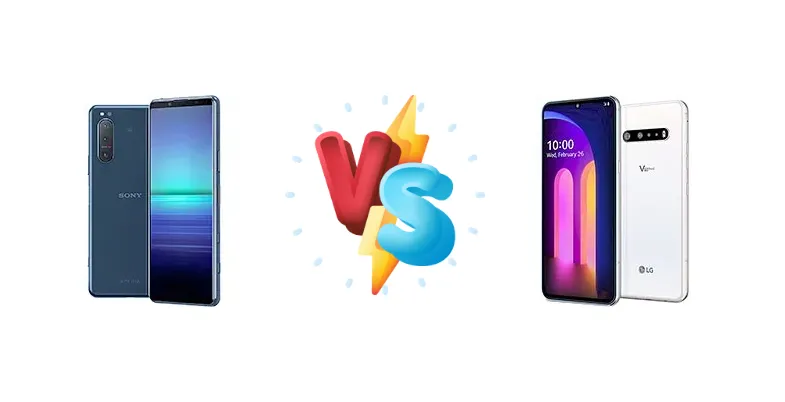
|
🏆 Quick Verdict
The Xperia 5 II edges out the V60 ThinQ thanks to its slightly brighter display and generally more refined software experience. While the V60 boasts excellent battery life and a headphone jack, the Xperia 5 II's superior camera processing and compact design give it a slight advantage.
| PHONES | ||
|---|---|---|
| Phone Names | Sony Xperia 5 II | LG V60 ThinQ 5G |
| Network | ||
|---|---|---|
| 2G bands | GSM 850 / 900 / 1800 / 1900 | GSM 850 / 900 / 1800 / 1900 |
| 3G bands | HSDPA 800 / 850 / 900 / 1700(AWS) / 1900 / 2100 | HSDPA 850 / 900 / 1700(AWS) / 1900 / 2100 |
| 4G bands | 1, 2, 3, 4, 5, 7, 8, 12, 13, 17, 19, 20, 25, 26, 28, 29, 32, 34, 38, 39, 40, 41, 46, 48, 66 | 2, 4, 5, 12, 25, 26, 41, 46, 48, 66, 71 - USA |
| 5G bands | 1, 3, 8, 28, 77, 78 SA/NSA | 2, 25, 41, 66, 71 SA/NSA/Sub6 |
| Speed | HSPA 42.2/5.76 Mbps, LTE Cat18 1200/150 Mbps, 5G | HSPA 42.2/5.76 Mbps, LTE (7CA) Cat22, 5G |
| Technology | GSM / HSPA / LTE / 5G | GSM / CDMA / HSPA / EVDO / LTE / 5G |
| - | CDMA2000 1xEV-DO | |
| Launch | ||
|---|---|---|
| Announced | 2020, September 17 | 2020, February 26. Released 2020, March 20 |
| Status | Available. Released 2020, October 12 | Discontinued |
| Body | ||
|---|---|---|
| Build | Glass front (Gorilla Glass 6), glass back (Gorilla Glass 6), aluminum frame | Glass front (Gorilla Glass 5), glass back (Gorilla Glass 6), aluminum frame |
| Dimensions | 158 x 68 x 8 mm (6.22 x 2.68 x 0.31 in) | 169.3 x 77.6 x 8.9 mm (6.67 x 3.06 x 0.35 in) |
| SIM | · Nano-SIM· Nano-SIM + Nano-SIM | · Nano-SIM· Nano-SIM + Nano-SIM |
| Weight | 163 g (5.75 oz) | 213 g (Global)/ 218 g (Verizon) (7.51 oz) |
| IP65/IP68 dust/water resistant (up to 1.5m for 30 mins) | IP68 dust/water resistant (up to 1.5m for 30 min) MIL-STD-810G compliant* Method 516.6, Procedure IV "Transit Drop" *does not guarantee ruggedness or use in extreme conditions | |
| Display | ||
|---|---|---|
| Protection | Corning Gorilla Glass 6 | Corning Gorilla Glass 5 |
| Resolution | 1080 x 2520 pixels, 21:9 ratio (~449 ppi density) | 1080 x 2460 pixels (~395 ppi density) |
| Size | 6.1 inches, 86.9 cm2 (~80.9% screen-to-body ratio) | 6.8 inches, 109.8 cm2 (~83.6% screen-to-body ratio) |
| Type | OLED, 120Hz, HDR BT.2020 | P-OLED, HDR10+ |
| Triluminos display X-Reality Engine | Always-on display | |
| Platform | ||
|---|---|---|
| CPU | Octa-core (1x2.84 GHz Cortex-A77 & 3x2.42 GHz Cortex-A77 & 4x1.80 GHz Cortex-A55) | Octa-core (1x2.84 GHz Cortex-A77 & 3x2.42 GHz Cortex-A77 & 4x1.80 GHz Cortex-A55) |
| Chipset | Qualcomm SM8250 Snapdragon 865 5G (7 nm+) | Qualcomm SM8250 Snapdragon 865 5G (7 nm+) |
| GPU | Adreno 650 | Adreno 650 |
| OS | Android 10, upgradable to Android 12 | Android 10, upgradable to Android 13 |
| Memory | ||
|---|---|---|
| Card slot | microSDXC (uses shared SIM slot) | microSDXC (uses shared SIM slot) - dual-SIM model |
| Internal | 128GB 8GB RAM, 256GB 8GB RAM | 128GB 8GB RAM, 256GB 8GB RAM |
| UFS 3.0 | UFS 2.1 | |
| Main Camera | ||
|---|---|---|
| Dual | - | 64 MP, f/1.8, 27mm (standard), 1/1.72", 0.8µm, dual pixel PDAF, OIS 13 MP, f/1.9, 12mm (ultrawide), 1/3.4", 1.0µm 0.3 MP, TOF 3D, f/1.4, (depth) |
| Features | Zeiss optics, color spectrum sensor, LED flash, panorama, HDR, eye tracking | Dual-LED dual-tone flash, HDR, panorama |
| Triple | 12 MP, f/1.7, 24mm (wide), 1/1.7", 1.8µm, dual pixel PDAF, OIS 12 MP, f/2.4, 70mm (telephoto), 1/3.4", 1.0µm, PDAF, 3x optical zoom, OIS 12 MP, f/2.2, 124˚, 16mm (ultrawide), 1/2.55", dual pixel PDAF | - |
| Video | 4K@24/30/60/120fps HDR, 1080p, 5-axis gyro-EIS, OIS | 8K@30fps, 4K@30/60fps, 1080p, HDR10+, 24-bit/192kHz stereo sound rec., gyro-EIS |
| Selfie camera | ||
|---|---|---|
| Features | HDR | HDR |
| Single | 8 MP, f/2.0, 24mm (wide), 1/4.0", 1.12µm | 10 MP, f/1.9, 30mm (standard), 1/3.1", 1.22µm |
| Video | 1080p@30fps, 5-axis gyro-EIS | 4K@30fps, gyro-EIS |
| Sound | ||
|---|---|---|
| 3.5mm jack | Yes | Yes |
| 35mm jack | Yes | Yes |
| Loudspeaker | Yes, with stereo speakers | Yes, with stereo speakers |
| 24-bit/192kHz audio Dynamic vibration system | 32-bit/192kHz audio 24-bit/192kHz audio recording | |
| Comms | ||
|---|---|---|
| Bluetooth | 5.1, A2DP, aptX HD, LE | 5.1, A2DP, LE, aptX HD |
| NFC | Yes | Yes |
| Positioning | GPS, GLONASS, BDS, GALILEO, QZSS | GPS, GLONASS, GALILEO, BDS |
| Radio | No | FM radio (USA model only) |
| USB | USB Type-C 3.1, OTG | USB Type-C 3.1, OTG |
| WLAN | Wi-Fi 802.11 a/b/g/n/ac/6, dual-band, Wi-Fi Direct, DLNA | Wi-Fi 802.11 a/b/g/n/ac/6, dual-band, Wi-Fi Direct, DLNA |
| Features | ||
|---|---|---|
| Sensors | Fingerprint (side-mounted), accelerometer, gyro, proximity, barometer, compass | Fingerprint (under display, optical), accelerometer, gyro, proximity, compass, barometer |
| Battery | ||
|---|---|---|
| Charging | 21W wired, PD3.0, 50% in 30 min | Wired, PD2.0, QC4 Wireless |
| Type | Li-Ion 4000 mAh | Li-Po 5000 mAh |
| Misc | ||
|---|---|---|
| Colors | Black, Grey, Blue, Pink | Classy Blue, Classy White |
| Models | SO-52A, XQ-AS52, XQ-AS62, XQ-AS72, A002SO, SOG02 | LM-V600, A001LG |
| Price | About 650 EUR | About 700 EUR |
| Pricing | ||
|---|---|---|
| 128GB 8GB RAM | $ 695.00 | - |
| RENEWED | £ 239.00 | - |
| Tests | ||
|---|---|---|
| Battery life | Endurance rating 102h | Endurance rating 103h |
| Camera | Photo / Video | - |
| Display | Contrast ratio: Infinite (nominal) | - |
| Loudspeaker | -28.3 LUFS (Average) | - |
| Performance | AnTuTu: 532655 (v8) GeekBench: 3301 (v5.1) GFXBench: 41fps (ES 3.1 onscreen) | - |
Sony Xperia 5 II
- Excellent camera performance
- Compact and ergonomic design
- Bright and vibrant display (600 nits)
- Clean Android experience
- 120Hz refresh rate
- Charging speed could be faster (21W)
- No headphone jack
- Price was relatively high at launch
LG V60 ThinQ 5G
- Exceptional battery life (103h endurance)
- Headphone jack
- Expandable storage (microSD)
- Good overall performance
- Wireless charging
- Larger and heavier design
- Camera processing can be inconsistent
- Software updates discontinued by LG
- Slower charging (PD2.0, QC4)
Display Comparison
Both phones feature OLED displays, but the Xperia 5 II boasts a measured peak brightness of 600 nits, offering slightly better visibility in bright sunlight. The V60's display, while excellent, doesn't quite reach the same level of brightness. Both offer vibrant colors and deep blacks thanks to the OLED technology. The Xperia 5 II has a 120Hz refresh rate, providing smoother scrolling and animations.
Camera Comparison
The Xperia 5 II generally delivers more consistent and pleasing camera results, particularly in challenging lighting conditions. Sony's image processing tends to produce more natural-looking photos. The V60's camera is capable, but can sometimes produce over-processed images. Both offer excellent video recording capabilities.
Performance
Both devices are powered by the Snapdragon 865 5G chipset and 8GB of RAM, ensuring smooth performance for most tasks. Real-world performance is very similar, with both handling demanding games and multitasking with ease. The Xperia 5 II's software optimization might offer a slightly more responsive feel.
Battery Life
The LG V60 ThinQ 5G holds a slight edge in battery endurance, with an endurance rating of 103 hours compared to the Xperia 5 II's 102 hours. However, the difference is minimal and both phones should easily last a full day of moderate use.
Buying Guide
The Sony Xperia 5 II is ideal for photography enthusiasts who appreciate a compact form factor and a clean Android experience. The LG V60 ThinQ 5G is a good choice for users who prioritize long battery life, a headphone jack, and expandable storage, and don't mind a larger device.