
Sony Xperia 10 vs Xperia 1: A Detailed Comparison
| Phones Images | |||||
|---|---|---|---|---|---|
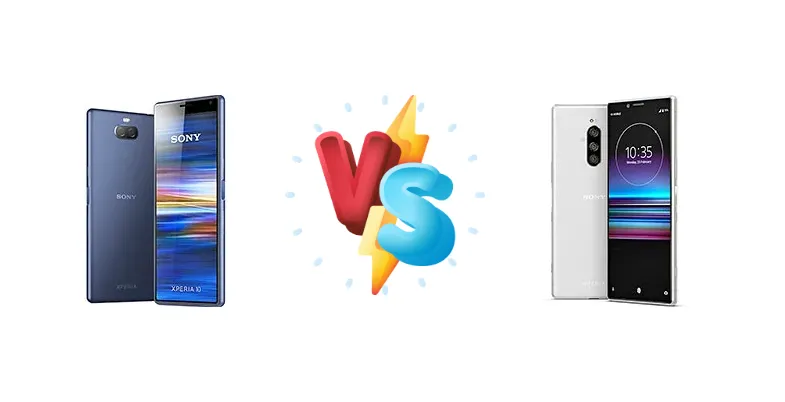
|
🏆 Quick Verdict
The Xperia 1 is the clear winner for users prioritizing performance, a brighter display, and a flagship experience. However, the Xperia 10 remains a compelling option for budget-conscious buyers seeking excellent battery life and a decent display in a compact form factor.
| PHONES | ||
|---|---|---|
| Phone Names | Sony Xperia 10 | Sony Xperia 1 |
| Network | ||
|---|---|---|
| 2G bands | GSM 850 / 900 / 1800 / 1900 | GSM 850 / 900 / 1800 / 1900 |
| 3G bands | HSDPA 850 / 900 / 1900 / 2100 - I3113, I4113, I4193 | HSDPA 800 / 850 / 900 / 1700(AWS) / 1900 / 2100 |
| 4G bands | 1, 2, 3, 5, 7, 8, 20, 28, 32, 38 - I3113, I4113 | 1, 2, 3, 4, 5, 7, 8, 12, 13, 17, 19, 20, 26, 28, 29, 32, 38, 39, 40, 41, 46, 66 |
| Speed | HSPA 42.2/5.76 Mbps, LTE (2CA) Cat12 600/50 Mbps | HSPA 42.2/5.76 Mbps, LTE Cat19 1600/150 Mbps |
| Technology | GSM / HSPA / LTE | GSM / HSPA / LTE |
| 1, 2, 3, 5, 7, 8, 20, 28, 38, 39, 40, 41 - I4193 | - | |
| Launch | ||
|---|---|---|
| Announced | 2019, February 25. Released 2019, February 27 | 2019, February 25. Released 2019, May 30 |
| Status | Discontinued | Discontinued |
| Body | ||
|---|---|---|
| Build | Glass front (Gorilla Glass 5), plastic back, plastic frame | Glass front (Gorilla Glass 6), glass back (Gorilla Glass 6), aluminum frame |
| Dimensions | 156 x 68 x 8.4 mm (6.14 x 2.68 x 0.33 in) | 167 x 72 x 8.2 mm (6.57 x 2.83 x 0.32 in) |
| SIM | · Nano-SIM· Nano-SIM + Nano-SIM | · Nano-SIM· Nano-SIM + Nano-SIM |
| Weight | 162 g (5.71 oz) | 178 g (6.28 oz) |
| - | IP65/IP68 dust/water resistant (up to 1.5m for 30 mins) | |
| Display | ||
|---|---|---|
| Protection | Corning Gorilla Glass 5 | Corning Gorilla Glass 6 |
| Resolution | 1080 x 2520 pixels, 21:9 ratio (~457 ppi density) | 1644 x 3840 pixels, 21:9 ratio (~643 ppi density) |
| Size | 6.0 inches, 84.1 cm2 (~79.3% screen-to-body ratio) | 6.5 inches, 98.6 cm2 (~82.0% screen-to-body ratio) |
| Type | IPS LCD | OLED, HDR BT.2020 |
| - | Runs at 1096 x 2560 pixels except for select use cases Triluminos display X-Reality Engine | |
| Platform | ||
|---|---|---|
| CPU | Octa-core 2.2 GHz Cortex-A53 | Octa-core (1x2.84 GHz Kryo 485 & 3x2.42 GHz Kryo 485 & 4x1.78 GHz Kryo 485) |
| Chipset | Qualcomm SDM630 Snapdragon 630 (14 nm) | Qualcomm SM8150 Snapdragon 855 (7 nm) |
| GPU | Adreno 508 | Adreno 640 |
| OS | Android 9.0 (Pie) | Android 9.0 (Pie), upgradable to Android 11 |
| Memory | ||
|---|---|---|
| Card slot | microSDXC (uses shared SIM slot) | microSDXC (uses shared SIM slot) - dual SIM model only |
| Internal | 64GB 3GB RAM, 64GB 4GB RAM | 64GB 6GB RAM, 128GB 6GB RAM |
| eMMC 5.1 | UFS 2.1 | |
| Main Camera | ||
|---|---|---|
| Dual | 13 MP, f/2.0, 27mm (wide), 1/3.1", 1.12µm, PDAF Auxiliary lens | - |
| Features | LED flash, HDR, panorama | Color spectrum sensor, LED flash, panorama, HDR, eye tracking |
| Triple | - | 12 MP, f/1.6, 26mm (wide), 1/2.55", 1.4µm, predictive dual pixel PDAF, 5-axis OIS 12 MP, f/2.4, 52mm (telephoto), 1/3.4", 1.0µm, predictive PDAF, 2x optical zoom, 5-axis OIS 12 MP, f/2.4, 16mm (ultrawide), 1/3.4", 1.0µm |
| Video | 4K@30fps, 1080p@30fps | 4K@24/25/30fps HDR, 1080p@60fps, 1080p@30fps (5-axis gyro-EIS), 1080p@960fps |
| Selfie camera | ||
|---|---|---|
| Features | - | HDR |
| Single | 8 MP, f/2.0, 24mm (wide), 1/4.0", 1.12µm | 8 MP, f/2.0, 24mm (wide), 1/4.0", 1.12µm |
| Video | 1080p@30fps | 1080p@30fps (5-axis gyro-EIS) |
| Sound | ||
|---|---|---|
| 3.5mm jack | Yes | No |
| 35mm jack | Yes | No |
| Loudspeaker | Yes | Yes, with stereo speakers |
| 24-bit/192kHz audio | 24-bit/192kHz audio Dynamic vibration system | |
| Comms | ||
|---|---|---|
| Bluetooth | 5.0, A2DP, LE, aptX HD | 5.0, A2DP, aptX HD, LE |
| NFC | Yes | Yes |
| Positioning | GPS, GLONASS | GPS, GLONASS, BDS, GALILEO |
| Radio | FM radio | No |
| USB | USB Type-C 2.0, OTG | USB Type-C 3.1, OTG |
| WLAN | Wi-Fi 802.11 a/b/g/n/ac, dual-band, Wi-Fi Direct | Wi-Fi 802.11 a/b/g/n/ac, dual-band, Wi-Fi Direct, DLNA |
| Features | ||
|---|---|---|
| Sensors | Fingerprint (side-mounted), accelerometer, proximity, compass | Fingerprint (side-mounted), accelerometer, gyro, proximity, barometer, compass |
| Battery | ||
|---|---|---|
| Charging | 18W wired, PD, QC3 | 18W wired, PD2.0 |
| Type | Li-Ion 2870 mAh, non-removable | Li-Ion 3330 mAh, non-removable |
| Misc | ||
|---|---|---|
| Colors | Black, Navy, Silver, Pink | Black, Gray, Purple, White |
| Models | I3113, I4113, I4193, I3123 | J8110, J8170, J9110, J9150, SOV40, SO-03L |
| Price | About 280 EUR | About 500 EUR |
| Tests | ||
|---|---|---|
| Audio quality | Noise -92.2dB / Crosstalk -97.1dB | Noise -93.6dB / Crosstalk -85.2dB |
| Battery life | Endurance rating 65h | Endurance rating 79h |
| Camera | Photo / Video | Photo / Video |
| Display | Contrast ratio: 1517:1 (nominal) | Contrast ratio: Infinite (nominal) |
| Loudspeaker | -30.2 LUFS (Below average) | -26.7 LUFS (Good) |
| Performance | AnTuTu: 89697 (v7), 112198 (v8) GeekBench: 3985 (v4.4), 990 (v5.1) GFXBench: 4.3fps (ES 3.1 onscreen) | AnTuTu: 356734 (v7), 418206 (v8) GeekBench: 10985 (v4.4), 2753 (v5.1) GFXBench: 33fps (ES 3.1 onscreen) |
Sony Xperia 10
- Excellent battery life
- Affordable price
- Compact design
- Good contrast ratio display
- Lower performance
- Less vibrant display
- Older chipset
- Potentially less advanced camera
Sony Xperia 1
- Flagship performance
- Bright and vibrant display
- Advanced camera system
- Premium design
- Excellent battery life
- Higher price
- Potentially larger size
- May consume more power under heavy load
Display Comparison
The Xperia 1's display is a significant upgrade. While the Xperia 10 boasts a respectable 1517:1 contrast ratio, the Xperia 1's 'Infinite' contrast ratio (likely referring to OLED's inherent capabilities) and 665 nits of peak brightness offer a far more vibrant and visible experience, especially outdoors. The Xperia 1 also likely features a higher resolution and potentially HDR support, further enhancing its visual appeal.
Camera Comparison
Both phones offer Photo/Video capabilities, but the Xperia 1's hardware is likely superior. While specific camera specs aren't provided, the Snapdragon 855 typically pairs with more advanced camera sensors and image processing capabilities. Expect better low-light performance, dynamic range, and overall image quality from the Xperia 1. The Xperia 1 also likely has more camera lenses and features.
Performance
The Xperia 1's Snapdragon 855 chipset is a powerhouse compared to the Xperia 10's Snapdragon 630. The 855 offers significantly faster processing speeds, smoother multitasking, and better gaming performance. The Xperia 1's CPU configuration (1x2.84 GHz Kryo 485 & 3x2.42 GHz Kryo 485 & 4x1.78 GHz Kryo 485) is designed for optimal performance across various tasks, while the 630 is more suited for basic usage.
Battery Life
Both phones share an impressive endurance rating of 65h. This suggests excellent battery life on both devices, making them suitable for heavy users. However, the Xperia 1's more powerful processor might consume slightly more power under intense load, though the larger battery capacity could offset this.
Buying Guide
The Sony Xperia 10 is ideal for users who prioritize battery life, affordability, and a compact design. It's a great choice for everyday use and those who don't need the absolute best performance. The Sony Xperia 1 is perfect for photography enthusiasts, power users, and those who want a premium smartphone experience with a stunning display and top-tier performance.