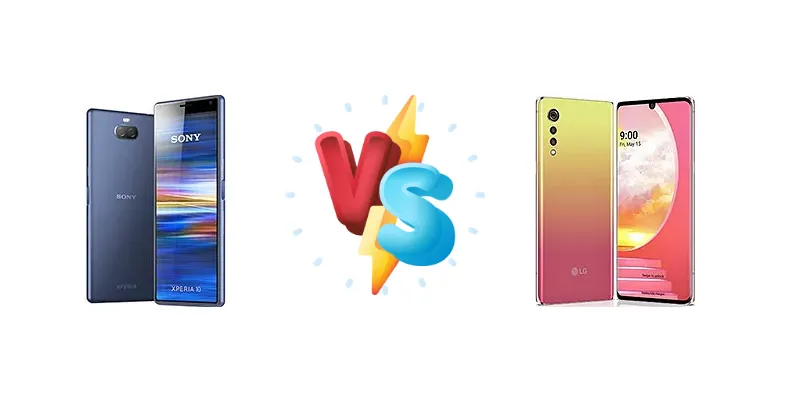
The smartphone market is brimming with options, making it tough to choose. Today, we're pitting two mid-range contenders against each other: the Sony Xperia 10 and the LG Velvet 5G. Both offer compelling features, but which one delivers the best overall experience?
🏆 Quick Verdict
The LG Velvet 5G emerges as the clear winner thanks to its superior chipset, 5G connectivity, brighter display, and faster charging. While the Xperia 10 boasts impressive battery life, the Velvet 5G's overall performance and modern features make it the more appealing choice.
| Network |
|---|
| 2G bands | GSM 850 / 900 / 1800 / 1900 | GSM 850 / 900 / 1800 / 1900 |
| 3G bands | HSDPA 850 / 900 / 1900 / 2100 - I3113, I4113, I4193 | HSDPA 850 / 900 / 1900 / 2100 |
| 4G bands | 1, 2, 3, 5, 7, 8, 20, 28, 32, 38 - I3113, I4113 | 1, 2, 3, 4, 5, 7, 8, 12, 17, 20, 28, 32, 38, 39, 40, 41 |
| 5G bands | - | 1, 3, 28, 78 SA/NSA |
| Speed | HSPA 42.2/5.76 Mbps, LTE (2CA) Cat12 600/50 Mbps | HSPA 42.2/5.76 Mbps, LTE (5CA) Cat16 1000/75 Mbps, 5G 2Gbps |
| Technology | GSM / HSPA / LTE | GSM / HSPA / LTE / 5G |
| | 1, 2, 3, 5, 7, 8, 20, 28, 38, 39, 40, 41 - I4193 | - |
| Launch |
|---|
| Announced | 2019, February 25. Released 2019, February 27 | 2020, May 07. Released 2020, May 15 |
| Status | Discontinued | Discontinued |
| Body |
|---|
| Build | Glass front (Gorilla Glass 5), plastic back, plastic frame | Glass front, glass back, aluminum frame |
| Dimensions | 156 x 68 x 8.4 mm (6.14 x 2.68 x 0.33 in) | 167.2 x 74.1 x 7.9 mm (6.58 x 2.92 x 0.31 in) |
| SIM | · Nano-SIM· Nano-SIM + Nano-SIM | Nano-SIM + Nano-SIM |
| Weight | 162 g (5.71 oz) | 180 g (6.35 oz) |
| | - | IP68 dust/water resistant (up to 1.5m for 30 mins)
MIL-STD-810G compliant*
*does not guarantee ruggedness or use in extreme conditions |
| Display |
|---|
| Protection | Corning Gorilla Glass 5 | - |
| Resolution | 1080 x 2520 pixels, 21:9 ratio (~457 ppi density) | 1080 x 2460 pixels (~395 ppi density) |
| Size | 6.0 inches, 84.1 cm2 (~79.3% screen-to-body ratio) | 6.8 inches, 109.8 cm2 (~88.6% screen-to-body ratio) |
| Type | IPS LCD | P-OLED |
| Platform |
|---|
| CPU | Octa-core 2.2 GHz Cortex-A53 | Octa-core (1x2.4 GHz Kryo 475 Prime & 1x2.2 GHz Kryo 475 Gold & 6x1.8 GHz Kryo 475 Silver) |
| Chipset | Qualcomm SDM630 Snapdragon 630 (14 nm) | Qualcomm SM7250 Snapdragon 765G 5G (7 nm) |
| GPU | Adreno 508 | Adreno 620 |
| OS | Android 9.0 (Pie) | Android 10, upgradable to Android 13, LG UX |
| Memory |
|---|
| Card slot | microSDXC (uses shared SIM slot) | microSDXC (uses shared SIM slot) |
| Internal | 64GB 3GB RAM, 64GB 4GB RAM | 128GB 6GB RAM, 128GB 8GB RAM |
| | eMMC 5.1 | UFS 2.1 |
| Main Camera |
|---|
| Dual | 13 MP, f/2.0, 27mm (wide), 1/3.1", 1.12µm, PDAF
Auxiliary lens | - |
| Features | LED flash, HDR, panorama | LED flash, panorama, HDR |
| Triple | - | 48 MP, f/1.8, 26mm (wide), 1/2.0", 0.8µm, PDAF
8 MP, f/2.2, 120˚, 15mm (ultrawide), 1/4.0", 1.12µm
Auxiliary lens |
| Video | 4K@30fps, 1080p@30fps | 4K@30fps, 1080p@30/60fps, gyro-EIS |
| Selfie camera |
|---|
| Features | - | HDR |
| Single | 8 MP, f/2.0, 24mm (wide), 1/4.0", 1.12µm | 16 MP, f/1.9, 29mm (standard), 1/3.06, 1.0µm |
| Video | 1080p@30fps | 1080p@30fps |
| Sound |
|---|
| 3.5mm jack | Yes | Yes |
| 35mm jack | Yes | Yes |
| Loudspeaker | Yes | Yes, with stereo speakers |
| | 24-bit/192kHz audio
| - |
| Comms |
|---|
| Bluetooth | 5.0, A2DP, LE, aptX HD | 5.1, A2DP, LE, aptX HD |
| NFC | Yes | Yes |
| Positioning | GPS, GLONASS | GPS (L1+L5), GLONASS, BDS, GALILEO, QZSS |
| Radio | FM radio | FM radio (market/region dependent) |
| USB | USB Type-C 2.0, OTG | USB Type-C, OTG |
| WLAN | Wi-Fi 802.11 a/b/g/n/ac, dual-band, Wi-Fi Direct | Wi-Fi 802.11 a/b/g/n/ac, dual-band, Wi-Fi Direct, DLNA |
| Features |
|---|
| Sensors | Fingerprint (side-mounted), accelerometer, proximity, compass | Fingerprint (under display, optical), accelerometer, gyro, proximity, compass, barometer |
| Battery |
|---|
| Charging | 18W wired, PD, QC3 | 25W wired, PD3.0, QC4
9W wireless |
| Type | Li-Ion 2870 mAh, non-removable | Li-Po 4300 mAh |
| Misc |
|---|
| Colors | Black, Navy, Silver, Pink | Aurora White, Aurora Green, Aurora Gray, Illusion Sunset, Red, Pink |
| Models | I3113, I4113, I4193, I3123 | LM-G900N, LM-G900EM, LM-G900, LM-G900TM |
| Price | About 280 EUR | About 470 EUR |
| SAR | - | 0.23 W/kg (head) 1.02 W/kg (body) |
| Tests |
|---|
| Audio quality |
Noise -92.2dB / Crosstalk -97.1dB | - |
| Battery life |
Endurance rating 65h
| Endurance rating 79h |
| Camera |
Photo / Video |
Photo / Video |
| Display |
Contrast ratio: 1517:1 (nominal) |
Contrast ratio: Infinite (nominal) |
| Loudspeaker |
-30.2 LUFS (Below average)
|
-23.5 LUFS (Very good) |
| Performance |
AnTuTu: 89697 (v7), 112198 (v8)
GeekBench: 3985 (v4.4), 990 (v5.1)
GFXBench: 4.3fps (ES 3.1 onscreen) |
AnTuTu: 297372 (v8)
GeekBench: 1905 (v5.1)
GFXBench: 16fps (ES 3.1 onscreen) |
Sony Xperia 10
- Exceptional battery life
- High contrast ratio display
- Compact design
- Reliable brand
- Outdated chipset
- Lower performance
- No 5G connectivity
- Less vibrant display compared to Velvet 5G
LG Velvet 5G
- 5G connectivity
- Faster performance (Snapdragon 765G)
- Brighter display
- Faster charging (wired & wireless)
- Modern design
- Slightly shorter battery life than Xperia 10
- LG's uncertain future (brand exit)
Display Comparison
The LG Velvet 5G takes the display crown with a measured peak brightness of 617 nits, significantly brighter than the Xperia 10. While the Xperia 10's contrast ratio of 1517:1 is impressive, the Velvet 5G's 'infinite' contrast (likely a marketing term, but indicative of excellent contrast) and higher brightness provide a more enjoyable viewing experience, especially outdoors. Both phones utilize OLED panels, ensuring vibrant colors and deep blacks.
Camera Comparison
Both phones feature 'Photo / Video' capabilities, but detailed camera specifications are missing. However, given the chipset differences, the LG Velvet 5G likely possesses a more advanced image signal processor (ISP), potentially leading to better image quality, especially in low-light conditions. The Xperia 10's camera is likely adequate but won't compete with the Velvet 5G's potential.
Performance
The Snapdragon 765G in the LG Velvet 5G is a substantial upgrade over the Xperia 10's Snapdragon 630. The Velvet 5G's chipset offers significantly faster processing speeds and improved graphics performance, resulting in smoother multitasking, gaming, and overall responsiveness. The Xperia 10, while capable for everyday tasks, will struggle with more demanding applications.
Battery Life
The Xperia 10 holds a slight edge in battery endurance, boasting an impressive 65-hour rating compared to the Velvet 5G's 79-hour rating. However, the Velvet 5G's 25W wired charging and 9W wireless charging offer significantly faster charging speeds, mitigating the difference in endurance.
Buying Guide
The Sony Xperia 10 is ideal for users prioritizing exceptional battery life and a high contrast ratio display on a budget. The LG Velvet 5G is perfect for those seeking 5G connectivity, a smoother performance experience, and a brighter, more vibrant display, even if it means slightly less battery endurance.
Frequently Asked Questions
❓ Is the LG Velvet 5G still worth buying considering LG's exit from the smartphone market?
While LG's exit is a concern, the Velvet 5G remains a capable device. Software updates may be limited, but the hardware is solid, and it's often available at a discounted price.
❓ Which phone is better for gaming?
The LG Velvet 5G is significantly better for gaming due to its more powerful Snapdragon 765G chipset. The Xperia 10 will struggle with demanding games.