
Sony Xperia 10 VI vs. Nothing Phone (2a) Plus: A Detailed Comparison
| Phones Images | |||||
|---|---|---|---|---|---|
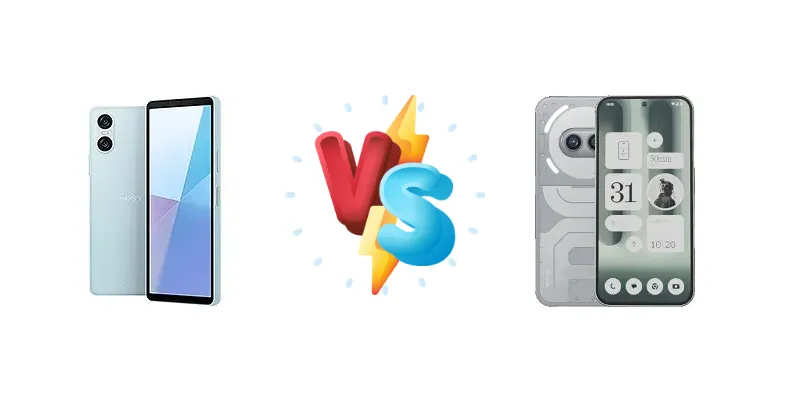
|
🏆 Quick Verdict
For the average user prioritizing battery life and faster charging, the Nothing Phone (2a) Plus is the better choice. Its 16:34 active use score and 50W charging significantly outperform the Xperia 10 VI’s 13:56 and standard PD/QC charging. However, the Xperia 10 VI offers a slightly brighter display.
| PHONES | ||
|---|---|---|
| Phone Names | Sony Xperia 10 VI | Nothing Phone (2a) Plus |
| Network | ||
|---|---|---|
| 2G bands | GSM 850 / 900 / 1800 / 1900 | GSM 850 / 900 / 1800 / 1900 |
| 3G bands | HSDPA 850 / 900 / 1700(AWS) / 2100 | HSDPA 800 / 850 / 900 / 1700(AWS) / 1900 / 2100 |
| 4G bands | 1, 3, 4, 5, 7, 8, 20, 28, 38, 39, 40, 41 | 1, 3, 4, 5, 7, 8, 18, 19, 20, 26, 28, 38, 39, 40, 41, 42, 66 |
| 5G bands | 1, 3, 5, 7, 8, 20, 28, 38, 40, 41, 77, 78, 79 SA/NSA | 1, 3, 5, 7, 8, 20, 28, 38, 40, 41, 66, 77, 78 SA/NSA |
| Speed | HSPA, LTE, 5G | HSPA, LTE, 5G |
| Technology | GSM / HSPA / LTE / 5G | GSM / HSPA / LTE / 5G |
| Launch | ||
|---|---|---|
| Announced | 2024, May 15 | 2024, July 31 |
| Status | Available. Released 2024, June 13 | Available. Released 2024, August 03 |
| Body | ||
|---|---|---|
| Build | Glass front (Gorilla Glass Victus), plastic frame, plastic back | Glass front (Gorilla Glass 5), plastic frame, plastic back |
| Dimensions | 155 x 68 x 8.3 mm (6.10 x 2.68 x 0.33 in) | 161.7 x 76.3 x 8.5 mm (6.37 x 3.00 x 0.33 in) |
| SIM | · Nano-SIM + eSIM· Nano-SIM + Nano-SIM | Nano-SIM + Nano-SIM |
| Weight | 164 g (5.78 oz) | 190 g (6.70 oz) |
| Display | ||
|---|---|---|
| Protection | Corning Gorilla Glass Victus | Corning Gorilla Glass 5 |
| Resolution | 1080 x 2520 pixels, 21:9 ratio (~449 ppi density) | 1080 x 2412 pixels, 20:9 ratio (~395 ppi density) |
| Size | 6.1 inches, 86.9 cm2 (~82.5% screen-to-body ratio) | 6.7 inches, 107.5 cm2 (~87.1% screen-to-body ratio) |
| Type | OLED, 1B colors, HDR | AMOLED, 1B colors, 120Hz, 2160Hz PWM, HDR10+, 700 nits (typ), 1100 nits (HBM), 1300 nits (peak) |
| Platform | ||
|---|---|---|
| CPU | Octa-core (4x2.2 GHz Cortex-A78 & 4x1.8 GHz Cortex-A55) | Octa-core (2x3.0 GHz Cortex-A715 & 6x 2.0 GHz Cortex-A510) |
| Chipset | Qualcomm SM6450 Snapdragon 6 Gen 1 (4 nm) | Mediatek Dimensity 7350 Pro (4 nm) |
| GPU | Adreno 710 | Mali-G610 MC4 |
| OS | Android 14, upgradable to Android 16, up to 3 major Android upgrades | Android 14, up to 3 major Android upgrades, Nothing OS 3.0 |
| Memory | ||
|---|---|---|
| Card slot | microSDXC (uses shared SIM slot) | No |
| Internal | 128GB 8GB RAM | 256GB 8GB RAM, 256GB 12GB RAM |
| Main Camera | ||
|---|---|---|
| Dual | 48 MP, f/1.8, 26mm (wide), 1/2.0", 0.8µm, PDAF, OIS 8 MP, f/2.2, 120˚, 16mm (ultrawide), 1/4.0", 1.12µm | 50 MP, f/1.9, 24mm (wide), 1/1.57", 1.0µm, PDAF, OIS 50 MP, f/2.2, 114˚ (ultrawide), 1/2.76", 0.64µm |
| Features | LED flash, HDR, panorama | LED flash, panorama, HDR |
| Video | 4K@30fps, 1080p@30/60/120fps, gyro-EIS, OIS | 4K@30fps, 1080p@60/120fps, gyro-EIS |
| Selfie camera | ||
|---|---|---|
| Features | HDR | HDR |
| Single | 8 MP, f/2.0, 26mm (wide), 1/4.0", 1.12µm | 50 MP, f/2.2, (wide), 1/2.76" |
| Video | 1080p@30fps | 4K@30fps |
| Sound | ||
|---|---|---|
| 35mm jack | Yes | No |
| Loudspeaker | Yes, with stereo speakers | Yes, with stereo speakers |
| Comms | ||
|---|---|---|
| Bluetooth | 5.2, A2DP, LE, aptX HD, aptX Adaptive | 5.3, A2DP, LE |
| NFC | Yes | Yes, 360˚ |
| Positioning | GPS, GLONASS, GALILEO, BDS, QZSS | GPS, GALILEO, GLONASS, BDS, QZSS |
| Radio | No | No |
| USB | USB Type-C 2.0, OTG | USB Type-C 2.0, OTG |
| WLAN | Wi-Fi 802.11 a/b/g/n/ac, dual-band, Wi-Fi Direct | Wi-Fi 802.11 a/b/g/n/ac/6, dual-band, Wi-Fi Direct |
| Features | ||
|---|---|---|
| Sensors | Fingerprint (side-mounted), accelerometer, gyro, proximity, compass | Fingerprint (under display, optical), accelerometer, gyro, proximity, compass |
| Battery | ||
|---|---|---|
| Charging | Wired, PD, QC | 50W wired, 50% in 21 min, 100% in 56 min |
| Type | 5000 mAh | 5000 mAh |
| Misc | ||
|---|---|---|
| Colors | Blue, Black, White | Black, Grey |
| Models | XQ-ES54, XQ-ES72, XQ-ES72/L2TWCX0, XQ-ES72/B2TWCX0, XQ-ES72/W2TWCX0, XQES54EUKCB.GC | A142P |
| Price | € 342.14 / $ 799.00 / £ 317.49 | € 269.90 / ₹ 22,599 |
Sony Xperia 10 VI
- Slightly brighter display (1010 nits)
- Sony’s established media software features
- Efficient Snapdragon 6 Gen 1 chipset
- Shorter battery life (13:56h active use)
- Slower charging speeds (PD/QC only)
- Less powerful CPU compared to the competition
Nothing Phone (2a) Plus
- Longer battery life (16:34h active use)
- Faster 50W charging (100% in 56 minutes)
- More powerful Dimensity 7350 Pro chipset
- Slightly lower peak display brightness (1097 nits)
- Nothing OS may not appeal to all users
- Design may be polarizing
Display Comparison
Both devices utilize 4nm chipsets, contributing to power efficiency, but their displays differ. The Nothing Phone (2a) Plus boasts a peak brightness of 1097 nits, exceeding the Xperia 10 VI’s 1010 nits, making it more readable under direct sunlight. While both likely employ OLED panels (based on market segment), neither specification details refresh rates or panel technology like LTPO. The higher peak brightness of the Nothing Phone (2a) Plus provides a tangible benefit for outdoor users.
Camera Comparison
Without detailed camera specifications, a direct comparison is limited. However, the market positioning suggests the Nothing Phone (2a) Plus likely features a more advanced primary sensor. The Xperia 10 VI, traditionally, focuses on color science and image processing rather than raw sensor size. The absence of information regarding OIS or lens apertures makes a definitive judgment impossible, but the Dimensity 7350 Pro’s ISP capabilities likely provide a more robust image processing pipeline.
Performance
The Nothing Phone (2a) Plus leverages the Mediatek Dimensity 7350 Pro, featuring a more powerful CPU configuration with 2x3.0 GHz Cortex-A715 cores and 6x2.0 GHz Cortex-A510 cores, compared to the Xperia 10 VI’s Qualcomm Snapdragon 6 Gen 1 (4x2.2 GHz Cortex-A78 & 4x1.8 GHz Cortex-A55). This translates to a noticeable performance advantage for the Nothing Phone (2a) Plus in CPU-intensive tasks and gaming. The Snapdragon 6 Gen 1 prioritizes efficiency, while the Dimensity 7350 Pro aims for a balance of power and efficiency. Both are built on a 4nm process, but the core architecture favors the Nothing Phone (2a) Plus.
Battery Life
The Nothing Phone (2a) Plus clearly wins in battery performance and charging speed. Its active use score of 16:34h significantly surpasses the Xperia 10 VI’s 13:56h. Furthermore, the Nothing Phone (2a) Plus supports 50W wired charging, achieving 50% charge in 21 minutes and 100% in 56 minutes, a substantial improvement over the Xperia 10 VI’s standard PD/QC charging, which lacks specific timing details. This faster charging is crucial for users who need to quickly top up their device.
Buying Guide
Buy the Sony Xperia 10 VI if you prioritize a slightly brighter display for outdoor visibility and value Sony’s established media-centric software features. Buy the Nothing Phone (2a) Plus if you prefer longer battery life, significantly faster charging speeds, and a more modern, eye-catching design with a more powerful processor for demanding tasks.