
Sony Xperia 10 VI vs Motorola Edge 50 Pro: A Deep Dive into Mid-Range Champions
| Phones Images | |||||
|---|---|---|---|---|---|
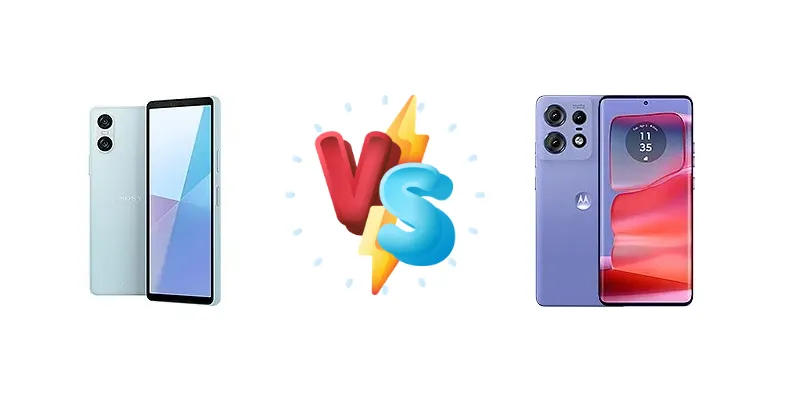
|
🏆 Quick Verdict
For the average user prioritizing longevity, the Sony Xperia 10 VI emerges as the winner. Its exceptional 13:56h active use battery life significantly outpaces the Edge 50 Pro’s 11:59h, making it ideal for power users. However, the Motorola Edge 50 Pro’s 125W charging is a game-changer for those who value quick top-ups.
| PHONES | ||
|---|---|---|
| Phone Names | Sony Xperia 10 VI | Motorola Edge 50 Pro |
| Network | ||
|---|---|---|
| 2G bands | GSM 850 / 900 / 1800 / 1900 | GSM 850 / 900 / 1800 / 1900 |
| 3G bands | HSDPA 850 / 900 / 1700(AWS) / 2100 | HSDPA 850 / 900 / 1700(AWS) / 1900 / 2100 |
| 4G bands | 1, 3, 4, 5, 7, 8, 20, 28, 38, 39, 40, 41 | 1, 2, 3, 4, 5, 7, 8, 12, 13, 17, 18, 19, 20, 26, 28, 32, 38, 39, 40, 41, 43, 48, 66 |
| 5G bands | 1, 3, 5, 7, 8, 20, 28, 38, 40, 41, 77, 78, 79 SA/NSA | 1, 2, 3, 5, 7, 8, 20, 26, 28, 38, 40, 41, 66, 77, 78 SA/NSA/Sub6 |
| Speed | HSPA, LTE, 5G | HSPA, LTE, 5G |
| Technology | GSM / HSPA / LTE / 5G | GSM / HSPA / LTE / 5G |
| Launch | ||
|---|---|---|
| Announced | 2024, May 15 | 2024, April 03 |
| Status | Available. Released 2024, June 13 | Available. Released 2024, April 08 |
| Body | ||
|---|---|---|
| Build | Glass front (Gorilla Glass Victus), plastic frame, plastic back | Glass front, plastic back or silicone polymer back (eco leather), aluminum frame |
| Dimensions | 155 x 68 x 8.3 mm (6.10 x 2.68 x 0.33 in) | 161.2 x 72.4 x 8.2 mm (6.35 x 2.85 x 0.32 in) |
| SIM | · Nano-SIM + eSIM· Nano-SIM + Nano-SIM | · Nano-SIM + eSIM· Nano-SIM + Nano-SIM |
| Weight | 164 g (5.78 oz) | 186 g (6.56 oz) |
| Display | ||
|---|---|---|
| Protection | Corning Gorilla Glass Victus | Corning Gorilla Glass (unspecified version) |
| Resolution | 1080 x 2520 pixels, 21:9 ratio (~449 ppi density) | 1220 x 2712 pixels, 20:9 ratio (~446 ppi density) |
| Size | 6.1 inches, 86.9 cm2 (~82.5% screen-to-body ratio) | 6.7 inches, 107.4 cm2 (~92.0% screen-to-body ratio) |
| Type | OLED, 1B colors, HDR | P-OLED, 1B colors, 144Hz, HDR10+, 2000 nits (peak) |
| Platform | ||
|---|---|---|
| CPU | Octa-core (4x2.2 GHz Cortex-A78 & 4x1.8 GHz Cortex-A55) | Octa-core (1x2.63 GHz Cortex-A715 & 4x2.4 GHz Cortex-A715 & 3x1.8 GHz Cortex-A510) |
| Chipset | Qualcomm SM6450 Snapdragon 6 Gen 1 (4 nm) | Qualcomm SM7550-AB Snapdragon 7 Gen 3 (4 nm) |
| GPU | Adreno 710 | Adreno 720 |
| OS | Android 14, upgradable to Android 16, up to 3 major Android upgrades | Android 14, up to 3 major Android upgrades |
| Memory | ||
|---|---|---|
| Card slot | microSDXC (uses shared SIM slot) | No |
| Internal | 128GB 8GB RAM | 128GB 8GB RAM, 256GB 8GB RAM, 256GB 12GB RAM, 512GB 12GB RAM |
| Main Camera | ||
|---|---|---|
| Dual | 48 MP, f/1.8, 26mm (wide), 1/2.0", 0.8µm, PDAF, OIS 8 MP, f/2.2, 120˚, 16mm (ultrawide), 1/4.0", 1.12µm | - |
| Features | LED flash, HDR, panorama | Laser AF, LED flash, panorama, HDR |
| Triple | - | 50 MP, f/1.4, 25mm (wide), 1/1.55", 1.0µm, multi-directional PDAF, OIS 10 MP, f/2.0, 67mm (telephoto), 1/3.94", 1.0µm, PDAF, OIS, 3x optical zoom 13 MP, f/2.2, 16mm, 120˚ (ultrawide), 1/3.0", 1.12µm, PDAF |
| Video | 4K@30fps, 1080p@30/60/120fps, gyro-EIS, OIS | 4K@30fps, 1080p@30/60/120/240fps, 10-bit HDR10+, gyro-EIS |
| Selfie camera | ||
|---|---|---|
| Features | HDR | HDR |
| Single | 8 MP, f/2.0, 26mm (wide), 1/4.0", 1.12µm | 50 MP, f/1.9, 21mm (wide), 0.64µm, AF |
| Video | 1080p@30fps | 4K@30fps, 1080p@30/60fps |
| Sound | ||
|---|---|---|
| 35mm jack | Yes | No |
| Loudspeaker | Yes, with stereo speakers | Yes, with stereo speakers |
| Comms | ||
|---|---|---|
| Bluetooth | 5.2, A2DP, LE, aptX HD, aptX Adaptive | 5.4, A2DP, LE |
| NFC | Yes | Yes |
| Positioning | GPS, GLONASS, GALILEO, BDS, QZSS | GPS, GLONASS, GALILEO, BDS, QZSS, NavIC |
| Radio | No | No |
| USB | USB Type-C 2.0, OTG | USB Type-C 3.1, OTG, DisplayPort 1.4 |
| WLAN | Wi-Fi 802.11 a/b/g/n/ac, dual-band, Wi-Fi Direct | Wi-Fi 802.11 a/b/g/n/ac/6e, tri-band, Wi-Fi Direct |
| Features | ||
|---|---|---|
| Sensors | Fingerprint (side-mounted), accelerometer, gyro, proximity, compass | Fingerprint (under display, optical), accelerometer, gyro, proximity, compass |
| Battery | ||
|---|---|---|
| Charging | Wired, PD, QC | 125W wired, 100% in 18 min 50W wireless 10W reverse wireless |
| Type | 5000 mAh | Li-Po 4500 mAh |
| Misc | ||
|---|---|---|
| Colors | Blue, Black, White | Luxe Lavender, Black Beauty, Moonlight Pearl, Vanilla Cream |
| Models | XQ-ES54, XQ-ES72, XQ-ES72/L2TWCX0, XQ-ES72/B2TWCX0, XQ-ES72/W2TWCX0, XQES54EUKCB.GC | XT2403-2 |
| Price | € 342.14 / $ 799.00 / £ 317.49 | € 410.57 / $ 399.00 / £ 369.99 / ₹ 22,995 |
| SAR | - | 1.08 W/kg (head) 1.08 W/kg (body) |
Sony Xperia 10 VI
- Exceptional battery life (13:56h active use)
- More efficient processor for longer runtimes
- Potentially more refined software experience (Sony's approach)
- Less powerful processor compared to the Edge 50 Pro
- Slower charging speeds
- Lower peak display brightness
Motorola Edge 50 Pro
- Significantly faster processor (Snapdragon 7 Gen 3)
- Ultra-fast 125W wired charging (18 minutes to 100%)
- Higher peak display brightness for better outdoor visibility
- Shorter battery life (11:59h active use)
- Potentially more aggressive power management needed
- Software experience may be less refined than Sony's
Display Comparison
Both the Xperia 10 VI and Edge 50 Pro feature displays manufactured using a 4nm process, but differ in brightness and likely panel technology. The Xperia 10 VI achieves a measured peak brightness of 1010 nits, while the Edge 50 Pro reaches 1295 nits. This suggests the Edge 50 Pro will offer better visibility in direct sunlight. While neither specification details LTPO technology, the higher brightness of the Motorola device suggests a more modern panel capable of dynamic refresh rate adjustments for power saving. The difference in brightness will be most noticeable when viewing HDR content or outdoors.
Camera Comparison
Without detailed camera specifications, a direct comparison is limited. However, the chipset difference suggests the Edge 50 Pro will have a more powerful ISP (Image Signal Processor) for faster image processing and potentially better low-light performance. The Snapdragon 7 Gen 3’s capabilities will allow for more sophisticated computational photography features. While both phones likely feature multi-camera systems, the Edge 50 Pro’s processor gives it an edge in image quality and video recording capabilities. We can assume the Motorola will offer more advanced features like 4K/60fps video recording.
Performance
The Motorola Edge 50 Pro’s Snapdragon 7 Gen 3 chipset represents a significant leap in performance over the Xperia 10 VI’s Snapdragon 6 Gen 1. The Edge 50 Pro utilizes a tri-cluster configuration (1x2.63 GHz Cortex-A715, 4x2.4 GHz Cortex-A715, 3x1.8 GHz Cortex-A510) compared to the Xperia 10 VI’s quad-core setup (4x2.2 GHz Cortex-A78 & 4x1.8 GHz Cortex-A55). This translates to faster app loading times, smoother multitasking, and improved gaming performance on the Motorola. The Snapdragon 7 Gen 3’s more modern CPU cores and GPU will handle graphically intensive tasks with greater ease. However, the Xperia 10 VI’s Snapdragon 6 Gen 1 is still capable for everyday tasks and less demanding games.
Battery Life
Battery life is where the Xperia 10 VI truly shines. Its active use score of 13:56h is a substantial improvement over the Edge 50 Pro’s 11:59h. This difference is likely due to the less power-hungry Snapdragon 6 Gen 1 and potentially more efficient software optimization. However, the Edge 50 Pro compensates with incredibly fast charging: 125W wired charging, capable of reaching 100% in just 18 minutes, alongside 50W wireless and 10W reverse wireless charging. The Xperia 10 VI only offers wired charging with PD and QC, lacking the speed and convenience of the Motorola’s charging options.
Buying Guide
Buy the Sony Xperia 10 VI if you need a phone that can reliably last through a full day – and then some – on a single charge, and if you value a more understated, refined software experience. Buy the Motorola Edge 50 Pro if you prioritize fast charging, a more powerful processor for demanding tasks, and a potentially more vibrant display experience, even if it means sacrificing some battery endurance.