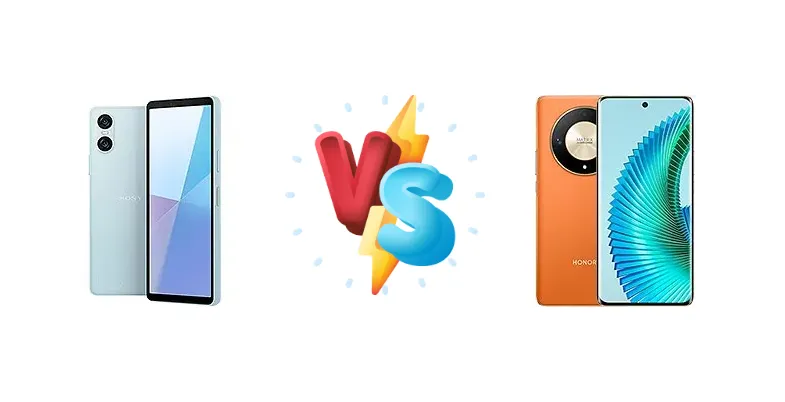
The Sony Xperia 10 VI and Honor Magic6 Lite represent compelling options in the increasingly competitive mid-range smartphone market. Both devices leverage the Qualcomm Snapdragon 6 Gen 1 chipset, but diverge in their approach to battery optimization, display technology, and charging capabilities. This comparison dissects these differences to determine which phone delivers the best overall experience.
🏆 Quick Verdict
For users prioritizing sustained battery life and a brighter display, the Sony Xperia 10 VI emerges as the winner. Its 13:56h active use score and 1010 nits peak brightness provide a tangible advantage. However, the Honor Magic6 Lite’s 35W charging offers a quicker top-up, making it a strong contender for those valuing convenience.
| Network |
|---|
| 2G bands | GSM 850 / 900 / 1800 / 1900 | GSM 850 / 900 / 1800 / 1900 |
| 3G bands | HSDPA 850 / 900 / 1700(AWS) / 2100 | HSDPA 850 / 900 / 1900 / 2100 |
| 4G bands | 1, 3, 4, 5, 7, 8, 20, 28, 38, 39, 40, 41 | LTE |
| 5G bands | 1, 3, 5, 7, 8, 20, 28, 38, 40, 41, 77, 78, 79 SA/NSA | SA/NSA |
| Speed | HSPA, LTE, 5G | HSPA, LTE, 5G |
| Technology | GSM / HSPA / LTE / 5G | GSM / HSPA / LTE / 5G |
| Launch |
|---|
| Announced | 2024, May 15 | 2023, December 04 |
| Status | Available. Released 2024, June 13 | Available. Released 2023, December 27 |
| Body |
|---|
| Build | Glass front (Gorilla Glass Victus), plastic frame, plastic back | - |
| Dimensions | 155 x 68 x 8.3 mm (6.10 x 2.68 x 0.33 in) | 163.6 x 75.5 x 8 mm (6.44 x 2.97 x 0.31 in) |
| SIM | · Nano-SIM + eSIM· Nano-SIM + Nano-SIM | Nano-SIM + Nano-SIM |
| Weight | 164 g (5.78 oz) | 185 g (6.53 oz) |
| Display |
|---|
| Protection | Corning Gorilla Glass Victus | - |
| Resolution | 1080 x 2520 pixels, 21:9 ratio (~449 ppi density) | 1220 x 2652 pixels, 19.5:9 ratio (~431 ppi density) |
| Size | 6.1 inches, 86.9 cm2 (~82.5% screen-to-body ratio) | 6.78 inches, 112.6 cm2 (~91.2% screen-to-body ratio) |
| Type | OLED, 1B colors, HDR | AMOLED, 1B colors, 120Hz, 1200 nits (peak) |
| Platform |
|---|
| CPU | Octa-core (4x2.2 GHz Cortex-A78 & 4x1.8 GHz Cortex-A55) | Octa-core (4x2.2 GHz Cortex-A78 & 4x1.8 GHz Cortex-A55) |
| Chipset | Qualcomm SM6450 Snapdragon 6 Gen 1 (4 nm) | Qualcomm SM6450 Snapdragon 6 Gen 1 (4 nm) |
| GPU | Adreno 710 | Adreno 710 |
| OS | Android 14, upgradable to Android 16, up to 3 major Android upgrades | Android 13, Magic OS 7.2 |
| Memory |
|---|
| Card slot | microSDXC (uses shared SIM slot) | No |
| Internal | 128GB 8GB RAM | 256GB 8GB RAM, 512GB 8GB RAM |
| Main Camera |
|---|
| Dual | 48 MP, f/1.8, 26mm (wide), 1/2.0", 0.8µm, PDAF, OIS
8 MP, f/2.2, 120˚, 16mm (ultrawide), 1/4.0", 1.12µm | - |
| Features | LED flash, HDR, panorama | LED flash, panorama, HDR |
| Triple | - | 108 MP, f/1.8, (wide), 1/1.67", PDAF
5 MP, f/2.2, (ultrawide)
2 MP (macro) |
| Video | 4K@30fps, 1080p@30/60/120fps, gyro-EIS, OIS | 4K@30fps, 1080p@30fps |
| Selfie camera |
|---|
| Features | HDR | - |
| Single | 8 MP, f/2.0, 26mm (wide), 1/4.0", 1.12µm | 16 MP, f/2.5, (wide) |
| Video | 1080p@30fps | 1080p@30fps |
| Sound |
|---|
| 35mm jack | Yes | No |
| Loudspeaker | Yes, with stereo speakers | Yes |
| Comms |
|---|
| Bluetooth | 5.2, A2DP, LE, aptX HD, aptX Adaptive | 5.1, A2DP, LE |
| NFC | Yes | Yes (market/region dependent) |
| Positioning | GPS, GLONASS, GALILEO, BDS, QZSS | GPS, GLONASS, GALILEO, BDS |
| Radio | No | No |
| USB | USB Type-C 2.0, OTG | USB Type-C 2.0, OTG |
| WLAN | Wi-Fi 802.11 a/b/g/n/ac, dual-band, Wi-Fi Direct | Wi-Fi 802.11 a/b/g/n/ac, dual-band, Wi-Fi Direct |
| Features |
|---|
| Sensors | Fingerprint (side-mounted), accelerometer, gyro, proximity, compass | Fingerprint (under display, optical), accelerometer, gyro, proximity, compass |
| Battery |
|---|
| Charging | Wired, PD, QC | 35W wired
Reverse wired |
| Type | 5000 mAh | Market-dependent versions:· Li-Po 5300 mAh (Europe)· Li-Po 5800 mAh (LATAM) |
| Misc |
|---|
| Colors | Blue, Black, White | Sunrise Orange, Midnight Black, Emerald Green |
| Models | XQ-ES54, XQ-ES72, XQ-ES72/L2TWCX0, XQ-ES72/B2TWCX0, XQ-ES72/W2TWCX0, XQES54EUKCB.GC | ALI-NX3 |
| Price | € 342.14 / $ 799.00 / £ 317.49 | About 180 EUR |
Sony Xperia 10 VI
- Longer battery life (13:56h active use)
- Brighter display (1010 nits)
- Efficient Snapdragon 6 Gen 1 chipset
- Charging speed likely slower than Magic6 Lite
- Camera specifications are unknown
Honor Magic6 Lite
- Faster 35W wired charging
- Reverse wired charging capability
- Snapdragon 6 Gen 1 chipset
- Shorter battery life (13:08h active use)
- Display brightness likely lower than Xperia 10 VI
Display Comparison
Both the Xperia 10 VI and Magic6 Lite utilize OLED displays, but the Xperia 10 VI boasts a significantly brighter panel, reaching a measured 1010 nits. This translates to superior visibility under direct sunlight, a crucial advantage for outdoor users. While the Magic6 Lite’s display specs aren’t provided, the brightness difference is a key differentiator. The absence of information on PWM dimming frequency for either device makes it difficult to assess potential eye strain, but users sensitive to flicker should investigate further.
Camera Comparison
Detailed camera specifications are limited. Without sensor size, aperture, or OIS details, a direct comparison is challenging. The focus should be on image processing algorithms and real-world photo samples. The absence of information suggests neither phone prioritizes a flagship-level camera experience. The inclusion of a 2MP macro camera on either device is likely a marketing tactic, offering limited practical benefit due to its small sensor size and low resolution.
Performance
Both devices are powered by the Qualcomm Snapdragon 6 Gen 1 (4nm) chipset, featuring an octa-core CPU configuration with 4x2.2 GHz Cortex-A78 and 4x1.8 GHz Cortex-A55 cores. This indicates comparable processing power for everyday tasks and moderate gaming. The 4nm fabrication process contributes to improved thermal efficiency compared to older nodes, minimizing throttling during sustained workloads. However, RAM specifications are missing; faster LPDDR5x RAM would provide a noticeable performance boost, particularly for multitasking.
Battery Life
The Sony Xperia 10 VI delivers a superior active use battery score of 13:56h, outperforming the Honor Magic6 Lite’s 13:08h. While the difference isn’t massive, it represents a noticeable improvement in endurance. The Magic6 Lite compensates with 35W wired charging, including reverse wired charging, allowing it to top up faster and even function as a power bank for other devices. The Xperia 10 VI’s charging speed is unspecified, suggesting it’s likely slower, potentially requiring longer to reach a full charge.
Buying Guide
Buy the Sony Xperia 10 VI if you need exceptional battery endurance for all-day use and appreciate a brighter, more visible screen in outdoor conditions. Buy the Honor Magic6 Lite if you prioritize faster charging speeds and appreciate the convenience of reverse wired charging, even if it means slightly less overall battery life.
Frequently Asked Questions
❓ Does the Snapdragon 6 Gen 1 in either phone struggle with demanding games like Genshin Impact?
The Snapdragon 6 Gen 1 is a capable mid-range chipset, but demanding titles like Genshin Impact will likely require reduced graphics settings for smooth gameplay on both the Xperia 10 VI and Magic6 Lite. Thermal throttling could also become a factor during extended gaming sessions.
❓ Is the 35W charging on the Honor Magic6 Lite significantly faster in real-world use?
Yes, 35W charging is noticeably faster than typical slower charging standards. While a precise 0-100% time isn't available, the Magic6 Lite will likely reach a full charge in under 90 minutes, offering a significant convenience advantage over the Xperia 10 VI, which likely charges at a slower rate.
❓ How does the lack of detailed camera specs impact the photo quality comparison?
Without knowing sensor sizes, apertures, or OIS implementation, it's impossible to definitively say which phone takes better photos. Image processing algorithms play a crucial role, and real-world photo samples are essential for evaluating camera performance. Expect both phones to perform adequately in good lighting conditions, but struggle in low-light scenarios.