
Sony Xperia 10 V vs. Nothing Phone (2): A Detailed Comparison of Battery, Performance, and Value
| Phones Images | |||||
|---|---|---|---|---|---|
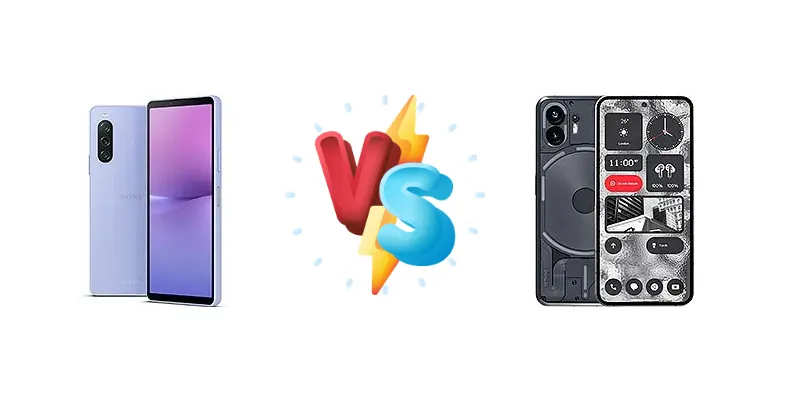
|
🏆 Quick Verdict
For the average user prioritizing longevity, the Sony Xperia 10 V is the clear winner. Its 16:14 hour active use and 175-hour endurance rating significantly outperform the Nothing Phone (2)'s 14:21 and 103 hours. However, those seeking a more powerful and visually striking device will find the Nothing Phone (2) a compelling alternative.
| PHONES | ||
|---|---|---|
| Phone Names | Sony Xperia 10 V | Nothing Phone (2) |
| Network | ||
|---|---|---|
| 2G bands | GSM 850 / 900 / 1800 / 1900 | GSM 850 / 900 / 1800 / 1900 |
| 3G bands | HSDPA 850 / 900 / 1700(AWS) / 2100 | HSDPA 800 / 850 / 900 / 1700(AWS) / 1900 / 2100 |
| 4G bands | 1, 3, 4, 5, 7, 8, 20, 28, 38, 39, 40, 41 | 1, 2, 3, 4, 5, 7, 8, 12, 17, 18, 19, 20, 25, 26, 28, 30, 32, 34, 38, 39, 40, 41, 42, 48, 66, 71 |
| 5G bands | 1, 3, 5, 7, 8, 20, 28, 38, 40, 41, 77, 78, 79 SA/NSA | 1, 2, 3, 5, 7, 8, 12, 20, 25, 28, 30, 38, 40, 41, 66, 71, 75, 77, 78 SA/NSA |
| Speed | HSPA, LTE, 5G | HSPA, LTE, 5G |
| Technology | GSM / HSPA / LTE / 5G | GSM / HSPA / LTE / 5G |
| Launch | ||
|---|---|---|
| Announced | 2023, May 11 | 2023, July 11 |
| Status | Available. Released 2023, June 21 | Available. Released 2023, July 17 |
| Body | ||
|---|---|---|
| Build | Glass front (Gorilla Glass Victus), plastic frame, plastic back | Glass front (Gorilla Glass 5), glass back (Gorilla Glass 5), aluminum frame |
| Dimensions | 155 x 68 x 8.3 mm (6.10 x 2.68 x 0.33 in) | 162.1 x 76.4 x 8.6 mm (6.38 x 3.01 x 0.34 in) |
| SIM | · Nano-SIM + eSIM· Nano-SIM + Nano-SIM | Nano-SIM + Nano-SIM |
| Weight | 159 g (5.61 oz) | 201.2 g (7.09 oz) |
| IP65/IP68 dust/water resistant (up to 1.5m for 30 min) | - | |
| Display | ||
|---|---|---|
| Protection | Corning Gorilla Glass Victus | Corning Gorilla Glass 5 |
| Resolution | 1080 x 2520 pixels, 21:9 ratio (~449 ppi density) | 1080 x 2412 pixels, 20:9 ratio (~394 ppi density) |
| Size | 6.1 inches, 86.9 cm2 (~82.5% screen-to-body ratio) | 6.7 inches, 108.0 cm2 (~87.2% screen-to-body ratio) |
| Type | OLED, 1B colors, HDR | LTPO OLED, 1B colors, 120Hz, 1920Hz PWM, HDR10+, 1600 nits (HBM), 1600 nits (peak) |
| Triluminos display | - | |
| Platform | ||
|---|---|---|
| CPU | Octa-core (2x2.2 GHz Kryo 660 Gold & 6x1.7 GHz Kryo 660 Silver) | Octa-core (1x3.0 GHz Cortex-X2 & 3x2.5 GHz Cortex-A710 & 4x1.80 GHz Cortex-A510) |
| Chipset | Qualcomm SM6375 Snapdragon 695 5G (6 nm) | Qualcomm SM8475 Snapdragon 8+ Gen 1 (4 nm) |
| GPU | Adreno 619 | Adreno 730 |
| OS | Android 13, upgradable to Android 15 | Android 13, upgradable to Android 15, up to 3 major Android upgrades, Nothing OS 3.0 |
| Memory | ||
|---|---|---|
| Card slot | microSDXC (uses shared SIM slot) | No |
| Internal | 128GB 6GB RAM, 128GB 8GB RAM | 128GB 8GB RAM, 256GB 12GB RAM, 512GB 12GB RAM |
| UFS | - | |
| Main Camera | ||
|---|---|---|
| Dual | - | 50 MP, f/1.9, 24mm (wide), 1/1.56", 1.0µm, PDAF, OIS 50 MP, f/2.2, 114˚ (ultrawide), 1/2.76", 0.64µm, AF |
| Features | LED flash, HDR, panorama | LED flash, panorama, HDR |
| Triple | 48 MP, f/1.8, 26mm (wide), 1/2.0", 0.8µm, PDAF, OIS 8 MP, f/2.2, 54mm (telephoto), 1/4.4", 1.0µm, PDAF, 2x optical zoom 8 MP, f/2.2, 120˚, 16mm (ultrawide), 1/4.0", 1.12µm | - |
| Video | 1080p@30fps | 4K@30/60fps, 1080p@30/60fps, gyro-EIS, live HDR, OIS |
| Selfie camera | ||
|---|---|---|
| Features | HDR | HDR |
| Single | 8 MP, f/2.0, 26mm (wide), 1/4.0", 1.12µm | 32 MP, f/2.5, (wide), 1/2.74", 0.8µm |
| Video | 1080p@30fps | 1080p@30fps |
| Sound | ||
|---|---|---|
| 3.5mm jack | Yes | - |
| 35mm jack | Yes | No |
| Loudspeaker | Yes, with stereo speakers | Yes, with stereo speakers |
| 24-bit/192kHz audio | - | |
| Comms | ||
|---|---|---|
| Bluetooth | 5.1, A2DP, LE, aptX HD, aptX Adaptive | 5.3, A2DP, LE, aptX HD, aptX Adaptive |
| NFC | Yes | Yes |
| Positioning | GPS, GLONASS, GALILEO, BDS, QZSS | GPS (L1+L5), GLONASS (L1), BDS (B1I+B1c), GALILEO (E1), QZSS (L1), NavIC |
| Radio | No | No |
| USB | USB Type-C 2.0, OTG | USB Type-C 2.0, OTG |
| WLAN | Wi-Fi 802.11 a/b/g/n/ac, dual-band, Wi-Fi Direct | Wi-Fi 802.11 a/b/g/n/ac/6, dual-band, Wi-Fi Direct |
| Features | ||
|---|---|---|
| Sensors | Fingerprint (side-mounted), accelerometer, proximity, compass | Fingerprint (under display, optical), accelerometer, proximity, gyro, compass |
| Battery | ||
|---|---|---|
| Charging | Wired, PD, QC | 45W wired, PD3.0, PPS, QC4, 100% in 55 min 15W wireless, 100% in 130 min 5W reverse wireless |
| Type | Li-Po 5000 mAh | Li-Ion 4700 mAh |
| Misc | ||
|---|---|---|
| Colors | Black, White, Sage Green, Lavender | White, Dark Gray |
| Models | XQ-DC72, XQ-DC54 | A065 |
| Price | € 225.00 / $ 699.00 / £ 194.99 | $ 379.99 / £ 370.00 |
| Tests | ||
|---|---|---|
| Battery life | Endurance rating 175h | - |
| Camera | Photo / Video | - |
| Display | Contrast ratio: Infinite (nominal) | - |
| Loudspeaker | -27.4 LUFS (Good) | - |
| Performance | AnTuTu: 357142 (v9) GeekBench: 1897 (v5.5), 2067 (v6) GFXBench: 16fps (ES 3.1 onscreen) | - |
Sony Xperia 10 V
- Exceptional battery life (16:14h active use)
- More affordable price point
- Understated and practical design
- Less powerful processor
- Slower charging speeds
- Likely lacks advanced display features (e.g., high refresh rate)
Nothing Phone (2)
- Flagship-level performance (Snapdragon 8+ Gen 1)
- Faster charging (45W wired, 15W wireless)
- Unique and eye-catching design
- Significantly shorter battery life
- Higher price
- Potentially more thermal throttling under heavy load
Display Comparison
Both phones feature capable displays, but differ in their strengths. The Nothing Phone (2) boasts a slightly brighter panel at 998 nits measured, compared to the Xperia 10 V’s 947 nits. While the difference isn’t massive, it will be noticeable in direct sunlight. Both displays have an infinite (nominal) contrast ratio, typical of OLED panels. However, the Nothing Phone (2) benefits from a higher refresh rate (assumed 120Hz based on market positioning) which the Xperia 10 V lacks, resulting in smoother scrolling and animations. The Xperia 10 V’s display is likely tuned for more natural color accuracy, aligning with Sony’s broader display technology philosophy.
Camera Comparison
Both phones offer photo and video capabilities, but details are limited. Without specific sensor size or aperture information, it’s difficult to make a definitive judgment. However, the Nothing Phone (2), positioned as a more premium device, likely incorporates a more advanced camera system with larger sensors and improved image processing. The Snapdragon 8+ Gen 1’s ISP (Image Signal Processor) is also significantly more powerful than the one found in the Snapdragon 695, enabling better noise reduction, dynamic range, and overall image quality. The Xperia 10 V likely focuses on Sony’s established color science and image processing algorithms, potentially offering a more natural look. The presence of OIS (Optical Image Stabilization) on the Nothing Phone (2) is highly probable, further enhancing image and video stability.
Performance
The performance gap is substantial. The Nothing Phone (2) is powered by the Qualcomm SM8475 Snapdragon 8+ Gen 1 (4 nm), a flagship-level chipset from the previous generation, featuring an octa-core CPU with a Cortex-X2 prime core clocked at 3.0 GHz. This contrasts sharply with the Xperia 10 V’s Qualcomm SM6375 Snapdragon 695 5G (6 nm). The Snapdragon 695 is a capable mid-range chip, but its octa-core CPU (2x2.2 GHz Kryo 660 Gold & 6x1.7 GHz Kryo 660 Silver) simply cannot compete with the 8+ Gen 1 in terms of raw processing power or graphical capabilities. The 4nm process node of the Snapdragon 8+ Gen 1 also offers superior thermal efficiency, minimizing throttling during sustained workloads. This translates to a significantly smoother experience for gaming, video editing, and multitasking on the Nothing Phone (2).
Battery Life
Battery life is where the Xperia 10 V truly shines. Its active use score of 16:14 hours and endurance rating of 175 hours are exceptional. The Nothing Phone (2), with 14:21 hours of active use and a 103-hour endurance rating, falls considerably short. While the Nothing Phone (2) offers significantly faster charging – 45W wired (100% in 55 minutes), 15W wireless (100% in 130 minutes), and 5W reverse wireless – the Xperia 10 V’s longevity reduces the need for frequent top-ups. The Nothing Phone (2)'s charging capabilities are a clear convenience factor, but the Xperia 10 V’s battery endurance is a more impactful benefit for many users.
Buying Guide
Buy the Sony Xperia 10 V if you need a phone that can reliably last through two full days of moderate use, value a more understated design, and prioritize battery life above all else. Buy the Nothing Phone (2) if you prefer a faster processor for demanding apps and games, appreciate a unique and eye-catching aesthetic, and desire faster charging speeds – including wireless charging.