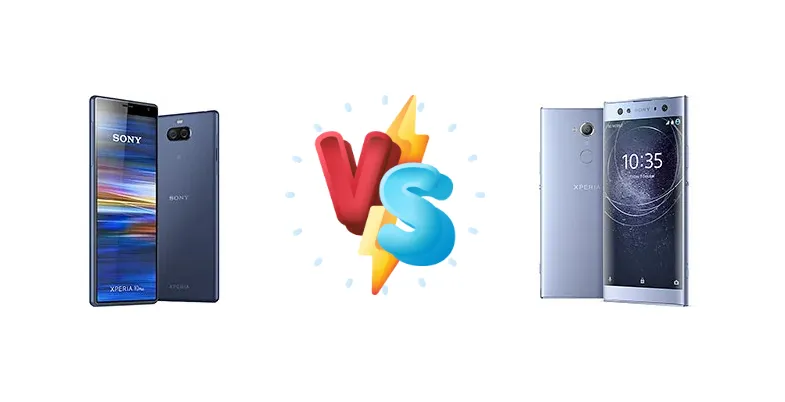
Sony's Xperia line offers a unique blend of features, often prioritizing display quality and audio. But which of these older models, the Xperia 10 Plus and the Xperia XA2 Ultra, holds up best today? We'll dive deep into their specs and performance to help you decide.
🏆 Quick Verdict
The Xperia XA2 Ultra edges out the 10 Plus thanks to its superior sunlight readability and slightly better battery endurance. While both offer excellent displays, the XA2 Ultra's overall package, including its more compact design, makes it a stronger contender for budget-conscious users.
| Network |
|---|
| 2G bands | GSM 850 / 900 / 1800 / 1900 | GSM 850 / 900 / 1800 / 1900 - SIM 1 & SIM 2 (dual-SIM model only) |
| 3G bands | HSDPA 850 / 900 / 1900 / 2100 - I3213, I4213, I4293 | HSDPA 850 / 900 / 1900 / 2100 - H3213, H4213, H4233 |
| 4G bands | 1, 2, 3, 5, 7, 8, 20, 28, 32, 38 - I3213, I4213 | 1, 2, 3, 5, 7, 8, 20, 38 - H3213, H4213 |
| Speed | HSPA 42.2/5.76 Mbps, LTE (2CA) Cat12 600/50 Mbps | HSPA 42.2/5.76 Mbps, LTE (3CA) Cat13 600/150 Mbps |
| Technology | GSM / HSPA / LTE | GSM / HSPA / LTE |
| | 1, 2, 3, 4, 5, 7, 8, 12, 13, 17, 25, 28, 29, 66 - I3223 | - |
| Launch |
|---|
| Announced | 2019, February 25. Released 2019, February 27 | 2018, January. Released 2018, February |
| Status | Discontinued | Discontinued |
| Body |
|---|
| Build | Glass front (Gorilla Glass 5), plastic back, plastic frame | Glass front (Gorilla Glass 4), plastic back, aluminum frame |
| Dimensions | 167 x 73 x 8.3 mm (6.57 x 2.87 x 0.33 in) | 163 x 80 x 9.5 mm (6.42 x 3.15 x 0.37 in) |
| SIM | · Nano-SIM· Nano-SIM + Nano-SIM | · Nano-SIM· Nano-SIM + Nano-SIM |
| Weight | 180 g (6.35 oz) | 221 g (7.80 oz) |
| Display |
|---|
| Protection | Corning Gorilla Glass 5 | Corning Gorilla Glass 4 |
| Resolution | 1080 x 2520 pixels, 21:9 ratio (~422 ppi density) | 1080 x 1920 pixels, 16:9 ratio (~367 ppi density) |
| Size | 6.5 inches, 98.7 cm2 (~81.0% screen-to-body ratio) | 6.0 inches, 99.2 cm2 (~76.1% screen-to-body ratio) |
| Type | IPS LCD | IPS LCD |
| Platform |
|---|
| CPU | Octa-core (4x1.8 GHz Kryo 260 Gold & 4x1.6 GHz Kryo 260 Silver) | Octa-core 2.2 GHz Cortex-A53 |
| Chipset | Qualcomm SDM636 Snapdragon 636 (14 nm) | Qualcomm SDM630 Snapdragon 630 (14 nm) |
| GPU | Adreno 509 | Adreno 508 |
| OS | Android 9.0 (Pie) | Android 8.0 (Oreo), upgradable to Android 9.0 (Pie) |
| Memory |
|---|
| Card slot | microSDXC (uses shared SIM slot) | microSDXC (dedicated slot) |
| Internal | 64GB 4GB RAM, 64GB 6GB RAM | 32GB 4GB RAM, 64GB 4GB RAM |
| | eMMC 5.1 | - |
| Main Camera |
|---|
| Dual | 12 MP, f/1.8, 27mm (wide), 1/2.8", 1.25µm, PDAF
8 MP, f/2.4, 53mm (telephoto), 1/4.0", 1.12µm, PDAF, 2x optical zoom | - |
| Features | LED flash, HDR, panorama | LED flash, HDR, panorama |
| Single | - | 23 MP, f/2.0, 24mm (wide), 1/2.3", PDAF |
| Video | 4K@30fps, 1080p@30fps | 4K@30fps, 1080p@30fps, stereo sound rec., HDR |
| Selfie camera |
|---|
| Dual | - | 16 MP, f/2.0, 23mm (wide), 1/2.6", OIS, AF
8 MP, f/2.4, 1/4.0" |
| Features | HDR | - |
| Single | 8 MP, f/2.0, 24mm (wide), 1/4.0", 1.12µm | - |
| Video | 1080p@30fps | 1080p@30ps |
| Sound |
|---|
| 3.5mm jack | Yes | Yes |
| 35mm jack | Yes | Yes |
| Loudspeaker | Yes | Yes |
| | 24-bit/192kHz audio
| - |
| Comms |
|---|
| Bluetooth | 5.0, A2DP, LE, aptX HD | 5.0, A2DP, aptX HD, LE |
| NFC | Yes | Yes |
| Positioning | GPS, GLONASS | GPS, GLONASS |
| Radio | FM radio | FM radio |
| USB | USB Type-C 2.0, OTG | USB Type-C 2.0, OTG |
| WLAN | Wi-Fi 802.11 a/b/g/n/ac, dual-band, Wi-Fi Direct | Wi-Fi 802.11 a/b/g/n/ac, dual-band, Wi-Fi Direct |
| Features |
|---|
| Sensors | Fingerprint (side-mounted), accelerometer, proximity, compass | Fingerprint (rear-mounted), accelerometer, proximity, compass |
| Battery |
|---|
| Charging | 18W wired, PD, QC3 | 18W wired, QC3 |
| Type | Li-Ion 3000 mAh, non-removable | Li-Ion 3580 mAh, non-removable |
| Misc |
|---|
| Colors | Black, Navy, Silver, Gold | Silver, Black, Blue, Gold |
| Models | I3213, I4213, I4293, I3223 | H4213, H4233, H3213, H3223 |
| Price | About 560 EUR | About 260 EUR |
| Tests |
|---|
| Audio quality |
Noise -92.4dB / Crosstalk -96.7dB |
Noise -67.7dB / Crosstalk -92.7dB |
| Battery life |
Endurance rating 78h
| Endurance rating 100h |
| Camera |
Photo / Video |
Photo / Video |
| Display |
Contrast ratio: 1530:1 (nominal) |
Contrast ratio: 1562:1 (nominal), 3.445 (sunlight) |
| Loudspeaker |
-28.8 LUFS (Average)
|
Voice 68dB / Noise 73dB / Ring 80dB |
| Performance |
AnTuTu: 120573 (v7), 147163 (v8)
GeekBench: 4780 (v4.4), 1238 (v5.1)
GFXBench: 5fps (ES 3.1 onscreen) |
AnTuTu: 89110 (v7)
GeekBench: 4198 (v4.4)
GFXBench: 6fps (ES 3.1 onscreen) |
Sony Xperia 10 Plus
- Larger Display
- Slightly Newer Chipset (SDM636)
- PD & QC3 Charging
- Lower Battery Endurance
- Less Sunlight Readable Display
- Older Design
Sony Xperia XA2 Ultra
- Excellent Sunlight Readability
- Longer Battery Life
- More Compact Design
- Superior Front-Facing Cameras
- Older Chipset (SDM630)
- Less Modern Design
- No NFC (likely)
Display Comparison
Both phones boast impressive contrast ratios (1530:1 for the 10 Plus, 1562:1 for the XA2 Ultra). However, the XA2 Ultra shines with a remarkable 3.445 sunlight readability rating, making it significantly easier to view outdoors. The 10 Plus has a larger display, which some may prefer, but the XA2 Ultra's screen is arguably more usable in bright conditions.
Camera Comparison
Camera performance is comparable between the two. Both offer Photo/Video capabilities, but specific sensor details and image processing algorithms differ. Expect decent image quality in good lighting conditions, but low-light performance will be a weakness on both devices. The XA2 Ultra's front-facing cameras are a notable advantage, offering more versatility for selfies and video calls.
Performance
The Xperia 10 Plus utilizes a Qualcomm SDM636 Snapdragon 636, while the XA2 Ultra features a Qualcomm SDM630 Snapdragon 630. While both are mid-range chipsets, the 636 generally offers a slight performance advantage. However, in everyday use, the difference is likely minimal. Both phones will handle basic tasks and moderate gaming without issue.
Battery Life
The Xperia XA2 Ultra takes the lead in battery life, boasting an endurance rating of 100 hours compared to the 10 Plus's 78 hours. This difference translates to noticeably longer usage between charges, a significant benefit for users who prioritize longevity.
Buying Guide
Who should buy the Sony Xperia 10 Plus? Users prioritizing a larger screen and slightly more modern chipset might find value. Who should buy the Sony Xperia XA2 Ultra? Those seeking exceptional sunlight visibility, a more compact form factor, and slightly longer battery life will likely prefer the XA2 Ultra.
Frequently Asked Questions
❓ Which phone is better for outdoor use?
The Xperia XA2 Ultra is significantly better for outdoor use due to its exceptional sunlight readability rating.
❓ Is the Xperia 10 Plus worth buying over the XA2 Ultra?
It depends on your priorities. If you need a larger screen and a slightly more modern chipset, the 10 Plus might be suitable. Otherwise, the XA2 Ultra offers better value with its superior battery life and sunlight visibility.