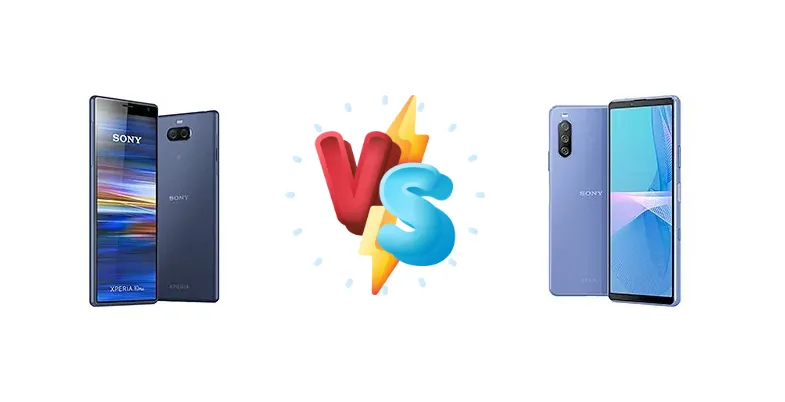
The Sony Xperia 10 series has consistently offered a compelling blend of features and affordability. But with the release of the Xperia 10 III, is it time to upgrade from the older Xperia 10 Plus? This comprehensive comparison will delve into the key differences to help you decide.
🏆 Quick Verdict
The Xperia 10 III is the clear winner, boasting a significantly improved chipset, 5G connectivity, and a brighter display. While the 10 Plus still offers impressive battery life, the 10 III's advancements make it a worthwhile upgrade for most users.
| Network |
|---|
| 2G bands | GSM 850 / 900 / 1800 / 1900 | GSM 850 / 900 / 1800 / 1900 |
| 3G bands | HSDPA 850 / 900 / 1900 / 2100 - I3213, I4213, I4293 | HSDPA 850 / 900 / 1700(AWS) / 2100 |
| 4G bands | 1, 2, 3, 5, 7, 8, 20, 28, 32, 38 - I3213, I4213 | 1, 3, 4, 5, 7, 8, 20, 28, 38, 39, 40, 41 |
| 5G bands | - | 1, 3, 7, 8, 28, 77, 78 SA/NSA |
| Speed | HSPA 42.2/5.76 Mbps, LTE (2CA) Cat12 600/50 Mbps | HSPA, LTE, 5G |
| Technology | GSM / HSPA / LTE | GSM / HSPA / LTE / 5G |
| | 1, 2, 3, 4, 5, 7, 8, 12, 13, 17, 25, 28, 29, 66 - I3223 | - |
| Launch |
|---|
| Announced | 2019, February 25. Released 2019, February 27 | 2021, April 14 |
| Status | Discontinued | Available. Released 2021, June 11 |
| Body |
|---|
| Build | Glass front (Gorilla Glass 5), plastic back, plastic frame | Glass front (Gorilla Glass 6), glass back (Gorilla Glass 6), plastic frame |
| Dimensions | 167 x 73 x 8.3 mm (6.57 x 2.87 x 0.33 in) | 154 x 68 x 8.3 mm (6.06 x 2.68 x 0.33 in) |
| SIM | · Nano-SIM· Nano-SIM + Nano-SIM | · Nano-SIM· Nano-SIM + Nano-SIM |
| Weight | 180 g (6.35 oz) | 169 g (5.96 oz) |
| | - | IP65/IP68 dust/water resistant (up to 1.5m for 30 mins) |
| Display |
|---|
| Protection | Corning Gorilla Glass 5 | Corning Gorilla Glass 6 |
| Resolution | 1080 x 2520 pixels, 21:9 ratio (~422 ppi density) | 1080 x 2520 pixels, 21:9 ratio (~457 ppi density) |
| Size | 6.5 inches, 98.7 cm2 (~81.0% screen-to-body ratio) | 6.0 inches, 84.1 cm2 (~80.3% screen-to-body ratio) |
| Type | IPS LCD | OLED, 1B colors, HDR |
| | - | Triluminos display |
| Platform |
|---|
| CPU | Octa-core (4x1.8 GHz Kryo 260 Gold & 4x1.6 GHz Kryo 260 Silver) | Octa-core (2x2.0 GHz Kryo 560 Gold & 6x1.7 GHz Kryo 560 Silver) |
| Chipset | Qualcomm SDM636 Snapdragon 636 (14 nm) | Qualcomm SM6350 Snapdragon 690 5G (8 nm) |
| GPU | Adreno 509 | Adreno 619 |
| OS | Android 9.0 (Pie) | Android 11, upgradable to Android 13 |
| Memory |
|---|
| Card slot | microSDXC (uses shared SIM slot) | microSDXC (uses shared SIM slot) |
| Internal | 64GB 4GB RAM, 64GB 6GB RAM | 128GB 6GB RAM, 256GB 6GB RAM |
| | eMMC 5.1 | UFS |
| Main Camera |
|---|
| Dual | 12 MP, f/1.8, 27mm (wide), 1/2.8", 1.25µm, PDAF
8 MP, f/2.4, 53mm (telephoto), 1/4.0", 1.12µm, PDAF, 2x optical zoom | - |
| Features | LED flash, HDR, panorama | LED flash, HDR, panorama |
| Triple | - | 12 MP, f/1.8, 27mm (wide), 1/2.8", PDAF
8 MP, f/2.4, 54mm (telephoto), 1/4.0", PDAF, 2x optical zoom
8 MP, f/2.2, 120˚, 16mm (ultrawide), 1/4.0" |
| Video | 4K@30fps, 1080p@30fps | 4K@30fps, 1080p@30fps |
| Selfie camera |
|---|
| Features | HDR | HDR |
| Single | 8 MP, f/2.0, 24mm (wide), 1/4.0", 1.12µm | 8 MP, f/2.0, 27mm (wide), 1/4.0" |
| Video | 1080p@30fps | 1080p@30fps |
| Sound |
|---|
| 3.5mm jack | Yes | Yes |
| 35mm jack | Yes | Yes |
| Loudspeaker | Yes | Yes |
| | 24-bit/192kHz audio
| 24-bit/192kHz audio
|
| Comms |
|---|
| Bluetooth | 5.0, A2DP, LE, aptX HD | 5.1, A2DP, LE, aptX HD |
| NFC | Yes | Yes |
| Positioning | GPS, GLONASS | GPS, GLONASS, GALILEO, BDS, QZSS |
| Radio | FM radio | FM radio (region dependent) |
| USB | USB Type-C 2.0, OTG | USB Type-C 3.1, OTG, Display Port |
| WLAN | Wi-Fi 802.11 a/b/g/n/ac, dual-band, Wi-Fi Direct | Wi-Fi 802.11 a/b/g/n/ac, dual-band, Wi-Fi Direct |
| Features |
|---|
| Sensors | Fingerprint (side-mounted), accelerometer, proximity, compass | Fingerprint (side-mounted), accelerometer, proximity, compass |
| Battery |
|---|
| Charging | 18W wired, PD, QC3 | 21W wired (unofficial rating), PD, QC |
| Type | Li-Ion 3000 mAh, non-removable | Li-Po 4500 mAh |
| Misc |
|---|
| Colors | Black, Navy, Silver, Gold | Black, White, Blue, Pink |
| Models | I3213, I4213, I4293, I3223 | SO-52B, SOG04, XQ-BT52, A102SO |
| Price | About 560 EUR | About 300 EUR |
| Tests |
|---|
| Audio quality |
Noise -92.4dB / Crosstalk -96.7dB | - |
| Battery life |
Endurance rating 78h
| Endurance rating 137h |
| Camera |
Photo / Video |
Photo / Video |
| Display |
Contrast ratio: 1530:1 (nominal) |
Contrast ratio: Infinite (nominal) |
| Loudspeaker |
-28.8 LUFS (Average)
|
-28.2 LUFS (Average) |
| Performance |
AnTuTu: 120573 (v7), 147163 (v8)
GeekBench: 4780 (v4.4), 1238 (v5.1)
GFXBench: 5fps (ES 3.1 onscreen) |
AnTuTu: 286216 (v8)
GeekBench: 1738 (v5.1)
GFXBench: 12fps (ES 3.1 onscreen) |
Sony Xperia 10 Plus
- Excellent battery life
- Affordable price
- Good display contrast
- Outdated chipset
- No 5G connectivity
- Lower display brightness
Sony Xperia 10 III
- Faster processor (Snapdragon 690 5G)
- 5G connectivity
- Brighter display
- Improved battery life
- Slightly higher price
- Camera improvements are marginal
Display Comparison
The Xperia 10 III features a noticeable upgrade in display brightness, reaching 559 nits (measured) compared to the 10 Plus's unspecified brightness. While both offer a nominal infinite contrast ratio, the 10 III's higher brightness makes it more usable outdoors. The 10 Plus's display is still good, but the 10 III provides a more vibrant viewing experience.
Camera Comparison
Both phones offer similar camera setups, but the 10 III's newer processor allows for improved image processing and potentially better low-light performance. While neither phone is a photography powerhouse, the 10 III likely delivers slightly better results. Specific camera specs are not significantly different, so software optimization plays a larger role.
Performance
The Snapdragon 690 5G in the Xperia 10 III is a substantial improvement over the Snapdragon 636 in the 10 Plus. Expect smoother multitasking, faster app loading times, and better overall responsiveness. The 10 III's newer chipset also benefits from improved power efficiency.
Battery Life
The Xperia 10 III boasts a significantly improved endurance rating of 137h compared to the 10 Plus's 78h. This translates to noticeably longer battery life on a single charge, a major advantage for users who prioritize longevity.
Buying Guide
Who should buy the Sony Xperia 10 Plus? Those on a tight budget who prioritize exceptional battery life and don't need 5G. Who should buy the Sony Xperia 10 III? Anyone seeking a faster processor, 5G connectivity, a brighter screen, and a more modern Android experience.
Frequently Asked Questions
❓ Is the Xperia 10 III worth upgrading from the Xperia 10 Plus?
Yes, the Xperia 10 III offers significant improvements in performance, display brightness, and battery life, making it a worthwhile upgrade, especially if you want 5G connectivity.
❓ Which phone has better battery life?
The Xperia 10 III has significantly better battery life with an endurance rating of 137h compared to the Xperia 10 Plus's 78h.