
Sony Xperia 10 IV vs Xperia 1 IV: A Clash of Titans
| Phones Images | |||||
|---|---|---|---|---|---|
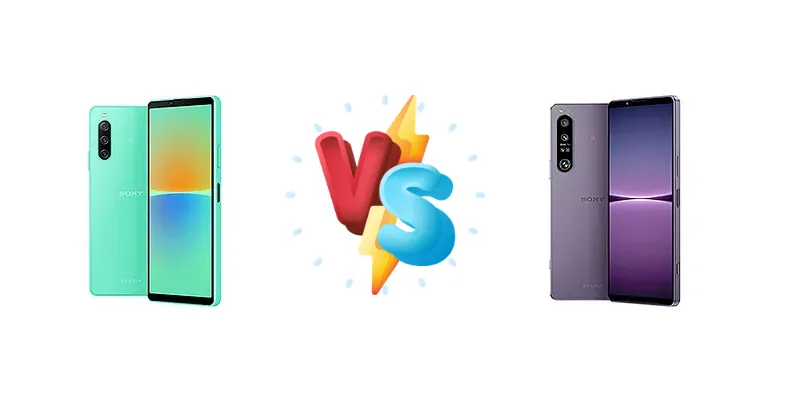
|
🏆 Quick Verdict
The Xperia 1 IV is the clear winner, boasting a significantly more powerful processor, superior camera system, and faster charging. However, the Xperia 10 IV offers exceptional battery life and a more budget-friendly price point, making it a compelling choice for value-conscious users.
| PHONES | ||
|---|---|---|
| Phone Names | Sony Xperia 10 IV | Sony Xperia 1 IV |
| Network | ||
|---|---|---|
| 2G bands | GSM 850 / 900 / 1800 / 1900 | GSM 850 / 900 / 1800 / 1900 |
| 3G bands | HSDPA 850 / 900 / 1700(AWS) / 2100 | HSDPA 800 / 850 / 900 / 1700(AWS) / 1900 / 2100 |
| 4G bands | 1, 3, 4, 5, 7, 8, 20, 28, 38, 39, 40, 41 | 1, 2, 3, 4, 5, 7, 8, 12, 13, 17, 19, 20, 25, 26, 28, 29, 32, 34, 38, 39, 40, 41, 46, 66 - Europe |
| 5G bands | 1, 3, 7, 8, 28, 38, 41, 77, 78, 79 SA/NSA | 1, 3, 5, 7, 8, 20, 28, 38, 40, 41, 77, 78 SA/NSA/Sub6 - Europe |
| Speed | HSPA, LTE, 5G | HSPA, LTE, 5G |
| Technology | GSM / HSPA / LTE / 5G | GSM / HSPA / LTE / 5G |
| - | 1, 3, 5, 7, 8, 28, 38, 40, 41, 77, 78, 79 SA/NSA/Sub6 - Asia | |
| Launch | ||
|---|---|---|
| Announced | 2022, May 11 | 2022, May 11 |
| Status | Available. Released 2022, June 30 | Available. Released 2022, June 11 |
| Body | ||
|---|---|---|
| Build | Glass front (Gorilla Glass Victus), plastic frame, plastic back | Glass front (Gorilla Glass Victus), glass back (Gorilla Glass Victus), aluminum frame |
| Dimensions | 153 x 67 x 8.3 mm (6.02 x 2.64 x 0.33 in) | 165 x 71 x 8.2 mm (6.50 x 2.80 x 0.32 in) |
| SIM | · Nano-SIM + eSIM· Nano-SIM + Nano-SIM | · Nano-SIM + eSIM· Nano-SIM + Nano-SIM |
| Weight | 161 g (5.68 oz) | 185 g (6.53 oz) |
| IP65/IP68 dust/water resistant (up to 1.5m for 30 min) | IP65/IP68 dust/water resistant (up to 1.5m for 30 min) | |
| Display | ||
|---|---|---|
| Protection | Corning Gorilla Glass Victus | Corning Gorilla Glass Victus |
| Resolution | 1080 x 2520 pixels, 21:9 ratio (~457 ppi density) | 1644 x 3840 pixels, 21:9 ratio (~643 ppi density) |
| Size | 6.0 inches, 84.1 cm2 (~82.0% screen-to-body ratio) | 6.5 inches, 98.6 cm2 (~84.2% screen-to-body ratio) |
| Type | OLED, 1B colors, HDR | OLED, 1B colors, 120Hz, HDR BT.2020 |
| Triluminos display | Runs at 1096 x 2560 pixels except for select use cases | |
| Platform | ||
|---|---|---|
| CPU | Octa-core (2x2.2 GHz Kryo 660 Gold & 6x1.7 GHz Kryo 660 Silver) | Octa-core (1x3.00 GHz Cortex-X2 & 3x2.50 GHz Cortex-A710 & 4x1.80 GHz Cortex-A510) |
| Chipset | Qualcomm SM6375 Snapdragon 695 5G (6 nm) | Qualcomm SM8450 Snapdragon 8 Gen 1 (4 nm) |
| GPU | Adreno 619 | Adreno 730 |
| OS | Android 12, upgradable to Android 14 | Android 12, upgradable to Android 13 |
| Memory | ||
|---|---|---|
| Card slot | microSDXC (uses shared SIM slot) | microSDXC (uses shared SIM slot) |
| Internal | 128GB 6GB RAM | 256GB 12GB RAM, 512GB 12GB RAM, 512GB 16GB RAM |
| UFS | UFS 3.X | |
| Main Camera | ||
|---|---|---|
| Features | LED flash, HDR, panorama | Zeiss optics, Zeiss T* lens coating, color spectrum sensor, LED flash, panorama, HDR, eye tracking |
| Single | 8 MP, f/2.0, 27mm (wide), 1/4.0" | 12 MP, f/2.0, 24mm (wide), 1/2.9", 1.25µm |
| Triple | 12 MP, f/1.8, 27mm (wide), 1/2.8", PDAF, OIS 8 MP, f/2.2, 54mm (telephoto), 1/4.4", PDAF, 2x optical zoom 8 MP, f/2.2, 120˚, 16mm (ultrawide), 1/4.0" | 12 MP, f/1.7, 24mm (wide), 1/1.7", 1.8µm, dual pixel PDAF, OIS 12 MP, f/2.3, 85mm (telephoto), f/2.8, 125mm (telephoto), 1/3.5", dual pixel PDAF, 3.5x-5.2x continuous optical zoom, OIS 12 MP, f/2.2, 124˚, 16mm (ultrawide), 1/2.5", dual pixel PDAF 0.3 MP, TOF 3D, (depth) |
| Video | 1080p@30fps | 4K@24/25/30/60/120fps HDR, 1080p@30/60/120fps; 5-axis gyro-EIS, OIS |
| Selfie camera | ||
|---|---|---|
| Features | HDR | HDR |
| Single | 8 MP, f/2.0, 27mm (wide), 1/4.0" | 12 MP, f/2.0, 24mm (wide), 1/2.9", 1.25µm |
| Video | 1080p@30fps | 4K@30fps, 1080p@30/60fps, 5-axis gyro-EIS |
| Sound | ||
|---|---|---|
| 3.5mm jack | Yes | Yes |
| 35mm jack | Yes | Yes |
| Loudspeaker | Yes | Yes, with stereo speakers |
| 24-bit/192kHz audio | 24-bit/192kHz audio Dynamic vibration system | |
| Comms | ||
|---|---|---|
| Bluetooth | 5.1, A2DP, LE, aptX HD, aptX Adaptive | 5.2, A2DP, LE Audio, aptX HD, aptX Adaptive |
| NFC | Yes | Yes |
| Positioning | GPS, GLONASS, GALILEO, BDS, QZSS | GPS, GLONASS, BDS, GALILEO, QZSS |
| Radio | No | No |
| USB | USB Type-C 2.0, OTG | USB Type-C 3.2, OTG, video output |
| WLAN | Wi-Fi 802.11 a/b/g/n/ac, dual-band, Wi-Fi Direct | Wi-Fi 802.11 a/b/g/n/ac/6e, dual-band or tri-band (region dependent), Wi-Fi Direct, DLNA |
| Features | ||
|---|---|---|
| Sensors | Fingerprint (side-mounted), accelerometer, proximity, compass | Fingerprint (side-mounted), accelerometer, gyro, proximity, barometer, compass |
| - | Native Sony Alpha camera support | |
| Battery | ||
|---|---|---|
| Charging | 21W wired (unofficial rating), PD, QC | 30W wired, PD3.0, PPS, 50% in 30 min Wireless Reverse wireless |
| Type | Li-Po 5000 mAh | Li-Po 5000 mAh |
| Misc | ||
|---|---|---|
| Colors | Black, White, Mint, Lavender | Black, Violet, White |
| Models | XQ-CC54, XQ-CC72, SOG07 | XQCT62-B, XQCT54, XQCT54C0V.YD, XQCT54C0B.YD, XQCT54C0W.YD, XQCT54C0V.EEAC, XQCT54C0B.EEAC, XQ-CT72, XQ-CT54, XQ-CT62, SO-51C |
| Price | £ 99.99 / € 112.89 | $ 1,120.00 / € 489.00 |
| Tests | ||
|---|---|---|
| Battery life | Endurance rating 163h | Endurance rating 100h |
| Camera | Photo / Video | Photo / Video |
| Display | Contrast ratio: Infinite (nominal) | Contrast ratio: Infinite (nominal) |
| Loudspeaker | -30.6 LUFS (Below average) | -27.6 LUFS (Good) |
| Performance | AnTuTu: 396008 (v9) GeekBench: 1908 (v5.1) GFXBench: 16fps (ES 3.1 onscreen) | AnTuTu: 838832 (v9) GeekBench: 3403 (v5.1) GFXBench: 74fps (ES 3.1 onscreen) |
Sony Xperia 10 IV
- Exceptional battery life
- More affordable price
- Compact and lightweight design
- 5G connectivity
- Less powerful processor
- No 120Hz refresh rate
- Basic camera system
- Slower charging
Sony Xperia 1 IV
- Flagship performance
- Superior camera system
- 120Hz refresh rate display
- Fast charging (30W wired, wireless)
- Premium design
- Higher price
- Shorter battery life compared to 10 IV
- Can get warm under heavy load
Display Comparison
Both phones feature OLED displays with a nominal infinite contrast ratio. However, the Xperia 1 IV's Snapdragon 8 Gen 1 chipset allows for a smoother 120Hz refresh rate (a feature absent in the 10 IV), resulting in a more fluid visual experience. While the 10 IV hits 683 nits of brightness, the 1 IV manages 602 nits, a relatively minor difference. The 1 IV also has a slightly larger screen size (6.5 inches vs 6.0 inches).
Camera Comparison
The Xperia 1 IV's camera system is a major upgrade. It features a more advanced sensor, improved image processing, and features like 8K video recording. While both phones offer capable photography, the 1 IV consistently produces higher-quality images with better dynamic range and low-light performance. The 1 IV also has a telephoto lens, which the 10 IV lacks.
Performance
The performance gap is substantial. The Xperia 1 IV's Snapdragon 8 Gen 1, with its Cortex-X2 prime core, delivers significantly faster processing speeds and smoother multitasking compared to the Xperia 10 IV's Snapdragon 695 5G. Gaming and demanding applications will run noticeably better on the 1 IV.
Battery Life
The Xperia 10 IV shines in this category. Its endurance rating of 163h significantly surpasses the Xperia 1 IV's 100h. While the 1 IV supports faster 30W charging and wireless charging, the 10 IV's exceptional battery life provides longer usage between charges.
Buying Guide
The Sony Xperia 10 IV is ideal for users prioritizing long battery life, a compact design, and a reasonable price. It's a great option for everyday use and media consumption. The Sony Xperia 1 IV is best suited for photography enthusiasts, power users, and those who demand top-tier performance and a premium experience.