
Sony Xperia 10 IV vs Motorola Edge 30 Neo: A Head-to-Head Showdown
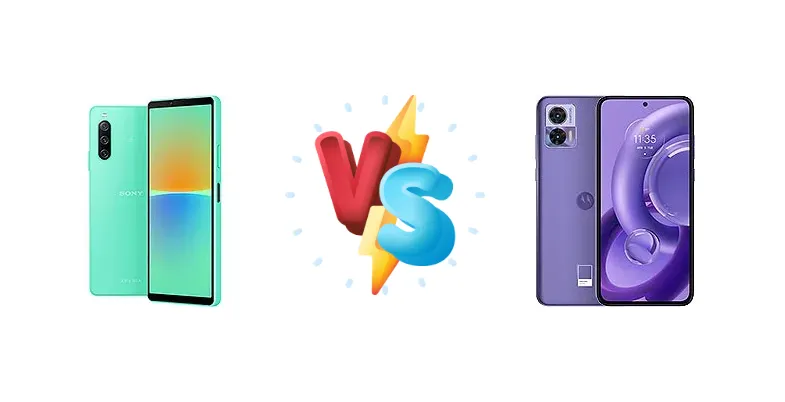
| Phones Images | |||||
|---|---|---|---|---|---|
|
🏆 Quick Verdict
The Motorola Edge 30 Neo takes the crown thanks to its significantly faster charging, brighter display, and generally more modern feel. While the Xperia 10 IV boasts impressive battery life, the Edge 30 Neo's overall package is more appealing for most users.
| PHONES | ||
|---|---|---|
| Phone Names | Sony Xperia 10 IV | Motorola Edge 30 Neo |
| Network | ||
|---|---|---|
| 2G bands | GSM 850 / 900 / 1800 / 1900 | GSM 850 / 900 / 1800 / 1900 |
| 3G bands | HSDPA 850 / 900 / 1700(AWS) / 2100 | HSDPA 850 / 900 / 1700(AWS) / 1900 / 2100 |
| 4G bands | 1, 3, 4, 5, 7, 8, 20, 28, 38, 39, 40, 41 | 1, 2, 3, 4, 5, 7, 8, 12, 17, 20, 25, 26, 28, 32, 38, 40, 41, 42, 43 |
| 5G bands | 1, 3, 7, 8, 28, 38, 41, 77, 78, 79 SA/NSA | 1, 3, 5, 7, 8, 20, 28, 38, 40, 41, 66, 78 SA/NSA |
| Speed | HSPA, LTE, 5G | HSPA, LTE, 5G |
| Technology | GSM / HSPA / LTE / 5G | GSM / HSPA / LTE / 5G |
| Launch | ||
|---|---|---|
| Announced | 2022, May 11 | 2022, September 08 |
| Status | Available. Released 2022, June 30 | Available. Released 2022, October 07 |
| Body | ||
|---|---|---|
| Build | Glass front (Gorilla Glass Victus), plastic frame, plastic back | Glass front, plastic frame, plastic back |
| Dimensions | 153 x 67 x 8.3 mm (6.02 x 2.64 x 0.33 in) | 152.9 x 71.2 x 7.8 mm (6.02 x 2.80 x 0.31 in) |
| SIM | · Nano-SIM + eSIM· Nano-SIM + Nano-SIM | · Nano-SIM· Nano-SIM + Nano-SIM |
| Weight | 161 g (5.68 oz) | 155 g (5.47 oz) |
| IP65/IP68 dust/water resistant (up to 1.5m for 30 min) | Splash and dust resistant | |
| Display | ||
|---|---|---|
| Protection | Corning Gorilla Glass Victus | - |
| Resolution | 1080 x 2520 pixels, 21:9 ratio (~457 ppi density) | 1080 x 2400 pixels, 20:9 ratio (~419 ppi density) |
| Size | 6.0 inches, 84.1 cm2 (~82.0% screen-to-body ratio) | 6.28 inches, 95.2 cm2 (~87.5% screen-to-body ratio) |
| Type | OLED, 1B colors, HDR | P-OLED, 120Hz |
| Triluminos display | - | |
| Platform | ||
|---|---|---|
| CPU | Octa-core (2x2.2 GHz Kryo 660 Gold & 6x1.7 GHz Kryo 660 Silver) | Octa-core (2x2.2 GHz Kryo 660 Gold & 6x1.7 GHz Kryo 660 Silver) |
| Chipset | Qualcomm SM6375 Snapdragon 695 5G (6 nm) | Qualcomm SM6375 Snapdragon 695 5G (6 nm) |
| GPU | Adreno 619 | Adreno 619 |
| OS | Android 12, upgradable to Android 14 | Android 12, planned upgrade to Android 15 |
| Memory | ||
|---|---|---|
| Card slot | microSDXC (uses shared SIM slot) | No |
| Internal | 128GB 6GB RAM | 128GB 6GB RAM, 128GB 8GB RAM, 256GB 8GB RAM |
| UFS | - | |
| Main Camera | ||
|---|---|---|
| Dual | - | 64 MP, f/1.8, (wide), 1/1.97", 0.7µm, PDAF, OIS 13 MP, f/2.2, 120˚ (ultrawide), 1/3.0", 1.12µm, AF |
| Features | LED flash, HDR, panorama | Dual-LED flash, HDR, panorama |
| Single | 8 MP, f/2.0, 27mm (wide), 1/4.0" | - |
| Triple | 12 MP, f/1.8, 27mm (wide), 1/2.8", PDAF, OIS 8 MP, f/2.2, 54mm (telephoto), 1/4.4", PDAF, 2x optical zoom 8 MP, f/2.2, 120˚, 16mm (ultrawide), 1/4.0" | - |
| Video | 1080p@30fps | 1080p@30/60/120fps |
| Selfie camera | ||
|---|---|---|
| Features | HDR | HDR |
| Single | 8 MP, f/2.0, 27mm (wide), 1/4.0" | 32 MP, f/2.4, (wide), 1/3.0", 0.7µm |
| Video | 1080p@30fps | 1080p@30fps |
| Sound | ||
|---|---|---|
| 3.5mm jack | Yes | No |
| 35mm jack | Yes | No |
| Loudspeaker | Yes | Yes, with stereo speakers |
| 24-bit/192kHz audio | - | |
| Comms | ||
|---|---|---|
| Bluetooth | 5.1, A2DP, LE, aptX HD, aptX Adaptive | 5.1, A2DP, LE, aptX HD, aptX Adaptive |
| NFC | Yes | Yes |
| Positioning | GPS, GLONASS, GALILEO, BDS, QZSS | GPS, GLONASS, GALILEO |
| Radio | No | No |
| USB | USB Type-C 2.0, OTG | USB Type-C 3.1, OTG |
| WLAN | Wi-Fi 802.11 a/b/g/n/ac, dual-band, Wi-Fi Direct | Wi-Fi 802.11 a/b/g/n/ac, dual-band, Wi-Fi Direct |
| Features | ||
|---|---|---|
| Sensors | Fingerprint (side-mounted), accelerometer, proximity, compass | Fingerprint (under display, optical), accelerometer, proximity, compass |
| Battery | ||
|---|---|---|
| Charging | 21W wired (unofficial rating), PD, QC | 68W wired 5W wireless |
| Type | Li-Po 5000 mAh | Li-Po 4020 mAh |
| Misc | ||
|---|---|---|
| Colors | Black, White, Mint, Lavender | Very Peri, Black Onyx, Ice Palace, Aqua Foam |
| Models | XQ-CC54, XQ-CC72, SOG07 | XT2245-1 |
| Price | £ 99.99 / € 112.89 | € 156.44 / $ 185.00 / £ 229.00 |
| Tests | ||
|---|---|---|
| Battery life | Endurance rating 163h | Endurance rating 104h |
| Camera | Photo / Video | Photo / Video |
| Display | Contrast ratio: Infinite (nominal) | Contrast ratio: Infinite (nominal) |
| Loudspeaker | -30.6 LUFS (Below average) | -26.4 LUFS (Good) |
| Performance | AnTuTu: 396008 (v9) GeekBench: 1908 (v5.1) GFXBench: 16fps (ES 3.1 onscreen) | AnTuTu: 380818 (v9) GeekBench: 1964 (v5.1) GFXBench: 16fps (ES 3.1 onscreen) |
Sony Xperia 10 IV
- Exceptional battery life
- Reliable camera performance
- Traditional Android experience
- Water and dust resistance (IP68)
- Lower display brightness
- Slower charging speed
- Less modern design
- Can feel slightly dated
Motorola Edge 30 Neo
- Fast 68W charging
- Bright and vibrant display
- Sleek and modern design
- Wireless charging
- Shorter battery life than Xperia 10 IV
- Camera performance can be inconsistent
- Plastic build may feel less premium
Display Comparison
The Motorola Edge 30 Neo shines here with a measured peak brightness of 1004 nits, significantly outperforming the Xperia 10 IV's 683 nits. Both have 'infinite' contrast ratios (a nominal value), but the Edge 30 Neo's higher brightness makes it much more usable outdoors. Both utilize OLED panels, offering excellent color accuracy and deep blacks.
Camera Comparison
Camera performance is subjective and requires more in-depth testing. Both phones feature capable camera systems, but the Edge 30 Neo often receives praise for its image processing and color science. The Xperia 10 IV's camera is generally considered reliable but less exciting. Detailed camera comparisons would require extensive testing.
Performance
Despite sharing the same Snapdragon 695 5G chipset and CPU configuration, real-world performance can vary due to software optimization. The Edge 30 Neo's software tends to be lighter, potentially offering a slightly snappier experience. Both phones are capable of handling everyday tasks and moderate gaming, but don't expect flagship-level performance.
Battery Life
The Xperia 10 IV's endurance rating of 163h is remarkable, suggesting exceptional battery life. However, this is a composite score and doesn't reflect real-world usage. The Edge 30 Neo's 104h rating is still respectable, but the difference is significant. The Edge 30 Neo's 68W charging is a game-changer, allowing for incredibly fast top-ups.
Buying Guide
The Sony Xperia 10 IV is ideal for users prioritizing exceptional battery life and a more traditional Android experience. The Motorola Edge 30 Neo is a better choice for those who value fast charging, a vibrant display, and a more contemporary design.