
Sony Xperia 10 III vs Xperia 5: A Detailed Comparison
| Phones Images | |||||
|---|---|---|---|---|---|
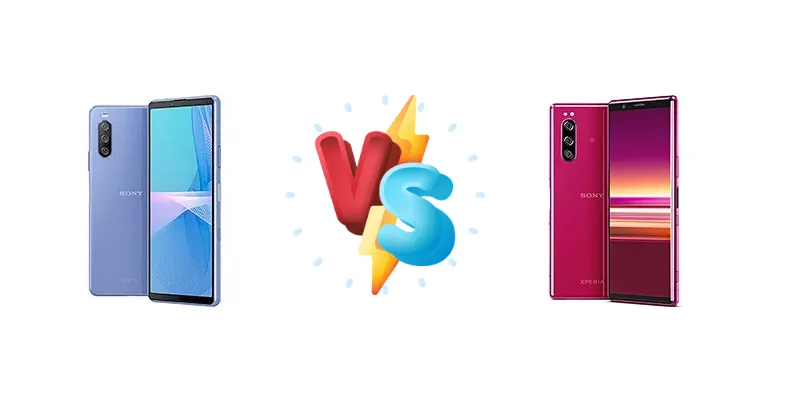
|
🏆 Quick Verdict
The Xperia 5 offers significantly better performance thanks to its Snapdragon 855 chipset and brighter display. While the Xperia 10 III boasts impressive battery life, the Xperia 5's overall package, including its superior processing power and camera capabilities, makes it the stronger contender for most users.
| PHONES | ||
|---|---|---|
| Phone Names | Sony Xperia 10 III | Sony Xperia 5 |
| Network | ||
|---|---|---|
| 2G bands | GSM 850 / 900 / 1800 / 1900 | GSM 850 / 900 / 1800 / 1900 |
| 3G bands | HSDPA 850 / 900 / 1700(AWS) / 2100 | HSDPA 800 / 850 / 900 / 1700(AWS) / 1900 / 2100 |
| 4G bands | 1, 3, 4, 5, 7, 8, 20, 28, 38, 39, 40, 41 | 1, 2, 3, 4, 5, 7, 8, 12, 13, 17, 19, 20, 25, 26, 28, 29, 32, 34, 38, 39, 40, 41, 46, 66 |
| 5G bands | 1, 3, 7, 8, 28, 77, 78 SA/NSA | - |
| Speed | HSPA, LTE, 5G | HSPA 42.2/5.76 Mbps, LTE Cat19 1600/150 Mbps |
| Technology | GSM / HSPA / LTE / 5G | GSM / HSPA / LTE |
| Launch | ||
|---|---|---|
| Announced | 2021, April 14 | 2019, September 05. Released 2019, October 05 |
| Status | Available. Released 2021, June 11 | Discontinued |
| Body | ||
|---|---|---|
| Build | Glass front (Gorilla Glass 6), glass back (Gorilla Glass 6), plastic frame | Glass front (Gorilla Glass 6), glass back (Gorilla Glass 6), aluminum frame |
| Dimensions | 154 x 68 x 8.3 mm (6.06 x 2.68 x 0.33 in) | 158 x 68 x 8.2 mm (6.22 x 2.68 x 0.32 in) |
| SIM | · Nano-SIM· Nano-SIM + Nano-SIM | · Nano-SIM· Nano-SIM + Nano-SIM |
| Weight | 169 g (5.96 oz) | 164 g (5.78 oz) |
| IP65/IP68 dust/water resistant (up to 1.5m for 30 mins) | IP65/IP68 dust/water resistant (up to 1.5m for 30 mins) | |
| Display | ||
|---|---|---|
| Protection | Corning Gorilla Glass 6 | Corning Gorilla Glass 6 |
| Resolution | 1080 x 2520 pixels, 21:9 ratio (~457 ppi density) | 1080 x 2520 pixels, 21:9 ratio (~449 ppi density) |
| Size | 6.0 inches, 84.1 cm2 (~80.3% screen-to-body ratio) | 6.1 inches, 86.9 cm2 (~80.9% screen-to-body ratio) |
| Type | OLED, 1B colors, HDR | OLED, HDR BT.2020 |
| Triluminos display | Triluminos display X-Reality Engine | |
| Platform | ||
|---|---|---|
| CPU | Octa-core (2x2.0 GHz Kryo 560 Gold & 6x1.7 GHz Kryo 560 Silver) | Octa-core (1x2.84 GHz Kryo 485 & 3x2.42 GHz Kryo 485 & 4x1.78 GHz Kryo 485) |
| Chipset | Qualcomm SM6350 Snapdragon 690 5G (8 nm) | Qualcomm SM8150 Snapdragon 855 (7 nm) |
| GPU | Adreno 619 | Adreno 640 |
| OS | Android 11, upgradable to Android 13 | Android 9.0 (Pie), upgradable to Android 11 |
| Memory | ||
|---|---|---|
| Card slot | microSDXC (uses shared SIM slot) | microSDXC (uses shared SIM slot) |
| Internal | 128GB 6GB RAM, 256GB 6GB RAM | 128GB 6GB RAM |
| UFS | UFS 2.1 | |
| Main Camera | ||
|---|---|---|
| Features | LED flash, HDR, panorama | Color spectrum sensor, LED flash, panorama, HDR, eye tracking |
| Triple | 12 MP, f/1.8, 27mm (wide), 1/2.8", PDAF 8 MP, f/2.4, 54mm (telephoto), 1/4.0", PDAF, 2x optical zoom 8 MP, f/2.2, 120˚, 16mm (ultrawide), 1/4.0" | 12 MP, f/1.6, 26mm (wide), 1/2.55", 1.4µm, predictive dual pixel PDAF, 5-axis OIS 12 MP, f/2.4, 52mm (telephoto), 1/3.4", 1.0µm, predictive PDAF, 2x optical zoom, 5-axis OIS 12 MP, f/2.4, 16mm (ultrawide), 1/3.4", 1.0µm |
| Video | 4K@30fps, 1080p@30fps | 4K@24/30fps HDR, 1080p@60fps, 1080p@30fps (5-axis gyro-EIS) |
| Selfie camera | ||
|---|---|---|
| Features | HDR | HDR |
| Single | 8 MP, f/2.0, 27mm (wide), 1/4.0" | 8 MP, f/2.0, 24mm (wide), 1/4.0", 1.12µm |
| Video | 1080p@30fps | 1080p@30fps (5-axis gyro-EIS) |
| Sound | ||
|---|---|---|
| 3.5mm jack | Yes | No |
| 35mm jack | Yes | No |
| Loudspeaker | Yes | Yes, with stereo speakers |
| 24-bit/192kHz audio | 24-bit/192kHz audio Dynamic vibration system | |
| Comms | ||
|---|---|---|
| Bluetooth | 5.1, A2DP, LE, aptX HD | 5.0, A2DP, aptX HD, LE |
| NFC | Yes | Yes |
| Positioning | GPS, GLONASS, GALILEO, BDS, QZSS | GPS, GLONASS, BDS, GALILEO |
| Radio | FM radio (region dependent) | No |
| USB | USB Type-C 3.1, OTG, Display Port | USB Type-C 3.1, OTG |
| WLAN | Wi-Fi 802.11 a/b/g/n/ac, dual-band, Wi-Fi Direct | Wi-Fi 802.11 a/b/g/n/ac, dual-band, Wi-Fi Direct, DLNA |
| Features | ||
|---|---|---|
| Sensors | Fingerprint (side-mounted), accelerometer, proximity, compass | Fingerprint (side-mounted), accelerometer, gyro, proximity, barometer, compass |
| Battery | ||
|---|---|---|
| Charging | 21W wired (unofficial rating), PD, QC | 18W wired, PD2.0 |
| Type | Li-Po 4500 mAh | Li-Ion 3140 mAh, non-removable |
| Misc | ||
|---|---|---|
| Colors | Black, White, Blue, Pink | Blue, Red, Black, Grey |
| Models | SO-52B, SOG04, XQ-BT52, A102SO | J8210, J8270, J9210, SOV41, SO-01M |
| Price | About 300 EUR | About 500 EUR |
| Pricing | ||
|---|---|---|
| 128GB 6GB RAM | - | $ 409.99 |
| RENEWED | - | $ 674.00 |
| Tests | ||
|---|---|---|
| Audio quality | - | Noise -93.0dB / Crosstalk -89.4dB |
| Battery life | Endurance rating 137h | Endurance rating 96h |
| Camera | Photo / Video | - |
| Display | Contrast ratio: Infinite (nominal) | Contrast ratio: Infinite (nominal) |
| Loudspeaker | -28.2 LUFS (Average) | -27.1 LUFS (Good) |
| Performance | AnTuTu: 286216 (v8) GeekBench: 1738 (v5.1) GFXBench: 12fps (ES 3.1 onscreen) | AnTuTu: 334809 (v7), 416601 (v8) GeekBench: 10941 (v4.4), 2825 (v5.1) GFXBench: 33fps (ES 3.1 onscreen) |
Sony Xperia 10 III
- Exceptional battery life
- More affordable price
- 5G connectivity
- Good display quality
- Lower performance
- Less powerful camera
- Older chipset
- Less premium feel
Sony Xperia 5
- Superior performance (Snapdragon 855)
- Brighter display
- Better camera quality
- More premium design
- Shorter battery life
- Higher price
- Smaller size may not suit everyone
Display Comparison
The Xperia 5 takes the lead in display quality. It boasts a measured peak brightness of 630 nits, noticeably brighter than the Xperia 10 III's 559 nits. Both offer an 'infinite' contrast ratio (nominal), suggesting excellent blacks, but the Xperia 5's higher brightness contributes to better visibility in outdoor conditions. Both phones feature OLED panels, providing vibrant colors and deep blacks.
Camera Comparison
While both phones offer capable cameras, the Xperia 5 generally produces better results. The Snapdragon 855's image signal processor (ISP) provides improved image processing capabilities. The Xperia 5 also typically features slightly better low-light performance and more refined image stabilization. Both phones offer a variety of shooting modes and features, but the Xperia 5's hardware advantage is noticeable.
Performance
Performance is where the Xperia 5 truly shines. Its Snapdragon 855 chipset is a significant upgrade over the Xperia 10 III's Snapdragon 690 5G. The 855 offers considerably faster processing speeds and better graphics performance, making it ideal for demanding games and multitasking. The Xperia 10 III is adequate for everyday tasks, but will struggle with more intensive applications.
Battery Life
The Xperia 10 III holds a clear advantage in battery life. Its endurance rating of 137 hours significantly surpasses the Xperia 5's 96 hours. This means the Xperia 10 III can easily last for multiple days on a single charge, making it a great choice for users who prioritize longevity.
Buying Guide
The Sony Xperia 10 III is ideal for users prioritizing exceptional battery life and a more budget-friendly price point. It's a solid choice for those who primarily use their phone for basic tasks and media consumption. The Sony Xperia 5 is better suited for power users, photographers, and gamers who demand high performance, a vibrant display, and a more advanced camera system, despite the higher price.