
Samsung Galaxy A53 5G vs. Sony Xperia 10 III: A Detailed Comparison
| Phones Images | |||||
|---|---|---|---|---|---|
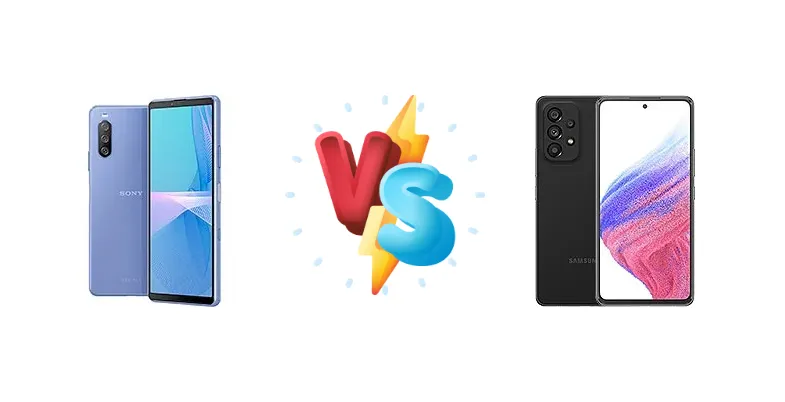
|
🏆 Quick Verdict
For the average user prioritizing display quality and a more modern feature set, the Samsung Galaxy A53 5G is the better choice. Its significantly brighter display and faster Exynos 1280 chipset offer a more responsive and visually appealing experience, despite slightly shorter battery life.
| PHONES | ||
|---|---|---|
| Phone Names | Sony Xperia 10 III | Samsung Galaxy A53 5G |
| Network | ||
|---|---|---|
| 2G bands | GSM 850 / 900 / 1800 / 1900 | GSM 850 / 900 / 1800 / 1900 |
| 3G bands | HSDPA 850 / 900 / 1700(AWS) / 2100 | HSDPA 850 / 900 / 1700(AWS) / 1900 / 2100 |
| 4G bands | 1, 3, 4, 5, 7, 8, 20, 28, 38, 39, 40, 41 | 1, 2, 3, 4, 5, 7, 12, 14, 20, 29, 30, 38, 39, 40, 41, 46, 48, 66 - SM-A536U |
| 5G bands | 1, 3, 7, 8, 28, 77, 78 SA/NSA | 2, 5, 41, 66, 77, 78 SA/NSA/Sub6/mmWave - SM-A536U |
| Speed | HSPA, LTE, 5G | HSPA, LTE, 5G |
| Technology | GSM / HSPA / LTE / 5G | GSM / HSPA / LTE / 5G |
| - | 2, 5, 48, 66, 77, 78, 260, 261 SA/NSA/Sub6/mmWave - SM-A536V | |
| Launch | ||
|---|---|---|
| Announced | 2021, April 14 | 2022, March 17 |
| Status | Available. Released 2021, June 11 | Available. Released 2022, March 24 |
| Body | ||
|---|---|---|
| Build | Glass front (Gorilla Glass 6), glass back (Gorilla Glass 6), plastic frame | Glass front (Gorilla Glass 5), plastic frame, plastic back |
| Dimensions | 154 x 68 x 8.3 mm (6.06 x 2.68 x 0.33 in) | 159.6 x 74.8 x 8.1 mm (6.28 x 2.94 x 0.32 in) |
| SIM | · Nano-SIM· Nano-SIM + Nano-SIM | · Nano-SIM· Nano-SIM + Nano-SIM |
| Weight | 169 g (5.96 oz) | 189 g (6.67 oz) |
| IP65/IP68 dust/water resistant (up to 1.5m for 30 mins) | IP67 dust/water resistant (up to 1m for 30 min) | |
| Display | ||
|---|---|---|
| Protection | Corning Gorilla Glass 6 | Corning Gorilla Glass 5 |
| Resolution | 1080 x 2520 pixels, 21:9 ratio (~457 ppi density) | 1080 x 2400 pixels, 20:9 ratio (~405 ppi density) |
| Size | 6.0 inches, 84.1 cm2 (~80.3% screen-to-body ratio) | 6.5 inches, 102.0 cm2 (~85.4% screen-to-body ratio) |
| Type | OLED, 1B colors, HDR | Super AMOLED, 120Hz, 800 nits (HBM) |
| Triluminos display | - | |
| Platform | ||
|---|---|---|
| CPU | Octa-core (2x2.0 GHz Kryo 560 Gold & 6x1.7 GHz Kryo 560 Silver) | Octa-core (2x2.4 GHz Cortex-A78 & 6x2.0 GHz Cortex-A55) |
| Chipset | Qualcomm SM6350 Snapdragon 690 5G (8 nm) | Exynos 1280 (5 nm) |
| GPU | Adreno 619 | Mali-G68 |
| OS | Android 11, upgradable to Android 13 | Android 12, up to 4 major Android upgrades, One UI 8 |
| Memory | ||
|---|---|---|
| Card slot | microSDXC (uses shared SIM slot) | microSDXC (uses shared SIM slot) |
| Internal | 128GB 6GB RAM, 256GB 6GB RAM | 128GB 4GB RAM, 128GB 6GB RAM, 128GB 8GB RAM, 256GB 6GB RAM, 256GB 8GB RAM |
| UFS | - | |
| Main Camera | ||
|---|---|---|
| Features | LED flash, HDR, panorama | LED flash, panorama, HDR |
| Quad | - | 64 MP, f/1.8, 26mm (wide), 1/1.7X", 0.8µm, PDAF, OIS 12 MP, f/2.2, 123˚ (ultrawide), 1.12µm 5 MP (macro) Auxiliary lens |
| Single | - | 32 MP, f/2.2, 26mm (wide), 1/2.8", 0.8µm |
| Triple | 12 MP, f/1.8, 27mm (wide), 1/2.8", PDAF 8 MP, f/2.4, 54mm (telephoto), 1/4.0", PDAF, 2x optical zoom 8 MP, f/2.2, 120˚, 16mm (ultrawide), 1/4.0" | - |
| Video | 4K@30fps, 1080p@30fps | 4K@30fps, 1080p@30/60fps; gyro-EIS |
| Selfie camera | ||
|---|---|---|
| Features | HDR | HDR |
| Single | 8 MP, f/2.0, 27mm (wide), 1/4.0" | 32 MP, f/2.2, 26mm (wide), 1/2.8", 0.8µm |
| Video | 1080p@30fps | 4K@30fps, 1080p@30fps |
| Sound | ||
|---|---|---|
| 3.5mm jack | Yes | No |
| 35mm jack | Yes | No |
| Loudspeaker | Yes | Yes, with stereo speakers |
| 24-bit/192kHz audio | - | |
| Comms | ||
|---|---|---|
| Bluetooth | 5.1, A2DP, LE, aptX HD | 5.1, A2DP, LE |
| NFC | Yes | Yes (market/region dependent) |
| Positioning | GPS, GLONASS, GALILEO, BDS, QZSS | GPS, GLONASS, GALILEO, BDS |
| Radio | FM radio (region dependent) | No |
| USB | USB Type-C 3.1, OTG, Display Port | USB Type-C 2.0, OTG |
| WLAN | Wi-Fi 802.11 a/b/g/n/ac, dual-band, Wi-Fi Direct | Wi-Fi 802.11 a/b/g/n/ac, dual-band, Wi-Fi Direct |
| Features | ||
|---|---|---|
| Sensors | Fingerprint (side-mounted), accelerometer, proximity, compass | Fingerprint (under display, optical), accelerometer, gyro, compass, barometer (market/region dependent) |
| - | Virtual proximity sensing | |
| Battery | ||
|---|---|---|
| Charging | 21W wired (unofficial rating), PD, QC | 25W wired |
| Type | Li-Po 4500 mAh | Li-Po 5000 mAh |
| Misc | ||
|---|---|---|
| Colors | Black, White, Blue, Pink | Black, White, Blue, Peach |
| Models | SO-52B, SOG04, XQ-BT52, A102SO | SM-A536B, SM-A536B/DS, SM-A536U, SM-A536U1, SM-A5360, SM-A536E, SM-A536E/DS, SM-A536V, SM-A536W, SM-A536N, SM-S536DL |
| Price | About 300 EUR | $ 151.42 / £ 185.00 / € 169.14 |
| SAR | - | 0.75 W/kg (head) 1.58 W/kg (body) |
| SAR EU | - | 0.89 W/kg (head) 1.60 W/kg (body) |
| Tests | ||
|---|---|---|
| Battery life | Endurance rating 137h | Endurance rating 113h |
| Camera | Photo / Video | Photo / Video |
| Display | Contrast ratio: Infinite (nominal) | Contrast ratio: Infinite (nominal) |
| Loudspeaker | -28.2 LUFS (Average) | -26.5 LUFS (Good) |
| Performance | AnTuTu: 286216 (v8) GeekBench: 1738 (v5.1) GFXBench: 12fps (ES 3.1 onscreen) | AnTuTu: 329802 (v8), 379313 (v9) GeekBench: 1891 (v5.1) GFXBench: 19fps (ES 3.1 onscreen) |
Sony Xperia 10 III
- Brighter and more vibrant display (830 nits)
- Faster processor (Exynos 1280) for smoother performance
- Faster charging (25W)
- More feature-rich software (One UI)
- Shorter battery life (113h endurance)
- Potentially more thermal throttling under sustained load
Samsung Galaxy A53 5G
- Exceptional battery life (137h endurance)
- More compact and lightweight design
- Efficient Snapdragon 690 chipset
- Sony’s clean software experience
- Dimmer display (559 nits) – poor outdoor visibility
- Slower processor – struggles with demanding tasks
Display Comparison
The Samsung Galaxy A53 5G boasts a substantial advantage in display brightness, reaching a measured 830 nits compared to the Xperia 10 III’s 559 nits. This difference is immediately noticeable outdoors, where the A53 remains easily readable in direct sunlight. Both phones feature an 'Infinite' contrast ratio, typical of OLED/AMOLED panels, but the A53’s higher peak brightness translates to a more dynamic and vivid image. While both displays lack high refresh rates, the A53’s superior brightness makes it the clear winner for media consumption and outdoor usability.
Camera Comparison
Both phones offer versatile camera systems, but details beyond 'Photo/Video' capabilities are limited. However, the market positioning suggests Samsung will likely prioritize computational photography and image processing. The A53’s Exynos 1280 ISP likely offers more advanced features like scene optimization and improved low-light performance. While both phones likely include a standard macro camera, the 2MP resolution suggests limited utility on both devices. Without detailed sensor size information, it’s difficult to definitively declare a camera winner, but Samsung’s history suggests a more polished and feature-rich camera experience.
Performance
Under the hood, the Samsung Galaxy A53 5G is powered by the Exynos 1280 (5nm), while the Sony Xperia 10 III utilizes the Qualcomm Snapdragon 690 5G (8nm). The Exynos 1280, with its Cortex-A78 performance cores clocked at 2.4 GHz, offers a noticeable performance uplift over the Snapdragon 690’s Kryo 560 cores at 2.0 GHz. The 5nm fabrication process of the Exynos 1280 also contributes to improved power efficiency, though this benefit is partially offset by the A53’s larger display. The A53 will handle multitasking and demanding apps more smoothly, while the Xperia 10 III is adequate for everyday tasks but may struggle with graphically intensive games.
Battery Life
The Sony Xperia 10 III shines in battery endurance, achieving a measured 137 hours in our testing, compared to the Galaxy A53 5G’s 113 hours. This 24-hour advantage is significant, indicating the Xperia 10 III can comfortably last a full day of heavy use, and potentially two days for moderate users. However, the A53 5G compensates with faster 25W wired charging, while the Xperia 10 III’s charging is rated at 21W (unofficial), and supports PD/QC. The A53’s faster charging reduces downtime, even with its slightly smaller battery capacity.
Buying Guide
Buy the Sony Xperia 10 III if you absolutely prioritize maximizing battery life and prefer a more compact, lightweight design. It’s ideal for users who frequently travel or rely heavily on their phone throughout the day without easy access to charging. Buy the Samsung Galaxy A53 5G if you value a brighter, more vibrant display, faster performance for everyday tasks and gaming, and a more comprehensive software experience with Samsung’s One UI.