
Google Pixel 6a vs. Sony Xperia 10 III: A Detailed Comparison of Performance and Endurance
| Phones Images | |||||
|---|---|---|---|---|---|
|
🏆 Quick Verdict
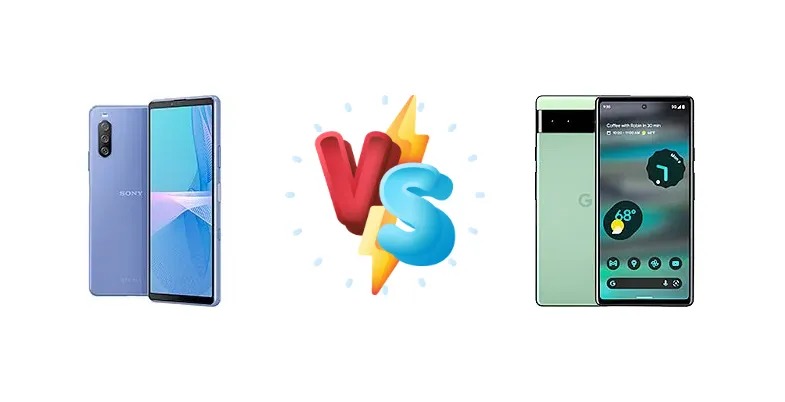
For most users, the Google Pixel 6a is the better choice. Its Google Tensor chipset delivers significantly faster performance and superior image processing, making it ideal for demanding apps and photography. However, the Sony Xperia 10 III remains a compelling option for those prioritizing exceptional battery life and a more streamlined Android experience.
| PHONES | ||
|---|---|---|
| Phone Names | Sony Xperia 10 III | Google Pixel 6a |
| Network | ||
|---|---|---|
| 2G bands | GSM 850 / 900 / 1800 / 1900 | GSM 850 / 900 / 1800 / 1900 |
| 3G bands | HSDPA 850 / 900 / 1700(AWS) / 2100 | HSDPA 800 / 850 / 900 / 1700(AWS) / 1900 / 2100 |
| 4G bands | 1, 3, 4, 5, 7, 8, 20, 28, 38, 39, 40, 41 | 1, 2, 3, 4, 5, 7, 8, 12, 13, 14, 17, 18, 19, 20, 25, 26, 28, 29, 30, 38, 39, 40, 41, 42, 48, 66, 71 - GX7AS, GB62Z (USA/Canada) |
| 5G bands | 1, 3, 7, 8, 28, 77, 78 SA/NSA | 1, 2, 3, 5, 7, 8, 12, 20, 25, 28, 30, 38, 40, 41, 48, 66, 71, 77, 78 SA/NSA/Sub6 - GX7AS (USA/Canada) |
| Speed | HSPA, LTE, 5G | HSPA, LTE, 5G |
| Technology | GSM / HSPA / LTE / 5G | GSM / HSPA / LTE / 5G |
| - | 1, 2, 3, 5, 7, 8, 12, 20, 25, 28, 30, 40, 48, 66, 71, 77, 78 SA/NSA/Sub6 - G1AZG (International) | |
| Launch | ||
|---|---|---|
| Announced | 2021, April 14 | 2022, May 11 |
| Status | Available. Released 2021, June 11 | Available. Released 2022, July 21 |
| Body | ||
|---|---|---|
| Build | Glass front (Gorilla Glass 6), glass back (Gorilla Glass 6), plastic frame | Glass front (Gorilla Glass 3), aluminum frame, plastic back |
| Dimensions | 154 x 68 x 8.3 mm (6.06 x 2.68 x 0.33 in) | 152.2 x 71.8 x 8.9 mm (5.99 x 2.83 x 0.35 in) |
| SIM | · Nano-SIM· Nano-SIM + Nano-SIM | Nano-SIM + eSIM |
| Weight | 169 g (5.96 oz) | 178 g (6.28 oz) |
| IP65/IP68 dust/water resistant (up to 1.5m for 30 mins) | IP67 dust/water resistant (up to 1m for 30 min) | |
| Display | ||
|---|---|---|
| Protection | Corning Gorilla Glass 6 | Corning Gorilla Glass 3 |
| Resolution | 1080 x 2520 pixels, 21:9 ratio (~457 ppi density) | 1080 x 2400 pixels, 20:9 ratio (~429 ppi density) |
| Size | 6.0 inches, 84.1 cm2 (~80.3% screen-to-body ratio) | 6.1 inches, 90.7 cm2 (~83.0% screen-to-body ratio) |
| Type | OLED, 1B colors, HDR | OLED, HDR |
| Triluminos display | Always-on display | |
| Platform | ||
|---|---|---|
| CPU | Octa-core (2x2.0 GHz Kryo 560 Gold & 6x1.7 GHz Kryo 560 Silver) | Octa-core (2x2.80 GHz Cortex-X1 & 2x2.25 GHz Cortex-A76 & 4x1.80 GHz Cortex-A55) |
| Chipset | Qualcomm SM6350 Snapdragon 690 5G (8 nm) | Google Tensor (5 nm) |
| GPU | Adreno 619 | Mali-G78 MP20 |
| OS | Android 11, upgradable to Android 13 | Android 12, upgradable to Android 15, up to 5 major Android upgrades |
| Memory | ||
|---|---|---|
| Card slot | microSDXC (uses shared SIM slot) | No |
| Internal | 128GB 6GB RAM, 256GB 6GB RAM | 128GB 6GB RAM |
| UFS | UFS 3.1 | |
| Main Camera | ||
|---|---|---|
| Dual | - | 12.2 MP, f/1.7, 27mm, (wide), 1/2.55", 1.4µm, dual pixel PDAF, OIS 12 MP, f/2.2, 17mm, 114˚ (ultrawide), 1.25µm |
| Features | LED flash, HDR, panorama | Dual-LED flash, Pixel Shift, Auto-HDR, panorama |
| Single | - | 8 MP, f/2.0, 24mm (wide), 1.12µm |
| Triple | 12 MP, f/1.8, 27mm (wide), 1/2.8", PDAF 8 MP, f/2.4, 54mm (telephoto), 1/4.0", PDAF, 2x optical zoom 8 MP, f/2.2, 120˚, 16mm (ultrawide), 1/4.0" | - |
| Video | 4K@30fps, 1080p@30fps | 4K@30/60fps, 1080p@30/60/120/240fps; gyro-EIS, OIS |
| Selfie camera | ||
|---|---|---|
| Features | HDR | HDR, panorama |
| Single | 8 MP, f/2.0, 27mm (wide), 1/4.0" | 8 MP, f/2.0, 24mm (wide), 1.12µm |
| Video | 1080p@30fps | 1080p@30fps |
| Sound | ||
|---|---|---|
| 3.5mm jack | Yes | No |
| 35mm jack | Yes | No |
| Loudspeaker | Yes | Yes, with stereo speakers |
| 24-bit/192kHz audio | - | |
| Comms | ||
|---|---|---|
| Bluetooth | 5.1, A2DP, LE, aptX HD | 5.2, A2DP, LE |
| NFC | Yes | Yes |
| Positioning | GPS, GLONASS, GALILEO, BDS, QZSS | GPS, GLONASS, GALILEO, QZSS |
| Radio | FM radio (region dependent) | No |
| USB | USB Type-C 3.1, OTG, Display Port | USB Type-C 3.1 |
| WLAN | Wi-Fi 802.11 a/b/g/n/ac, dual-band, Wi-Fi Direct | Wi-Fi 802.11 a/b/g/n/ac/6e, dual-band, Wi-Fi Direct |
| Features | ||
|---|---|---|
| Sensors | Fingerprint (side-mounted), accelerometer, proximity, compass | Fingerprint (under display, optical), accelerometer, gyro, proximity, compass, barometer |
| Battery | ||
|---|---|---|
| Charging | 21W wired (unofficial rating), PD, QC | 18W wired, PD3.0 |
| Type | Li-Po 4500 mAh | Li-Po 4410 mAh |
| Misc | ||
|---|---|---|
| Colors | Black, White, Blue, Pink | Chalk, Charcoal, Sage |
| Models | SO-52B, SOG04, XQ-BT52, A102SO | GX7AS, GB62Z, G1AZG, GB17L |
| Price | About 300 EUR | $ 138.99 / C$ 228.74 / ₹ 23,999 |
| Tests | ||
|---|---|---|
| Battery life | Endurance rating 137h | Endurance rating 94h |
| Camera | Photo / Video | - |
| Display | Contrast ratio: Infinite (nominal) | Contrast ratio: Infinite (nominal) |
| Loudspeaker | -28.2 LUFS (Average) | - |
| Performance | AnTuTu: 286216 (v8) GeekBench: 1738 (v5.1) GFXBench: 12fps (ES 3.1 onscreen) | - |
Sony Xperia 10 III
- Significantly faster performance with Google Tensor
- Superior camera quality and image processing
- Timely software updates and feature drops
- Shorter battery life compared to Xperia 10 III
- Slower charging speed (18W)
Google Pixel 6a
- Exceptional battery life (137h endurance)
- More streamlined Android experience
- Supports 21W fast charging
- Noticeably slower performance
- Less capable camera system
Display Comparison
The Pixel 6a boasts a significantly brighter display, reaching 876 nits compared to the Xperia 10 III’s 559 nits. This translates to much better visibility outdoors under direct sunlight. Both displays share an infinite (nominal) contrast ratio, typical of OLED panels, but the Pixel 6a’s higher brightness provides a more vibrant and engaging viewing experience. While neither phone features a high refresh rate, the Pixel 6a’s superior brightness is a clear advantage for everyday use.
Camera Comparison
While both phones offer capable cameras, the Pixel 6a leverages Google’s renowned computational photography to deliver superior image quality. The Pixel 6a’s image processing excels in dynamic range and low-light performance, consistently producing more detailed and vibrant photos. Although specific sensor sizes aren't provided, the Pixel 6a’s software algorithms compensate for any potential hardware limitations. The Xperia 10 III’s camera is competent, but lacks the Pixel 6a’s advanced features and image processing capabilities. The absence of detailed camera specs for the Xperia 10 III suggests a focus on simplicity rather than cutting-edge technology.
Performance
The performance gap between these two phones is substantial. The Google Pixel 6a’s Google Tensor chip, built on a 5nm process, features a powerful octa-core configuration with 2x2.80 GHz Cortex-X1 cores, dwarfing the Qualcomm SM6350 Snapdragon 690 5G (8nm) in the Xperia 10 III. The Tensor chip’s architecture, including the Cortex-A76 and A55 cores, provides a noticeable boost in multitasking, app loading times, and overall responsiveness. The Xperia 10 III’s Snapdragon 690 is adequate for basic tasks, but will struggle with graphically intensive games or demanding applications. The 5nm process of the Tensor chip also contributes to better thermal efficiency, potentially reducing throttling during sustained workloads.
Battery Life
The Sony Xperia 10 III shines in battery endurance, achieving a remarkable 137-hour rating. This is significantly higher than the Pixel 6a’s 94-hour rating. However, this advantage comes at the cost of performance. The Pixel 6a’s 18W charging, while slower than some competitors, is sufficient for topping up the battery overnight. The Xperia 10 III supports 21W wired charging with PD and QC, offering slightly faster charging speeds, but the larger difference in endurance means the Xperia 10 III will require less frequent charging overall.
Buying Guide
Buy the Sony Xperia 10 III if you absolutely need the longest possible battery life and prefer a less software-heavy Android experience. It’s ideal for users who primarily use their phone for communication, light browsing, and media consumption. Buy the Google Pixel 6a if you value performance, a superior camera experience, and timely software updates. It’s the better choice for gamers, photographers, and those who rely on demanding apps.