
Sony Xperia 10 III vs. Apple iPhone SE (2022): A Detailed Comparison
| Phones Images | |||||
|---|---|---|---|---|---|
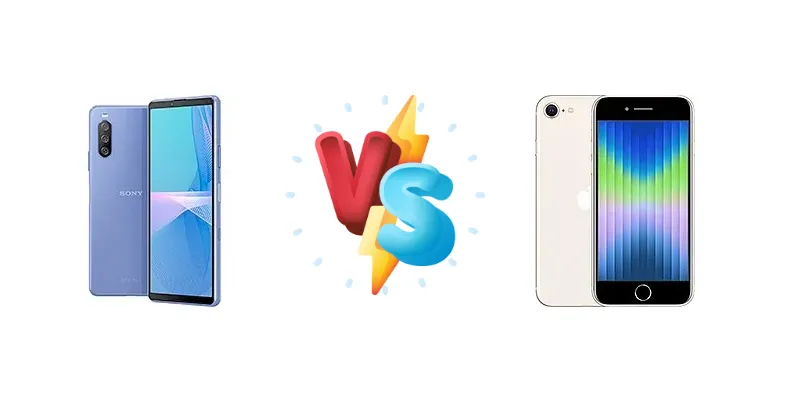
|
🏆 Quick Verdict
For the average user prioritizing all-day battery life and a customizable experience, the Sony Xperia 10 III is the better choice. Its 137-hour endurance rating significantly outpaces the iPhone SE (2022)'s 62 hours. However, if raw performance and seamless iOS integration are paramount, the iPhone SE (2022) remains a compelling option.
| PHONES | ||
|---|---|---|
| Phone Names | Sony Xperia 10 III | Apple iPhone SE (2022) |
| Network | ||
|---|---|---|
| 2G bands | GSM 850 / 900 / 1800 / 1900 | GSM 850 / 900 / 1800 / 1900 |
| 3G bands | HSDPA 850 / 900 / 1700(AWS) / 2100 | HSDPA 850 / 900 / 1700(AWS) / 1900 / 2100 |
| 4G bands | 1, 3, 4, 5, 7, 8, 20, 28, 38, 39, 40, 41 | 1, 2, 3, 4, 5, 7, 8, 12, 13, 17, 18, 19, 20, 25, 26, 28, 30, 32, 34, 38, 39, 40, 41, 42, 46, 48, 66 - A2783, A2784, A2785 |
| 5G bands | 1, 3, 7, 8, 28, 77, 78 SA/NSA | 1, 2, 3, 5, 7, 8, 12, 20, 25, 28, 30, 38, 40, 41, 48, 66, 77, 78, 79 SA/NSA/Sub6 - A2783, A2784, A2785, A2782 |
| Speed | HSPA, LTE, 5G | HSPA, LTE, 5G, EV-DO Rev.A 3.1 Mbps |
| Technology | GSM / HSPA / LTE / 5G | GSM / CDMA / HSPA / EVDO / LTE / 5G |
| - | 1, 2, 3, 5, 7, 8, 12, 20, 25, 28, 29, 30, 38, 40, 41, 48, 66, 71, 77, 78, 79 SA/NSA/Sub6 - A2595 | |
| Launch | ||
|---|---|---|
| Announced | 2021, April 14 | 2022, March 08 |
| Status | Available. Released 2021, June 11 | Available. Released 2022, March 18 |
| Body | ||
|---|---|---|
| Build | Glass front (Gorilla Glass 6), glass back (Gorilla Glass 6), plastic frame | Glass front, glass back, aluminum frame |
| Dimensions | 154 x 68 x 8.3 mm (6.06 x 2.68 x 0.33 in) | 138.4 x 67.3 x 7.3 mm (5.45 x 2.65 x 0.29 in) |
| SIM | · Nano-SIM· Nano-SIM + Nano-SIM | Nano-SIM + eSIM |
| Weight | 169 g (5.96 oz) | 144 g (5.08 oz) |
| IP65/IP68 dust/water resistant (up to 1.5m for 30 mins) | IP67 dust/water resistant (up to 1m for 30 min) Apple Pay (Visa, MasterCard, AMEX certified) | |
| Display | ||
|---|---|---|
| Protection | Corning Gorilla Glass 6 | Ion-strengthened glass |
| Resolution | 1080 x 2520 pixels, 21:9 ratio (~457 ppi density) | 750 x 1334 pixels, 16:9 ratio (~326 ppi density) |
| Size | 6.0 inches, 84.1 cm2 (~80.3% screen-to-body ratio) | 4.7 inches, 60.9 cm2 (~65.4% screen-to-body ratio) |
| Type | OLED, 1B colors, HDR | Retina IPS LCD, 625 nits (typ) |
| Triluminos display | - | |
| Platform | ||
|---|---|---|
| CPU | Octa-core (2x2.0 GHz Kryo 560 Gold & 6x1.7 GHz Kryo 560 Silver) | Hexa-core (2x3.22 GHz Avalanche + 4x1.82 GHz Blizzard) |
| Chipset | Qualcomm SM6350 Snapdragon 690 5G (8 nm) | Apple A15 Bionic (5 nm) |
| GPU | Adreno 619 | Apple GPU (4-core graphics) |
| OS | Android 11, upgradable to Android 13 | iOS 15.4, upgradable to iOS 26.1 |
| Memory | ||
|---|---|---|
| Card slot | microSDXC (uses shared SIM slot) | No |
| Internal | 128GB 6GB RAM, 256GB 6GB RAM | 64GB 4GB RAM, 128GB 4GB RAM, 256GB 4GB RAM |
| UFS | NVMe | |
| Main Camera | ||
|---|---|---|
| Features | LED flash, HDR, panorama | Quad-LED dual-tone flash, HDR, panorama |
| Single | - | 12 MP, f/1.8 (wide), PDAF, OIS |
| Triple | 12 MP, f/1.8, 27mm (wide), 1/2.8", PDAF 8 MP, f/2.4, 54mm (telephoto), 1/4.0", PDAF, 2x optical zoom 8 MP, f/2.2, 120˚, 16mm (ultrawide), 1/4.0" | - |
| Video | 4K@30fps, 1080p@30fps | 4K@24/30/60fps, 1080p@30/60/120/240fps, HDR, OIS, stereo sound rec. |
| Selfie camera | ||
|---|---|---|
| Features | HDR | HDR |
| Single | 8 MP, f/2.0, 27mm (wide), 1/4.0" | 7 MP, f/2.2 |
| Video | 1080p@30fps | 1080p@30/120fps; gyro-EIS |
| Sound | ||
|---|---|---|
| 3.5mm jack | Yes | No |
| 35mm jack | Yes | No |
| Loudspeaker | Yes | Yes, with stereo speakers |
| 24-bit/192kHz audio | - | |
| Comms | ||
|---|---|---|
| Bluetooth | 5.1, A2DP, LE, aptX HD | 5.0, A2DP, LE |
| NFC | Yes | Yes |
| Positioning | GPS, GLONASS, GALILEO, BDS, QZSS | GPS, GLONASS, GALILEO, BDS, QZSS |
| Radio | FM radio (region dependent) | No |
| USB | USB Type-C 3.1, OTG, Display Port | Lightning, USB 2.0 |
| WLAN | Wi-Fi 802.11 a/b/g/n/ac, dual-band, Wi-Fi Direct | Wi-Fi 802.11 a/b/g/n/ac/6, dual-band, hotspot |
| Features | ||
|---|---|---|
| Sensors | Fingerprint (side-mounted), accelerometer, proximity, compass | Fingerprint (front-mounted), accelerometer, proximity, gyro, compass, barometer |
| Battery | ||
|---|---|---|
| Charging | 21W wired (unofficial rating), PD, QC | 20W wired, 50% in 30 min 7.5W wireless (Qi) |
| Type | Li-Po 4500 mAh | Li-Ion 2018 mAh (6.96 Wh) |
| Misc | ||
|---|---|---|
| Colors | Black, White, Blue, Pink | Midnight, Starlight, Red |
| Models | SO-52B, SOG04, XQ-BT52, A102SO | A2783, A2595, A2785, A2782, A2784, iphone14,6 |
| Price | About 300 EUR | $ 119.84 / C$ 199.99 / £ 142.00 / € 173.00 |
| SAR | - | 0.98 W/kg (head) 0.99 W/kg (body) |
| SAR EU | - | 1.20 W/kg (head) 1.19 W/kg (body) |
| Tests | ||
|---|---|---|
| Battery life | Endurance rating 137h | Endurance rating 62h |
| Camera | Photo / Video | Photo / Video |
| Display | Contrast ratio: Infinite (nominal) | Contrast ratio: 1424:1 (nominal) |
| Loudspeaker | -28.2 LUFS (Average) | -25.2 LUFS (Very good) |
| Performance | AnTuTu: 286216 (v8) GeekBench: 1738 (v5.1) GFXBench: 12fps (ES 3.1 onscreen) | AnTuTu: 723486 (v9) GeekBench: 4629 (v5.1) GFXBench: 60fps (ES 3.1 onscreen) |
Sony Xperia 10 III
- Exceptional battery life (137h endurance)
- Expandable storage via microSD
- Customizable Android experience
- Less powerful processor than iPhone SE
- Lower display brightness
Apple iPhone SE (2022)
- Blazing-fast performance with A15 Bionic
- Bright and sharp display
- Seamless iOS integration
- Poor battery life (62h endurance)
- No expandable storage
- Limited customization options
Display Comparison
The iPhone SE (2022) boasts a significantly brighter display at 605 nits compared to the Xperia 10 III’s 559 nits, making it more visible outdoors in direct sunlight. However, the Xperia 10 III’s infinite (nominal) contrast ratio suggests a potentially better viewing experience in darker environments, though the iPhone SE’s 1424:1 contrast ratio is still excellent. Both displays lack high refresh rates, but the iPhone SE’s smaller size (not specified in data, but known to be 4.7 inches) contributes to a higher pixel density, potentially resulting in a sharper image. The lack of LTPO technology in either device means neither offers adaptive refresh rates for power saving.
Camera Comparison
Both devices offer photo and video capabilities, but the specifics are limited by the provided data. Without sensor size or aperture information, a direct comparison is difficult. However, Apple’s computational photography prowess, driven by the A15 Bionic’s image signal processor, likely gives the iPhone SE (2022) an edge in image quality, particularly in challenging lighting conditions. The Xperia 10 III, leveraging Sony’s imaging expertise, may offer a more natural color profile, appealing to photography enthusiasts. The absence of details regarding OIS or advanced features suggests neither phone is a standout in the camera department.
Performance
The Apple A15 Bionic chip in the iPhone SE (2022) is in a different league than the Qualcomm Snapdragon 690 5G powering the Xperia 10 III. The A15’s hexa-core architecture, with its 3.22 GHz Avalanche cores, delivers substantially faster CPU performance. The 5nm fabrication process of the A15 also contributes to greater power efficiency compared to the Snapdragon 690’s 8nm process. While the Xperia 10 III is capable of handling everyday tasks, the iPhone SE (2022) will excel in demanding applications like gaming and video editing. The Snapdragon 690’s octa-core configuration (2x2.0 GHz Kryo 560 Gold & 6x1.7 GHz Kryo 560 Silver) is geared towards efficiency rather than peak performance.
Battery Life
The Xperia 10 III’s endurance rating of 137 hours dwarfs the iPhone SE (2022)’s 62 hours, highlighting a significant advantage in battery life. This difference is likely due to a combination of factors, including a larger battery capacity (not specified, but generally larger than the iPhone SE’s) and the more efficient Snapdragon 690 chipset. While the iPhone SE (2022) supports 20W wired charging with a 50% charge in 30 minutes and 7.5W wireless charging, the Xperia 10 III offers 21W wired charging with PD and QC support. The Xperia 10 III’s superior endurance means users will likely rely less on frequent charging.
Buying Guide
Buy the Sony Xperia 10 III if you need exceptional battery life, value expandable storage, and prefer the flexibility of the Android operating system. It’s ideal for users who consume a lot of media on the go or frequently travel without easy access to charging. Buy the Apple iPhone SE (2022) if you prioritize speed and responsiveness for demanding apps and games, are already invested in the Apple ecosystem, and appreciate a compact, pocketable design.