
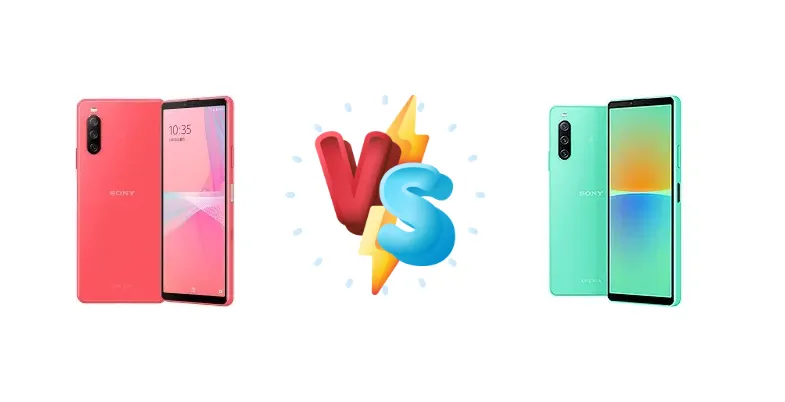
Sony Xperia 10 III Lite vs Xperia 10 IV: A Detailed Comparison
| Phones Images | |||||
|---|---|---|---|---|---|
|
🏆 Quick Verdict
The Xperia 10 IV edges out the Lite with a slightly more powerful chipset, brighter display, and faster charging. While the Lite offers a more budget-friendly option, the IV's improvements in key areas make it the overall better choice for most users seeking a reliable and capable mid-range Sony phone.
| PHONES | ||
|---|---|---|
| Phone Names | Sony Xperia 10 III Lite | Sony Xperia 10 IV |
| Network | ||
|---|---|---|
| 2G bands | GSM 850 / 900 / 1800 / 1900 | GSM 850 / 900 / 1800 / 1900 |
| 3G bands | HSDPA 850 / 1900 | HSDPA 850 / 900 / 1700(AWS) / 2100 |
| 4G bands | 1, 3, 4, 12, 18, 19, 38, 41 | 1, 3, 4, 5, 7, 8, 20, 28, 38, 39, 40, 41 |
| 5G bands | 77, 78 SA/NSA | 1, 3, 7, 8, 28, 38, 41, 77, 78, 79 SA/NSA |
| Speed | HSPA, LTE, 5G | HSPA, LTE, 5G |
| Technology | GSM / HSPA / LTE / 5G | GSM / HSPA / LTE / 5G |
| Launch | ||
|---|---|---|
| Announced | 2021, August 20 | 2022, May 11 |
| Status | Available. Released 2021, August 27 | Available. Released 2022, June 30 |
| Body | ||
|---|---|---|
| Build | Glass front (Gorilla Glass 6), glass back (Gorilla Glass 6), plastic frame | Glass front (Gorilla Glass Victus), plastic frame, plastic back |
| Dimensions | 154 x 68 x 8.3 mm (6.06 x 2.68 x 0.33 in) | 153 x 67 x 8.3 mm (6.02 x 2.64 x 0.33 in) |
| SIM | Nano-SIM + eSIM | · Nano-SIM + eSIM· Nano-SIM + Nano-SIM |
| Weight | 169 g (5.96 oz) | 161 g (5.68 oz) |
| - | IP65/IP68 dust/water resistant (up to 1.5m for 30 min) | |
| Display | ||
|---|---|---|
| Protection | Corning Gorilla Glass 6 | Corning Gorilla Glass Victus |
| Resolution | 1080 x 2520 pixels, 21:9 ratio (~457 ppi density) | 1080 x 2520 pixels, 21:9 ratio (~457 ppi density) |
| Size | 6.0 inches, 84.1 cm2 (~80.3% screen-to-body ratio) | 6.0 inches, 84.1 cm2 (~82.0% screen-to-body ratio) |
| Type | OLED, 1B colors, HDR | OLED, 1B colors, HDR |
| - | Triluminos display | |
| Platform | ||
|---|---|---|
| CPU | Octa-core (2x2.0 GHz Kryo 560 Gold & 6x1.7 GHz Kryo 560 Silver) | Octa-core (2x2.2 GHz Kryo 660 Gold & 6x1.7 GHz Kryo 660 Silver) |
| Chipset | Qualcomm SM6350 Snapdragon 690 5G (8 nm) | Qualcomm SM6375 Snapdragon 695 5G (6 nm) |
| GPU | Adreno 619 | Adreno 619 |
| OS | Android 11 | Android 12, upgradable to Android 14 |
| Memory | ||
|---|---|---|
| Card slot | microSDXC (uses shared SIM slot) | microSDXC (uses shared SIM slot) |
| Internal | 64GB 6GB RAM | 128GB 6GB RAM |
| - | UFS | |
| Main Camera | ||
|---|---|---|
| Features | LED flash, HDR, panorama | LED flash, HDR, panorama |
| Single | - | 8 MP, f/2.0, 27mm (wide), 1/4.0" |
| Triple | 12 MP, f/1.8, 27mm (wide), 1/2.8", PDAF 8 MP, f/2.4, 54mm (telephoto), 1/4.0", PDAF, 2x optical zoom 8 MP, f/2.2, 16mm, 120˚ (ultrawide), 1/4.0" | 12 MP, f/1.8, 27mm (wide), 1/2.8", PDAF, OIS 8 MP, f/2.2, 54mm (telephoto), 1/4.4", PDAF, 2x optical zoom 8 MP, f/2.2, 120˚, 16mm (ultrawide), 1/4.0" |
| Video | 4K@30fps, 1080p@30fps | 1080p@30fps |
| Selfie camera | ||
|---|---|---|
| Features | HDR | HDR |
| Single | 8 MP, f/2.0, 24mm (wide), 1/4.0" | 8 MP, f/2.0, 27mm (wide), 1/4.0" |
| Video | 1080p@30fps | 1080p@30fps |
| Sound | ||
|---|---|---|
| 3.5mm jack | Yes | Yes |
| 35mm jack | Yes | Yes |
| Loudspeaker | Yes | Yes |
| - | 24-bit/192kHz audio | |
| Comms | ||
|---|---|---|
| Bluetooth | 5.1, A2DP, LE, aptX HD | 5.1, A2DP, LE, aptX HD, aptX Adaptive |
| NFC | Yes | Yes |
| Positioning | GPS, GLONASS, GALILEO, BDS, QZSS | GPS, GLONASS, GALILEO, BDS, QZSS |
| Radio | No | No |
| USB | USB Type-C 3.1, OTG, video output | USB Type-C 2.0, OTG |
| WLAN | Wi-Fi 802.11 a/b/g/n/ac, dual-band, Wi-Fi Direct | Wi-Fi 802.11 a/b/g/n/ac, dual-band, Wi-Fi Direct |
| Features | ||
|---|---|---|
| Sensors | Fingerprint (side-mounted), accelerometer, proximity, compass | Fingerprint (side-mounted), accelerometer, proximity, compass |
| Battery | ||
|---|---|---|
| Charging | 30W wired, PD, QC | 21W wired (unofficial rating), PD, QC |
| Type | Li-Po 4500 mAh | Li-Po 5000 mAh |
| Misc | ||
|---|---|---|
| Colors | Black, White, Blue, Pink | Black, White, Mint, Lavender |
| Models | XQ-BT44 | XQ-CC54, XQ-CC72, SOG07 |
| Price | About 370 EUR | £ 99.99 / € 112.89 |
| Tests | ||
|---|---|---|
| Battery life | - | Endurance rating 163h |
| Camera | - | Photo / Video |
| Display | - | Contrast ratio: Infinite (nominal) |
| Loudspeaker | - | -30.6 LUFS (Below average) |
| Performance | - | AnTuTu: 396008 (v9) GeekBench: 1908 (v5.1) GFXBench: 16fps (ES 3.1 onscreen) |
Sony Xperia 10 III Lite
- More affordable
- Clean Android experience
- Decent battery life
- 5G connectivity
- Older chipset
- Lower display brightness
- Slower charging (in practice)
- Less powerful camera
Sony Xperia 10 IV
- Slightly more powerful chipset
- Brighter display
- Faster charging (potentially)
- Improved camera performance (likely)
- More modern design
- Higher price
- Still a mid-range device
- Charging speed not officially confirmed
Display Comparison
The Xperia 10 IV boasts a significantly brighter display, measured at 683 nits, compared to the Lite's unspecified brightness. While both offer a similar OLED panel, the IV's higher brightness provides a noticeable advantage in outdoor visibility. The 'Infinite' contrast ratio claim for the IV is nominal and doesn't provide concrete data, but OLED panels inherently offer excellent contrast.
Camera Comparison
Both phones feature Sony's camera technology, but the IV likely benefits from software optimizations and potentially slightly improved image processing due to its newer chipset. While specific camera specs are not detailed, the IV's newer hardware suggests a marginal improvement in photo and video quality, particularly in low-light conditions.
Performance
The Xperia 10 IV's Snapdragon 695 5G chipset (6nm) is a step up from the Lite's Snapdragon 690 5G (8nm). This translates to slightly better overall performance, smoother multitasking, and improved efficiency. While neither phone is a powerhouse, the IV offers a more responsive experience.
Battery Life
Both phones share an impressive endurance rating of 163h, indicating excellent battery life. However, the Xperia 10 IV's faster 21W charging (unofficial) provides a quicker top-up compared to the Lite's 30W charging (PD, QC). While 30W sounds faster, the IV's implementation and chipset efficiency may result in similar charging times in practice.
Buying Guide
Who should buy the Sony Xperia 10 III Lite? Budget-conscious users who prioritize a clean Android experience and don't need the absolute latest performance. Who should buy the Sony Xperia 10 IV? Users seeking a slightly more powerful processor, a brighter display for better outdoor visibility, and faster charging speeds, all while maintaining Sony's signature design and software.