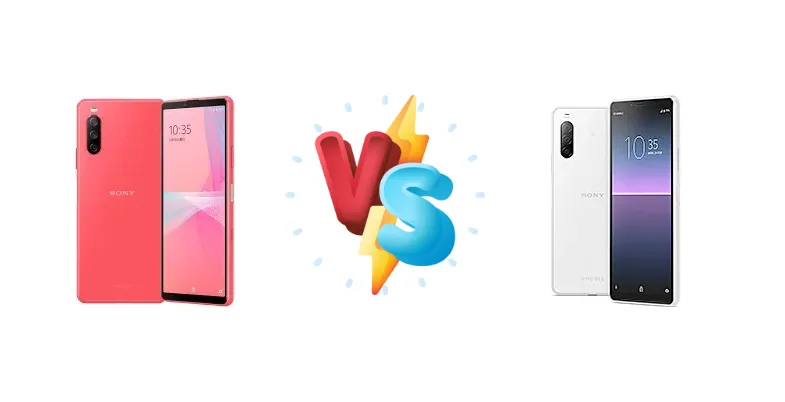
Sony's Xperia line offers a unique blend of features, often prioritizing display quality and a clean Android experience. The Xperia 10 III Lite and Xperia 10 II are both mid-range contenders, but cater to slightly different needs. Let's dive into a head-to-head comparison to see which one comes out on top.
🏆 Quick Verdict
The Xperia 10 III Lite boasts a newer, more powerful Snapdragon 690 5G chipset and faster charging, offering a performance edge. However, the Xperia 10 II's exceptional battery life and potentially superior display contrast make it a compelling alternative, especially for those prioritizing longevity.
| Network |
|---|
| 2G bands | GSM 850 / 900 / 1800 / 1900 | GSM 850 / 900 / 1800 / 1900 |
| 3G bands | HSDPA 850 / 1900 | HSDPA 850 / 900 / 1700(AWS) / 2100 |
| 4G bands | 1, 3, 4, 12, 18, 19, 38, 41 | 1, 3, 4, 5, 7, 8, 12, 20, 28, 38, 39, 40, 41 |
| 5G bands | 77, 78 SA/NSA | - |
| Speed | HSPA, LTE, 5G | HSPA 42.2/5.76 Mbps, LTE Cat11 600/75 Mbps |
| Technology | GSM / HSPA / LTE / 5G | GSM / HSPA / LTE |
| Launch |
|---|
| Announced | 2021, August 20 | 2020, February 24 |
| Status | Available. Released 2021, August 27 | Available. Released 2020, May 05 |
| Body |
|---|
| Build | Glass front (Gorilla Glass 6), glass back (Gorilla Glass 6), plastic frame | Glass front (Gorilla Glass 6), glass back (Gorilla Glass 6), plastic frame |
| Dimensions | 154 x 68 x 8.3 mm (6.06 x 2.68 x 0.33 in) | 157 x 69 x 8.2 mm (6.18 x 2.72 x 0.32 in) |
| SIM | Nano-SIM + eSIM | · Nano-SIM· Nano-SIM + Nano-SIM |
| Weight | 169 g (5.96 oz) | 151 g (5.33 oz) |
| | - | IP65/IP68 dust/water resistant (up to 1.5m for 30 mins) |
| Display |
|---|
| Protection | Corning Gorilla Glass 6 | Corning Gorilla Glass 6 |
| Resolution | 1080 x 2520 pixels, 21:9 ratio (~457 ppi density) | 1080 x 2520 pixels, 21:9 ratio (~457 ppi density) |
| Size | 6.0 inches, 84.1 cm2 (~80.3% screen-to-body ratio) | 6.0 inches, 84.1 cm2 (~77.6% screen-to-body ratio) |
| Type | OLED, 1B colors, HDR | OLED |
| Platform |
|---|
| CPU | Octa-core (2x2.0 GHz Kryo 560 Gold & 6x1.7 GHz Kryo 560 Silver) | Octa-core (4x2.0 GHz Kryo 260 Gold & 4x1.8 GHz Kryo 260 Silver) |
| Chipset | Qualcomm SM6350 Snapdragon 690 5G (8 nm) | Qualcomm SDM665 Snapdragon 665 (11 nm) |
| GPU | Adreno 619 | Adreno 610 |
| OS | Android 11 | Android 10, upgradable to Android 12 |
| Memory |
|---|
| Card slot | microSDXC (uses shared SIM slot) | microSDXC (uses shared SIM slot) |
| Internal | 64GB 6GB RAM | 64GB 4GB RAM, 128GB 4GB RAM |
| Main Camera |
|---|
| Features | LED flash, HDR, panorama | LED flash, HDR, panorama |
| Triple | 12 MP, f/1.8, 27mm (wide), 1/2.8", PDAF
8 MP, f/2.4, 54mm (telephoto), 1/4.0", PDAF, 2x optical zoom
8 MP, f/2.2, 16mm, 120˚ (ultrawide), 1/4.0" | 12 MP, f/2.0, 26mm (wide), 1/2.8", PDAF
8 MP, f/2.4, 52mm (telephoto), 1/4.0", PDAF, 2x optical zoom
8 MP, f/2.2, 120˚, 16mm (ultrawide), 1/4.0" |
| Video | 4K@30fps, 1080p@30fps | 4K@30fps, 1080p@30fps |
| Selfie camera |
|---|
| Features | HDR | HDR |
| Single | 8 MP, f/2.0, 24mm (wide), 1/4.0" | 8 MP, f/2.0, 24mm (wide), 1/4.0" |
| Video | 1080p@30fps | 1080p@30fps |
| Sound |
|---|
| 3.5mm jack | Yes | Yes |
| 35mm jack | Yes | Yes |
| Loudspeaker | Yes | Yes |
| | - | 24-bit/192kHz audio
|
| Comms |
|---|
| Bluetooth | 5.1, A2DP, LE, aptX HD | 5.0, A2DP, LE, aptX HD |
| NFC | Yes | Yes |
| Positioning | GPS, GLONASS, GALILEO, BDS, QZSS | GPS, GLONASS |
| Radio | No | No |
| USB | USB Type-C 3.1, OTG, video output | USB Type-C 2.0, OTG |
| WLAN | Wi-Fi 802.11 a/b/g/n/ac, dual-band, Wi-Fi Direct | Wi-Fi 802.11 a/b/g/n/ac, dual-band, Wi-Fi Direct |
| Features |
|---|
| Sensors | Fingerprint (side-mounted), accelerometer, proximity, compass | Fingerprint (side-mounted), accelerometer, proximity, compass |
| Battery |
|---|
| Charging | 30W wired, PD, QC | 18W wired, PD, QC3 |
| Type | Li-Po 4500 mAh | Li-Po 3600 mAh |
| Misc |
|---|
| Colors | Black, White, Blue, Pink | Black, White, Mint Green, Berry Blue |
| Models | XQ-BT44 | XQ-AU51, XQ-AU52, SO-41A |
| Price | About 370 EUR | About 700 EUR |
| Tests |
|---|
| Battery life | - | Endurance rating 92h |
| Camera | - |
Photo / Video |
| Display | - |
Contrast ratio: Infinite (nominal) |
| Loudspeaker | - |
-28.8 LUFS (Average) |
| Performance | - |
AnTuTu: 196545 (v8)
GeekBench: 5679 (v4.4), 1413 (v5.1)
GFXBench: 5.6fps (ES 3.1 onscreen) |
Sony Xperia 10 III Lite
- 5G Connectivity
- Faster Performance (Snapdragon 690)
- Faster Charging (30W)
- Slightly more modern design
- Potentially shorter battery life
- Smaller display
- Less established track record
Sony Xperia 10 II
- Exceptional Battery Life (92h endurance)
- Potentially better display contrast
- Proven reliability
- Slightly larger display
- Older chipset (Snapdragon 665)
- Slower charging (18W)
- Lacks 5G connectivity
Display Comparison
Both phones feature OLED displays, a rarity in this price range. The Xperia 10 II has a reported contrast ratio of 'infinite' (nominal), suggesting excellent blacks and vibrant colors. The Xperia 10 III Lite's display brightness is likely comparable, but lacks specific measured data. The Xperia 10 II's display is slightly larger at 6.0 inches vs 5.9 inches on the Lite.
Camera Comparison
Camera specs are similar on paper, both featuring a multi-lens setup. However, the newer image processing capabilities of the Snapdragon 690 5G in the Xperia 10 III Lite could result in slightly better image quality, especially in low-light conditions. The Xperia 10 II's camera has a proven track record, and image quality is generally considered good for its class.
Performance
The Snapdragon 690 5G in the Xperia 10 III Lite is a significant upgrade over the Snapdragon 665 in the Xperia 10 II. Expect noticeably faster app loading times, smoother multitasking, and improved gaming performance on the Lite. The 8nm process also contributes to potentially better power efficiency despite the increased performance.
Battery Life
The Xperia 10 II shines in this category. Its endurance rating of 92 hours is exceptional, significantly outperforming most smartphones. The Xperia 10 III Lite's battery capacity is likely smaller, and while the Snapdragon 690 5G is more efficient, it's unlikely to match the 10 II's longevity.
Buying Guide
The Xperia 10 III Lite is ideal for users who value 5G connectivity, smoother performance for everyday tasks, and faster charging. The Xperia 10 II is a great choice for those prioritizing exceptional battery life, a potentially better display contrast, and a more established, proven device.
Frequently Asked Questions
❓ Is the Xperia 10 III Lite worth the upgrade from the Xperia 10 II?
If 5G connectivity and improved performance are important to you, then yes. Otherwise, the Xperia 10 II's battery life is a significant advantage.
❓ Which phone has better software support?
Sony typically provides consistent software updates, but the Xperia 10 III Lite, being newer, is likely to receive updates for a longer period.