
Sony Xperia 10 II vs Xperia XZ3: A Clash of Generations
| Phones Images | |||||
|---|---|---|---|---|---|
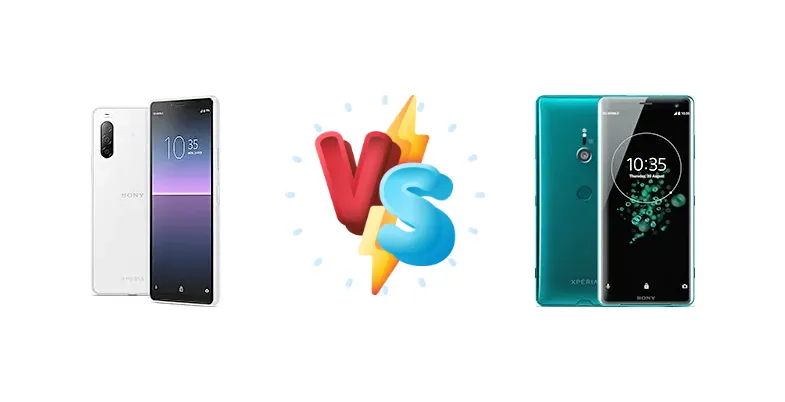
|
🏆 Quick Verdict
The Xperia XZ3 offers significantly better performance thanks to its Snapdragon 845 chipset and wireless charging. However, the Xperia 10 II boasts exceptional battery life and a slightly more modern design. For power users, the XZ3 wins; for budget-conscious users prioritizing longevity, the 10 II is a strong contender.
| PHONES | ||
|---|---|---|
| Phone Names | Sony Xperia 10 II | Sony Xperia XZ3 |
| Network | ||
|---|---|---|
| 2G bands | GSM 850 / 900 / 1800 / 1900 | GSM 850 / 900 / 1800 / 1900 |
| 3G bands | HSDPA 850 / 900 / 1700(AWS) / 2100 | HSDPA 800 / 850 / 900 / 1700(AWS) / 1900 / 2100 - H8416, H9436, H9493 |
| 4G bands | 1, 3, 4, 5, 7, 8, 12, 20, 28, 38, 39, 40, 41 | 1, 2, 3, 4, 5, 7, 8, 12, 13, 17, 19, 20, 26, 28, 29, 32, 38, 39, 40, 41, 46, 66 - H8416, H9436, H9493 |
| Speed | HSPA 42.2/5.76 Mbps, LTE Cat11 600/75 Mbps | HSPA 42.2/5.76 Mbps, LTE (5CA) Cat18 1200/200 Mbps |
| Technology | GSM / HSPA / LTE | GSM / HSPA / LTE |
| Launch | ||
|---|---|---|
| Announced | 2020, February 24 | 2018, August 30. Released 2018, October 05 |
| Status | Available. Released 2020, May 05 | Discontinued |
| Body | ||
|---|---|---|
| Build | Glass front (Gorilla Glass 6), glass back (Gorilla Glass 6), plastic frame | Glass front (Gorilla Glass 5), glass back (Gorilla Glass 5), aluminum frame |
| Dimensions | 157 x 69 x 8.2 mm (6.18 x 2.72 x 0.32 in) | 158 x 73 x 9.9 mm (6.22 x 2.87 x 0.39 in) |
| SIM | · Nano-SIM· Nano-SIM + Nano-SIM | · Nano-SIM· Nano-SIM + Nano-SIM |
| Weight | 151 g (5.33 oz) | 193 g (6.81 oz) |
| IP65/IP68 dust/water resistant (up to 1.5m for 30 mins) | IP65/IP68 dust/water resistant (up to 1.5m for 30 mins) | |
| Display | ||
|---|---|---|
| Protection | Corning Gorilla Glass 6 | Corning Gorilla Glass 5 |
| Resolution | 1080 x 2520 pixels, 21:9 ratio (~457 ppi density) | 1440 x 2880 pixels, 18:9 ratio (~537 ppi density) |
| Size | 6.0 inches, 84.1 cm2 (~77.6% screen-to-body ratio) | 6.0 inches, 92.9 cm2 (~80.5% screen-to-body ratio) |
| Type | OLED | P-OLED, HDR BT.2020 |
| - | Triluminos display X-Reality Engine | |
| Platform | ||
|---|---|---|
| CPU | Octa-core (4x2.0 GHz Kryo 260 Gold & 4x1.8 GHz Kryo 260 Silver) | Octa-core (4x2.7 GHz Kryo 385 Gold & 4x1.7 GHz Kryo 385 Silver) |
| Chipset | Qualcomm SDM665 Snapdragon 665 (11 nm) | Qualcomm SDM845 Snapdragon 845 (10 nm) |
| GPU | Adreno 610 | Adreno 630 |
| OS | Android 10, upgradable to Android 12 | Android 9.0 (Pie), upgradable to Android 10 |
| Memory | ||
|---|---|---|
| Card slot | microSDXC (uses shared SIM slot) | microSDXC (uses shared SIM slot) - dual SIM model only |
| Internal | 64GB 4GB RAM, 128GB 4GB RAM | 64GB 4GB RAM, 64GB 6GB RAM |
| - | UFS 2.1 | |
| Main Camera | ||
|---|---|---|
| Features | LED flash, HDR, panorama | Laser AF, color spectrum sensor, LED flash, panorama, HDR |
| Single | - | 19 MP, f/2.0, 25mm (wide), 1/2.3", 1.22µm, predictive PDAF |
| Triple | 12 MP, f/2.0, 26mm (wide), 1/2.8", PDAF 8 MP, f/2.4, 52mm (telephoto), 1/4.0", PDAF, 2x optical zoom 8 MP, f/2.2, 120˚, 16mm (ultrawide), 1/4.0" | - |
| Video | 4K@30fps, 1080p@30fps | 4K@30fps, 1080p@60fps, 1080p@30fps (5-axis gyro-EIS), 1080p@960fps, HDR |
| Selfie camera | ||
|---|---|---|
| Features | HDR | HDR |
| Single | 8 MP, f/2.0, 24mm (wide), 1/4.0" | 13 MP, f/1.9, 23mm (wide), 1/3.1", 1.12µm |
| Video | 1080p@30fps | 1080p@30fps (5-axis gyro-EIS) |
| Sound | ||
|---|---|---|
| 3.5mm jack | Yes | No |
| 35mm jack | Yes | No |
| Loudspeaker | Yes | Yes, with stereo speakers |
| 24-bit/192kHz audio | 24-bit/192kHz audio Dynamic vibration system | |
| Comms | ||
|---|---|---|
| Bluetooth | 5.0, A2DP, LE, aptX HD | 5.0, A2DP, aptX HD, LE |
| NFC | Yes | Yes |
| Positioning | GPS, GLONASS | GPS, GLONASS, BDS, GALILEO |
| Radio | No | No |
| USB | USB Type-C 2.0, OTG | USB Type-C 3.1, OTG |
| WLAN | Wi-Fi 802.11 a/b/g/n/ac, dual-band, Wi-Fi Direct | Wi-Fi 802.11 a/b/g/n/ac, dual-band, Wi-Fi Direct, DLNA |
| Features | ||
|---|---|---|
| Sensors | Fingerprint (side-mounted), accelerometer, proximity, compass | Fingerprint (rear-mounted), accelerometer, gyro, proximity, barometer, compass |
| Battery | ||
|---|---|---|
| Charging | 18W wired, PD, QC3 | 18W wired, PD2.0 Wireless (Qi) |
| Type | Li-Po 3600 mAh | Li-Ion 3300 mAh, non-removable |
| Misc | ||
|---|---|---|
| Colors | Black, White, Mint Green, Berry Blue | Black, Silver White, Forest Green, Bordeaux Red |
| Models | XQ-AU51, XQ-AU52, SO-41A | H9436, H8416, H9493 |
| Price | About 700 EUR | About 510 EUR |
| Tests | ||
|---|---|---|
| Audio quality | - | Noise -91.2dB / Crosstalk -88.7dB |
| Battery life | Endurance rating 92h | Endurance rating 90h |
| Camera | Photo / Video | Photo / Video |
| Display | Contrast ratio: Infinite (nominal) | Contrast ratio: Infinite (nominal), 4.502 (sunlight) |
| Loudspeaker | -28.8 LUFS (Average) | Voice 71dB / Noise 75dB / Ring 82dB |
| Performance | AnTuTu: 196545 (v8) GeekBench: 5679 (v4.4), 1413 (v5.1) GFXBench: 5.6fps (ES 3.1 onscreen) | AnTuTu: 284555 (v7), 295468 (v8) GeekBench: 8607 (v4.4), 2137 (v5.1) GFXBench: 19fps (ES 3.1 onscreen) |
Sony Xperia 10 II
- Exceptional battery life
- Affordable price
- Large display
- Modern design
- Lower performance
- Less bright display
- Older chipset
Sony Xperia XZ3
- Superior performance
- Brighter display (sunlight)
- Wireless charging
- Premium build quality
- Older design
- Shorter battery life compared to 10 II
- Potentially less software support
Display Comparison
The Xperia XZ3's display shines brighter, literally. Its measured sunlight legibility of 4.502 is noticeably better than the 10 II's. While both have 'infinite' contrast ratios (typical of OLED), the XZ3's higher peak brightness (estimated around 600 nits) provides a more vibrant viewing experience. The 10 II's display is perfectly adequate, but lacks the XZ3's punch.
Camera Comparison
Both phones offer capable cameras, but the XZ3 generally produces slightly better image quality, especially in challenging lighting conditions. The XZ3's image processing tends to be more refined. Both offer standard photo and video capabilities, but the XZ3's hardware advantage gives it a slight edge.
Performance
This is where the XZ3 truly dominates. The Snapdragon 845 is a significant step up from the 665 in the 10 II. Expect smoother multitasking, faster app loading times, and better gaming performance on the XZ3. The 10 II is capable for everyday tasks, but will struggle with demanding games or heavy workloads.
Battery Life
The Xperia 10 II takes the crown here. Its endurance rating of 92h is exceptional, significantly outperforming the XZ3's 90h. This translates to multiple days of use on a single charge for the 10 II, a major advantage for users who prioritize battery life.
Buying Guide
Who should buy the Sony Xperia 10 II? Users seeking a budget-friendly phone with incredible battery life and a large display for media consumption. Who should buy the Sony Xperia XZ3? Users who prioritize performance, a brighter display in sunlight, and wireless charging, and are comfortable with an older device.