
Sony Xperia 10 II vs Xperia 10 IV: A Detailed Comparison
| Phones Images | |||||
|---|---|---|---|---|---|
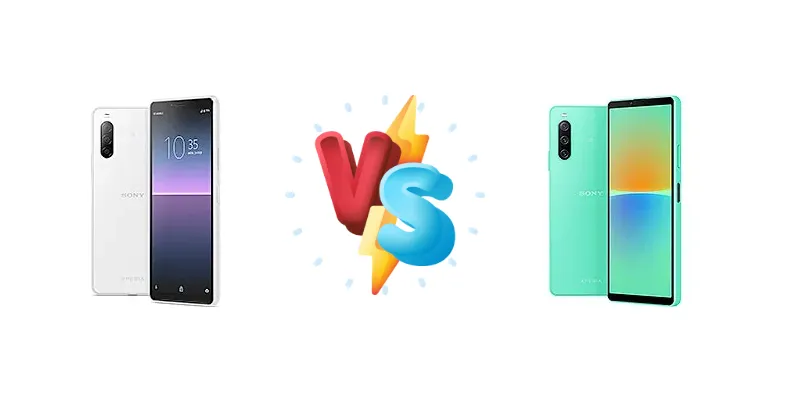
|
🏆 Quick Verdict
The Xperia 10 IV is the clear winner, boasting significantly improved battery life, a brighter display, a more modern chipset with 5G, and a generally more refined experience. While the 10 II remains a capable device, the 10 IV offers substantial upgrades justifying the price difference.
| PHONES | ||
|---|---|---|
| Phone Names | Sony Xperia 10 II | Sony Xperia 10 IV |
| Network | ||
|---|---|---|
| 2G bands | GSM 850 / 900 / 1800 / 1900 | GSM 850 / 900 / 1800 / 1900 |
| 3G bands | HSDPA 850 / 900 / 1700(AWS) / 2100 | HSDPA 850 / 900 / 1700(AWS) / 2100 |
| 4G bands | 1, 3, 4, 5, 7, 8, 12, 20, 28, 38, 39, 40, 41 | 1, 3, 4, 5, 7, 8, 20, 28, 38, 39, 40, 41 |
| 5G bands | - | 1, 3, 7, 8, 28, 38, 41, 77, 78, 79 SA/NSA |
| Speed | HSPA 42.2/5.76 Mbps, LTE Cat11 600/75 Mbps | HSPA, LTE, 5G |
| Technology | GSM / HSPA / LTE | GSM / HSPA / LTE / 5G |
| Launch | ||
|---|---|---|
| Announced | 2020, February 24 | 2022, May 11 |
| Status | Available. Released 2020, May 05 | Available. Released 2022, June 30 |
| Body | ||
|---|---|---|
| Build | Glass front (Gorilla Glass 6), glass back (Gorilla Glass 6), plastic frame | Glass front (Gorilla Glass Victus), plastic frame, plastic back |
| Dimensions | 157 x 69 x 8.2 mm (6.18 x 2.72 x 0.32 in) | 153 x 67 x 8.3 mm (6.02 x 2.64 x 0.33 in) |
| SIM | · Nano-SIM· Nano-SIM + Nano-SIM | · Nano-SIM + eSIM· Nano-SIM + Nano-SIM |
| Weight | 151 g (5.33 oz) | 161 g (5.68 oz) |
| IP65/IP68 dust/water resistant (up to 1.5m for 30 mins) | IP65/IP68 dust/water resistant (up to 1.5m for 30 min) | |
| Display | ||
|---|---|---|
| Protection | Corning Gorilla Glass 6 | Corning Gorilla Glass Victus |
| Resolution | 1080 x 2520 pixels, 21:9 ratio (~457 ppi density) | 1080 x 2520 pixels, 21:9 ratio (~457 ppi density) |
| Size | 6.0 inches, 84.1 cm2 (~77.6% screen-to-body ratio) | 6.0 inches, 84.1 cm2 (~82.0% screen-to-body ratio) |
| Type | OLED | OLED, 1B colors, HDR |
| - | Triluminos display | |
| Platform | ||
|---|---|---|
| CPU | Octa-core (4x2.0 GHz Kryo 260 Gold & 4x1.8 GHz Kryo 260 Silver) | Octa-core (2x2.2 GHz Kryo 660 Gold & 6x1.7 GHz Kryo 660 Silver) |
| Chipset | Qualcomm SDM665 Snapdragon 665 (11 nm) | Qualcomm SM6375 Snapdragon 695 5G (6 nm) |
| GPU | Adreno 610 | Adreno 619 |
| OS | Android 10, upgradable to Android 12 | Android 12, upgradable to Android 14 |
| Memory | ||
|---|---|---|
| Card slot | microSDXC (uses shared SIM slot) | microSDXC (uses shared SIM slot) |
| Internal | 64GB 4GB RAM, 128GB 4GB RAM | 128GB 6GB RAM |
| - | UFS | |
| Main Camera | ||
|---|---|---|
| Features | LED flash, HDR, panorama | LED flash, HDR, panorama |
| Single | - | 8 MP, f/2.0, 27mm (wide), 1/4.0" |
| Triple | 12 MP, f/2.0, 26mm (wide), 1/2.8", PDAF 8 MP, f/2.4, 52mm (telephoto), 1/4.0", PDAF, 2x optical zoom 8 MP, f/2.2, 120˚, 16mm (ultrawide), 1/4.0" | 12 MP, f/1.8, 27mm (wide), 1/2.8", PDAF, OIS 8 MP, f/2.2, 54mm (telephoto), 1/4.4", PDAF, 2x optical zoom 8 MP, f/2.2, 120˚, 16mm (ultrawide), 1/4.0" |
| Video | 4K@30fps, 1080p@30fps | 1080p@30fps |
| Selfie camera | ||
|---|---|---|
| Features | HDR | HDR |
| Single | 8 MP, f/2.0, 24mm (wide), 1/4.0" | 8 MP, f/2.0, 27mm (wide), 1/4.0" |
| Video | 1080p@30fps | 1080p@30fps |
| Sound | ||
|---|---|---|
| 3.5mm jack | Yes | Yes |
| 35mm jack | Yes | Yes |
| Loudspeaker | Yes | Yes |
| 24-bit/192kHz audio | 24-bit/192kHz audio | |
| Comms | ||
|---|---|---|
| Bluetooth | 5.0, A2DP, LE, aptX HD | 5.1, A2DP, LE, aptX HD, aptX Adaptive |
| NFC | Yes | Yes |
| Positioning | GPS, GLONASS | GPS, GLONASS, GALILEO, BDS, QZSS |
| Radio | No | No |
| USB | USB Type-C 2.0, OTG | USB Type-C 2.0, OTG |
| WLAN | Wi-Fi 802.11 a/b/g/n/ac, dual-band, Wi-Fi Direct | Wi-Fi 802.11 a/b/g/n/ac, dual-band, Wi-Fi Direct |
| Features | ||
|---|---|---|
| Sensors | Fingerprint (side-mounted), accelerometer, proximity, compass | Fingerprint (side-mounted), accelerometer, proximity, compass |
| Battery | ||
|---|---|---|
| Charging | 18W wired, PD, QC3 | 21W wired (unofficial rating), PD, QC |
| Type | Li-Po 3600 mAh | Li-Po 5000 mAh |
| Misc | ||
|---|---|---|
| Colors | Black, White, Mint Green, Berry Blue | Black, White, Mint, Lavender |
| Models | XQ-AU51, XQ-AU52, SO-41A | XQ-CC54, XQ-CC72, SOG07 |
| Price | About 700 EUR | £ 99.99 / € 112.89 |
| Tests | ||
|---|---|---|
| Battery life | Endurance rating 92h | Endurance rating 163h |
| Camera | Photo / Video | Photo / Video |
| Display | Contrast ratio: Infinite (nominal) | Contrast ratio: Infinite (nominal) |
| Loudspeaker | -28.8 LUFS (Average) | -30.6 LUFS (Below average) |
| Performance | AnTuTu: 196545 (v8) GeekBench: 5679 (v4.4), 1413 (v5.1) GFXBench: 5.6fps (ES 3.1 onscreen) | AnTuTu: 396008 (v9) GeekBench: 1908 (v5.1) GFXBench: 16fps (ES 3.1 onscreen) |
Sony Xperia 10 II
- Exceptional battery life (92h)
- Compact and lightweight design
- Affordable price
- Older chipset
- Lower display brightness
- No 5G connectivity
Sony Xperia 10 IV
- Significantly improved battery life (163h)
- Brighter display
- 5G connectivity
- More powerful chipset
- Higher price
- Charging speed could be faster
Display Comparison
The Xperia 10 IV features a noticeable upgrade in display brightness, reaching 683 nits compared to the 10 II's 520 nits. Both offer a cinematic 21:9 aspect ratio and OLED technology, ensuring vibrant colors and deep blacks. The improved brightness on the 10 IV makes it more usable outdoors. Both have an infinite contrast ratio.
Camera Comparison
While both phones offer capable camera systems, the Xperia 10 IV benefits from software enhancements and potentially improved image processing. Both offer similar camera configurations, but the 10 IV's newer sensor and processing pipeline likely result in slightly better image quality, especially in low-light conditions. Video recording capabilities are comparable.
Performance
The Snapdragon 695 5G in the Xperia 10 IV provides a significant performance boost over the Snapdragon 665 in the 10 II. The 10 IV's newer chipset is built on a more efficient 6nm process, contributing to better power efficiency and smoother multitasking. The CPU architecture is also improved, offering faster processing speeds.
Battery Life
The Xperia 10 IV's battery life is a standout feature, achieving an impressive endurance rating of 163 hours compared to the 10 II's 92 hours. This represents a substantial improvement, allowing for significantly longer usage between charges. The more efficient Snapdragon 695 5G also contributes to this extended battery life.
Buying Guide
Who should buy the Sony Xperia 10 II? Those on a tight budget who prioritize exceptional battery life and don't need 5G. Who should buy the Sony Xperia 10 IV? Anyone seeking a brighter screen, faster performance, 5G connectivity, and a longer-lasting battery in a compact form factor.