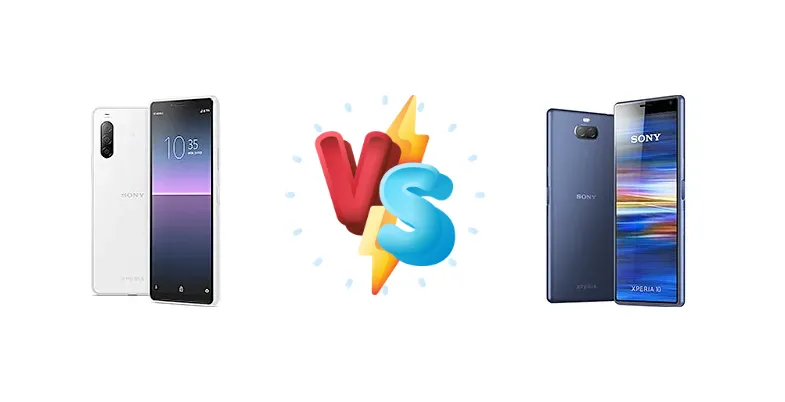
Sony's Xperia line offers a unique blend of features, often prioritizing display quality and battery life. The Xperia 10 and 10 II are two such devices, offering compelling value. But which one is right for you? This comprehensive comparison dives deep into their specs and performance.
🏆 Quick Verdict
The Xperia 10 II emerges as the clear winner thanks to its significantly improved battery life and more modern Snapdragon 665 chipset. While the original Xperia 10 boasts a superior contrast ratio, the 10 II's longevity and performance upgrades make it the better choice for most users.
| Network |
|---|
| 2G bands | GSM 850 / 900 / 1800 / 1900 | GSM 850 / 900 / 1800 / 1900 |
| 3G bands | HSDPA 850 / 900 / 1700(AWS) / 2100 | HSDPA 850 / 900 / 1900 / 2100 - I3113, I4113, I4193 |
| 4G bands | 1, 3, 4, 5, 7, 8, 12, 20, 28, 38, 39, 40, 41 | 1, 2, 3, 5, 7, 8, 20, 28, 32, 38 - I3113, I4113 |
| Speed | HSPA 42.2/5.76 Mbps, LTE Cat11 600/75 Mbps | HSPA 42.2/5.76 Mbps, LTE (2CA) Cat12 600/50 Mbps |
| Technology | GSM / HSPA / LTE | GSM / HSPA / LTE |
| | - | 1, 2, 3, 5, 7, 8, 20, 28, 38, 39, 40, 41 - I4193 |
| Launch |
|---|
| Announced | 2020, February 24 | 2019, February 25. Released 2019, February 27 |
| Status | Available. Released 2020, May 05 | Discontinued |
| Body |
|---|
| Build | Glass front (Gorilla Glass 6), glass back (Gorilla Glass 6), plastic frame | Glass front (Gorilla Glass 5), plastic back, plastic frame |
| Dimensions | 157 x 69 x 8.2 mm (6.18 x 2.72 x 0.32 in) | 156 x 68 x 8.4 mm (6.14 x 2.68 x 0.33 in) |
| SIM | · Nano-SIM· Nano-SIM + Nano-SIM | · Nano-SIM· Nano-SIM + Nano-SIM |
| Weight | 151 g (5.33 oz) | 162 g (5.71 oz) |
| | IP65/IP68 dust/water resistant (up to 1.5m for 30 mins) | - |
| Display |
|---|
| Protection | Corning Gorilla Glass 6 | Corning Gorilla Glass 5 |
| Resolution | 1080 x 2520 pixels, 21:9 ratio (~457 ppi density) | 1080 x 2520 pixels, 21:9 ratio (~457 ppi density) |
| Size | 6.0 inches, 84.1 cm2 (~77.6% screen-to-body ratio) | 6.0 inches, 84.1 cm2 (~79.3% screen-to-body ratio) |
| Type | OLED | IPS LCD |
| Platform |
|---|
| CPU | Octa-core (4x2.0 GHz Kryo 260 Gold & 4x1.8 GHz Kryo 260 Silver) | Octa-core 2.2 GHz Cortex-A53 |
| Chipset | Qualcomm SDM665 Snapdragon 665 (11 nm) | Qualcomm SDM630 Snapdragon 630 (14 nm) |
| GPU | Adreno 610 | Adreno 508 |
| OS | Android 10, upgradable to Android 12 | Android 9.0 (Pie) |
| Memory |
|---|
| Card slot | microSDXC (uses shared SIM slot) | microSDXC (uses shared SIM slot) |
| Internal | 64GB 4GB RAM, 128GB 4GB RAM | 64GB 3GB RAM, 64GB 4GB RAM |
| | - | eMMC 5.1 |
| Main Camera |
|---|
| Dual | - | 13 MP, f/2.0, 27mm (wide), 1/3.1", 1.12µm, PDAF
Auxiliary lens |
| Features | LED flash, HDR, panorama | LED flash, HDR, panorama |
| Triple | 12 MP, f/2.0, 26mm (wide), 1/2.8", PDAF
8 MP, f/2.4, 52mm (telephoto), 1/4.0", PDAF, 2x optical zoom
8 MP, f/2.2, 120˚, 16mm (ultrawide), 1/4.0" | - |
| Video | 4K@30fps, 1080p@30fps | 4K@30fps, 1080p@30fps |
| Selfie camera |
|---|
| Features | HDR | - |
| Single | 8 MP, f/2.0, 24mm (wide), 1/4.0" | 8 MP, f/2.0, 24mm (wide), 1/4.0", 1.12µm |
| Video | 1080p@30fps | 1080p@30fps |
| Sound |
|---|
| 3.5mm jack | Yes | Yes |
| 35mm jack | Yes | Yes |
| Loudspeaker | Yes | Yes |
| | 24-bit/192kHz audio
| 24-bit/192kHz audio
|
| Comms |
|---|
| Bluetooth | 5.0, A2DP, LE, aptX HD | 5.0, A2DP, LE, aptX HD |
| NFC | Yes | Yes |
| Positioning | GPS, GLONASS | GPS, GLONASS |
| Radio | No | FM radio |
| USB | USB Type-C 2.0, OTG | USB Type-C 2.0, OTG |
| WLAN | Wi-Fi 802.11 a/b/g/n/ac, dual-band, Wi-Fi Direct | Wi-Fi 802.11 a/b/g/n/ac, dual-band, Wi-Fi Direct |
| Features |
|---|
| Sensors | Fingerprint (side-mounted), accelerometer, proximity, compass | Fingerprint (side-mounted), accelerometer, proximity, compass |
| Battery |
|---|
| Charging | 18W wired, PD, QC3 | 18W wired, PD, QC3 |
| Type | Li-Po 3600 mAh | Li-Ion 2870 mAh, non-removable |
| Misc |
|---|
| Colors | Black, White, Mint Green, Berry Blue | Black, Navy, Silver, Pink |
| Models | XQ-AU51, XQ-AU52, SO-41A | I3113, I4113, I4193, I3123 |
| Price | About 700 EUR | About 280 EUR |
| Tests |
|---|
| Audio quality | - |
Noise -92.2dB / Crosstalk -97.1dB |
| Battery life | Endurance rating 92h |
Endurance rating 65h
|
| Camera |
Photo / Video |
Photo / Video |
| Display |
Contrast ratio: Infinite (nominal) |
Contrast ratio: 1517:1 (nominal) |
| Loudspeaker |
-28.8 LUFS (Average) |
-30.2 LUFS (Below average)
|
| Performance |
AnTuTu: 196545 (v8)
GeekBench: 5679 (v4.4), 1413 (v5.1)
GFXBench: 5.6fps (ES 3.1 onscreen) |
AnTuTu: 89697 (v7), 112198 (v8)
GeekBench: 3985 (v4.4), 990 (v5.1)
GFXBench: 4.3fps (ES 3.1 onscreen) |
Sony Xperia 10 II
- Significantly better battery life
- More modern chipset (Snapdragon 665)
- Higher peak brightness display
- Slightly improved performance
- Lower contrast ratio display compared to Xperia 10
- Potentially slightly higher price
Sony Xperia 10
- Excellent contrast ratio display
- More affordable
- Compact size
- Older chipset (Snapdragon 630)
- Shorter battery life
- Less responsive performance
Display Comparison
Both phones feature OLED displays, but the Xperia 10 has a notably higher contrast ratio (1517:1) compared to the Xperia 10 II's (nominal, likely lower). The Xperia 10 II does achieve a higher peak brightness of 520 nits, making it slightly better for outdoor visibility. Color accuracy is generally good on both, typical of Sony's displays.
Camera Comparison
Both phones offer similar camera setups, typically including a main lens, ultrawide lens, and telephoto lens. Image quality is decent in good lighting conditions on both, but low-light performance is a weakness. The Xperia 10 II may offer slightly improved image processing due to its newer chipset, but the differences are not drastic. Video recording capabilities are comparable.
Performance
The Xperia 10 II's Snapdragon 665 chipset is a significant upgrade over the Xperia 10's Snapdragon 630. The 11nm process offers improved efficiency, and the 665 generally provides a smoother and more responsive experience, especially when multitasking or running demanding apps. The CPU and GPU performance are noticeably better on the 10 II.
Battery Life
This is where the Xperia 10 II truly shines. Its endurance rating of 92h is a massive improvement over the Xperia 10's 65h. This translates to significantly longer battery life, easily lasting two full days on a single charge for moderate users.
Buying Guide
The Sony Xperia 10 II is ideal for users who prioritize long battery life and a slightly smoother user experience. It's a great option for those who want a reliable phone for media consumption and everyday tasks. The Xperia 10 is a good choice for budget-conscious buyers who value a high contrast display and don't mind slightly older hardware.
Frequently Asked Questions
❓ Is the Xperia 10 II worth the upgrade from the Xperia 10?
Yes, especially if battery life and performance are important to you. The 10 II offers a substantial improvement in these areas.
❓ Which phone has the better display overall?
The Xperia 10 has a slightly better contrast ratio, but the Xperia 10 II's higher brightness makes it more usable outdoors.