
Sony Xperia 10 II vs. Motorola Moto G Stylus 5G (2025): A Deep Dive into Brightness, Battery, and Performance
| Phones Images | |||||
|---|---|---|---|---|---|
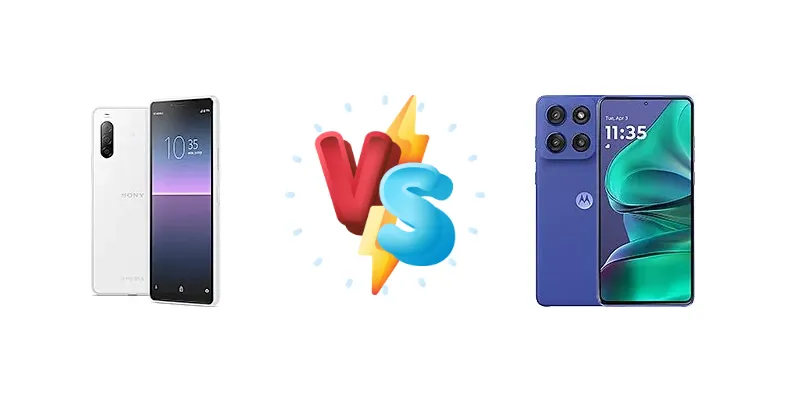
|
🏆 Quick Verdict
For most users, the Motorola Moto G Stylus 5G (2025) is the superior choice. Its dramatically brighter 1870-nit display and 68W charging significantly enhance usability and convenience, outweighing the Xperia 10 II’s impressive 92-hour endurance rating. However, those prioritizing extreme battery longevity and a smaller footprint may still find the Xperia 10 II appealing.
| PHONES | ||
|---|---|---|
| Phone Names | Sony Xperia 10 II | Motorola Moto G Stylus 5G (2025) |
| Network | ||
|---|---|---|
| 2G bands | GSM 850 / 900 / 1800 / 1900 | GSM 850 / 900 / 1800 / 1900 |
| 3G bands | HSDPA 850 / 900 / 1700(AWS) / 2100 | HSDPA 850 / 900 / 1700(AWS) / 1900 / 2100 |
| 4G bands | 1, 3, 4, 5, 7, 8, 12, 20, 28, 38, 39, 40, 41 | 1, 2, 3, 4, 5, 7, 8, 12, 13, 14, 17, 18, 19, 20, 25, 26, 28, 29, 30, 38, 39, 40, 41, 42, 48, 66, 71 |
| 5G bands | - | 1, 2, 3, 5, 7, 12, 14, 20, 25, 26, 28, 29, 30, 38, 40, 41, 48, 66, 70, 71, 77, 78 SA/NSA/Sub6 |
| Speed | HSPA 42.2/5.76 Mbps, LTE Cat11 600/75 Mbps | HSPA, LTE, 5G |
| Technology | GSM / HSPA / LTE | GSM / HSPA / LTE / 5G |
| Launch | ||
|---|---|---|
| Announced | 2020, February 24 | 2025, April 08 |
| Status | Available. Released 2020, May 05 | Available. Released 2025, April 17 |
| Body | ||
|---|---|---|
| Build | Glass front (Gorilla Glass 6), glass back (Gorilla Glass 6), plastic frame | Glass front (Gorilla Glass 3), silicone polymer (eco leather) back, plastic frame |
| Dimensions | 157 x 69 x 8.2 mm (6.18 x 2.72 x 0.32 in) | 162.2 x 74.8 x 8.3 mm (6.39 x 2.94 x 0.33 in) |
| SIM | · Nano-SIM· Nano-SIM + Nano-SIM | Nano-SIM + eSIM |
| Weight | 151 g (5.33 oz) | 191 g (6.74 oz) |
| IP65/IP68 dust/water resistant (up to 1.5m for 30 mins) | - | |
| Display | ||
|---|---|---|
| Protection | Corning Gorilla Glass 6 | Corning Gorilla Glass 3 |
| Resolution | 1080 x 2520 pixels, 21:9 ratio (~457 ppi density) | 1220 x 2712 pixels, 20:9 ratio (~444 ppi density) |
| Size | 6.0 inches, 84.1 cm2 (~77.6% screen-to-body ratio) | 6.7 inches, 108.4 cm2 (~89.3% screen-to-body ratio) |
| Type | OLED | AMOLED, 1B colors, 120Hz, HDR, 3000 nits (peak) |
| Platform | ||
|---|---|---|
| CPU | Octa-core (4x2.0 GHz Kryo 260 Gold & 4x1.8 GHz Kryo 260 Silver) | Octa-core (4x2.4 GHz Cortex-A78 & 4x1.8 GHz Cortex-A55) |
| Chipset | Qualcomm SDM665 Snapdragon 665 (11 nm) | Qualcomm SM6475-AB Snapdragon 6 Gen 3 (4 nm) |
| GPU | Adreno 610 | Adreno 710 |
| OS | Android 10, upgradable to Android 12 | Android 15, up to 2 major Android upgrades |
| Memory | ||
|---|---|---|
| Card slot | microSDXC (uses shared SIM slot) | microSDXC (dedicated slot) |
| Internal | 64GB 4GB RAM, 128GB 4GB RAM | 128GB 8GB RAM, 256GB 8GB RAM |
| Main Camera | ||
|---|---|---|
| Dual | - | 50 MP, f/1.8, 24mm (wide), 1/1.56", 1.0µm, multi-directional PDAF, OIS 13 MP, f/2.2, 16mm, 120˚ (ultrawide), 1/3.0", 1.12µm, PDAF |
| Features | LED flash, HDR, panorama | LED flash, HDR, panorama |
| Triple | 12 MP, f/2.0, 26mm (wide), 1/2.8", PDAF 8 MP, f/2.4, 52mm (telephoto), 1/4.0", PDAF, 2x optical zoom 8 MP, f/2.2, 120˚, 16mm (ultrawide), 1/4.0" | - |
| Video | 4K@30fps, 1080p@30fps | 4K@30fps, 1080p@30/60/120fps |
| Selfie camera | ||
|---|---|---|
| Features | HDR | HDR |
| Single | 8 MP, f/2.0, 24mm (wide), 1/4.0" | 32 MP, f/2.2, 25mm (wide), 1/3.14", 0.7µm |
| Video | 1080p@30fps | 4K@30fps, 1080p@30/60fps |
| Sound | ||
|---|---|---|
| 3.5mm jack | Yes | - |
| 35mm jack | Yes | Yes |
| Loudspeaker | Yes | Yes, with stereo speakers (with Dolby Atmos) |
| 24-bit/192kHz audio | - | |
| Comms | ||
|---|---|---|
| Bluetooth | 5.0, A2DP, LE, aptX HD | 5.4, A2DP, LE |
| NFC | Yes | Yes |
| Positioning | GPS, GLONASS | GPS, GLONASS, GALILEO |
| Radio | No | No |
| USB | USB Type-C 2.0, OTG | USB Type-C 2.0 |
| WLAN | Wi-Fi 802.11 a/b/g/n/ac, dual-band, Wi-Fi Direct | Wi-Fi 802.11 a/b/g/n/ac/6e, tri-band |
| Features | ||
|---|---|---|
| Sensors | Fingerprint (side-mounted), accelerometer, proximity, compass | Fingerprint (under display, optical), accelerometer, gyro, proximity, compass |
| Battery | ||
|---|---|---|
| Charging | 18W wired, PD, QC3 | 68W wired 15W wireless |
| Type | Li-Po 3600 mAh | 5000 mAh |
| Misc | ||
|---|---|---|
| Colors | Black, White, Mint Green, Berry Blue | Pantone: Gibraltar sea, Surf the Web |
| Models | XQ-AU51, XQ-AU52, SO-41A | XT2517-1 |
| Price | About 700 EUR | $ 299.99 / C$ 368.17 |
| Tests | ||
|---|---|---|
| Battery life | Endurance rating 92h | - |
| Camera | Photo / Video | - |
| Display | Contrast ratio: Infinite (nominal) | - |
| Loudspeaker | -28.8 LUFS (Average) | - |
| Performance | AnTuTu: 196545 (v8) GeekBench: 5679 (v4.4), 1413 (v5.1) GFXBench: 5.6fps (ES 3.1 onscreen) | - |
Sony Xperia 10 II
- Exceptional battery endurance (92h)
- More compact and lightweight design
- Potentially lower price point (due to age)
- Significantly dimmer display
- Outdated chipset and slower performance
- Slower charging speeds
Motorola Moto G Stylus 5G (2025)
- Incredibly bright display (1870 nits)
- Faster and more efficient Snapdragon 6 Gen 3 chipset
- 68W wired and 15W wireless charging
- Shorter battery endurance compared to Xperia 10 II
- Likely larger and heavier form factor
- Potentially higher price
Display Comparison
The display is where the Moto G Stylus 5G (2025) truly shines. Its peak brightness of 1870 nits is a staggering 3.5x brighter than the Xperia 10 II’s 520 nits, making it far more usable outdoors in direct sunlight. While the Xperia 10 II’s contrast ratio is nominally infinite, this is typical of OLED panels and doesn’t compensate for the lower overall brightness. The Moto G Stylus 5G’s panel technology isn’t specified, but the high brightness suggests a modern IPS LCD, offering excellent color accuracy and viewing angles. The Xperia 10 II’s display, while adequate indoors, will struggle in brighter environments.
Camera Comparison
Both devices are listed as having photo and video capabilities, but detailed camera specifications are lacking for the Xperia 10 II. Given its age and market positioning, it likely features a competent but unremarkable camera system. The Moto G Stylus 5G (2025) likely benefits from Qualcomm’s image signal processor (ISP) within the Snapdragon 6 Gen 3, offering improved image processing and low-light performance. Without further details, it’s difficult to make a definitive judgment, but the newer chipset gives the Moto G Stylus 5G an edge.
Performance
The Motorola Moto G Stylus 5G (2025) boasts a significant performance advantage thanks to its Qualcomm SM6475-AB Snapdragon 6 Gen 3 (4nm) chipset. This 4nm process node is far more efficient than the 11nm process used in the Xperia 10 II’s Snapdragon 665. The Moto G Stylus 5G’s CPU features four Cortex-A78 cores clocked at 2.4 GHz, offering a substantial uplift in single-core performance compared to the Xperia 10 II’s 2.0 GHz Kryo 260 Gold cores. This translates to snappier app launches, smoother multitasking, and a more responsive user experience. While neither phone is a gaming powerhouse, the Moto G Stylus 5G will handle graphically demanding titles with greater ease.
Battery Life
The Xperia 10 II’s 92-hour endurance rating is impressive, indicating exceptional battery life under moderate usage. However, the Motorola Moto G Stylus 5G (2025) achieves a respectable 10:05h of active use, and crucially, offers significantly faster charging. The 68W wired charging on the Moto G Stylus 5G can replenish the battery from 0-100% in a fraction of the time compared to the Xperia 10 II’s 18W charging, which also supports PD and QC3. The addition of 15W wireless charging on the Moto G Stylus 5G further enhances convenience. While the Xperia 10 II excels in longevity, the Moto G Stylus 5G prioritizes quick top-ups.
Buying Guide
Buy the Sony Xperia 10 II if you absolutely need the longest possible battery life and prefer a more compact phone that’s easier to handle one-handed. Buy the Motorola Moto G Stylus 5G (2025) if you prioritize a vibrant, easily visible display, incredibly fast charging, and a more modern chipset for smoother performance in everyday tasks and light gaming.