
Sony Xperia 10 II vs Google Pixel 4a 5G: A Deep Dive into Mid-Range Choices
| Phones Images | |||||
|---|---|---|---|---|---|
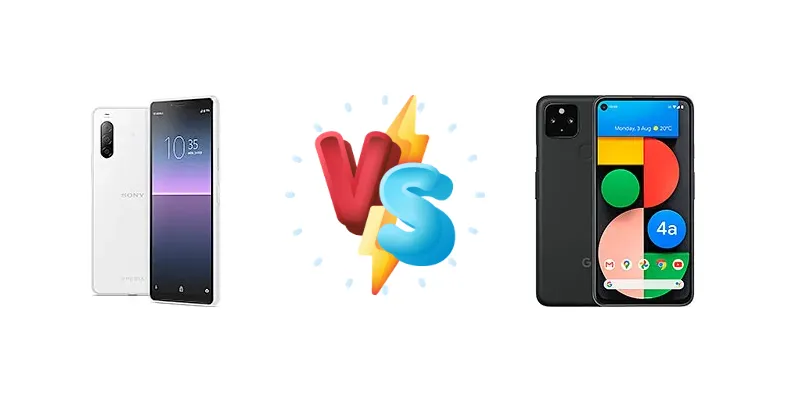
|
🏆 Quick Verdict
For the average user prioritizing performance and 5G, the Google Pixel 4a 5G is the better choice. Its Snapdragon 765G offers a significant performance uplift over the Xperia 10 II’s Snapdragon 665. However, if battery life is paramount and you value Sony’s software approach, the Xperia 10 II remains a compelling option.
| PHONES | ||
|---|---|---|
| Phone Names | Sony Xperia 10 II | Google Pixel 4a 5G |
| Network | ||
|---|---|---|
| 2G bands | GSM 850 / 900 / 1800 / 1900 | GSM 850 / 900 / 1800 / 1900 |
| 3G bands | HSDPA 850 / 900 / 1700(AWS) / 2100 | HSDPA 850 / 900 / 1700(AWS) / 1900 / 2100 |
| 4G bands | 1, 3, 4, 5, 7, 8, 12, 20, 28, 38, 39, 40, 41 | 1, 2, 3, 4, 5, 7, 8, 12, 13, 14, 17, 18, 19, 20, 25, 26, 28, 29, 30, 32, 38, 39, 40, 41, 42, 46, 48, 66, 71 |
| 5G bands | - | 1, 2, 3, 5, 7, 8, 12, 28, 41, 66, 71, 77, 78 Sub6, mmWave (market dependant) |
| Speed | HSPA 42.2/5.76 Mbps, LTE Cat11 600/75 Mbps | HSPA, LTE, 5G |
| Technology | GSM / HSPA / LTE | GSM / HSPA / LTE / 5G |
| Launch | ||
|---|---|---|
| Announced | 2020, February 24 | 2020, September 30 |
| Status | Available. Released 2020, May 05 | Available. Released 2020, November 05 |
| Body | ||
|---|---|---|
| Build | Glass front (Gorilla Glass 6), glass back (Gorilla Glass 6), plastic frame | Glass front (Gorilla Glass 3), plastic back, plastic frame |
| Dimensions | 157 x 69 x 8.2 mm (6.18 x 2.72 x 0.32 in) | 153.9 x 74 x 8.2 mm (Sub-6) or 8.5 mm (Sub-6 and mmWave) |
| SIM | · Nano-SIM· Nano-SIM + Nano-SIM | Nano-SIM + eSIM |
| Weight | 151 g (5.33 oz) | 168 g (5G Sub-6); 171 g ( 5G Sub-6 and mmWave) (5.93 oz) |
| IP65/IP68 dust/water resistant (up to 1.5m for 30 mins) | - | |
| Display | ||
|---|---|---|
| Protection | Corning Gorilla Glass 6 | Corning Gorilla Glass 3 |
| Resolution | 1080 x 2520 pixels, 21:9 ratio (~457 ppi density) | 1080 x 2340 pixels, 19.5:9 ratio (~413 ppi density) |
| Size | 6.0 inches, 84.1 cm2 (~77.6% screen-to-body ratio) | 6.2 inches, 95.7 cm2 (~84.1% screen-to-body ratio) |
| Type | OLED | OLED, HDR |
| - | Always-on display | |
| Platform | ||
|---|---|---|
| CPU | Octa-core (4x2.0 GHz Kryo 260 Gold & 4x1.8 GHz Kryo 260 Silver) | Octa-core (1x2.4 GHz Kryo 475 Prime & 1x2.2 GHz Kryo 475 Gold & 6x1.8 GHz Kryo 475 Silver) |
| Chipset | Qualcomm SDM665 Snapdragon 665 (11 nm) | Qualcomm SM7250 Snapdragon 765G 5G (7 nm) |
| GPU | Adreno 610 | Adreno 620 |
| OS | Android 10, upgradable to Android 12 | Android 11, upgradable to Android 14 |
| Memory | ||
|---|---|---|
| Card slot | microSDXC (uses shared SIM slot) | No |
| Internal | 64GB 4GB RAM, 128GB 4GB RAM | 128GB 6GB RAM |
| - | UFS 2.1 | |
| Main Camera | ||
|---|---|---|
| Dual | - | 12.2 MP, f/1.7, 27mm (wide), 1/2.55", 1.4µm, dual pixel PDAF, OIS 16 MP, f/2.2, 107˚ (ultrawide), 1.0µm |
| Features | LED flash, HDR, panorama | LED flash, Pixel Shift, Auto-HDR, panorama |
| Triple | 12 MP, f/2.0, 26mm (wide), 1/2.8", PDAF 8 MP, f/2.4, 52mm (telephoto), 1/4.0", PDAF, 2x optical zoom 8 MP, f/2.2, 120˚, 16mm (ultrawide), 1/4.0" | - |
| Video | 4K@30fps, 1080p@30fps | 4K@30/60fps, 1080p@30/60/120/240fps; gyro-EIS |
| Selfie camera | ||
|---|---|---|
| Features | HDR | HDR |
| Single | 8 MP, f/2.0, 24mm (wide), 1/4.0" | 8 MP, f/2.0, 24mm (wide), 1/4.0", 1.12µm |
| Video | 1080p@30fps | 1080p@30fps |
| Sound | ||
|---|---|---|
| 3.5mm jack | Yes | Yes |
| 35mm jack | Yes | Yes |
| Loudspeaker | Yes | Yes, with stereo speakers |
| 24-bit/192kHz audio | - | |
| Comms | ||
|---|---|---|
| Bluetooth | 5.0, A2DP, LE, aptX HD | 5.0, A2DP, LE, aptX HD |
| NFC | Yes | Yes |
| Positioning | GPS, GLONASS | GPS, GLONASS, GALILEO, QZSS, BDS |
| Radio | No | No |
| USB | USB Type-C 2.0, OTG | USB Type-C 3.1 |
| WLAN | Wi-Fi 802.11 a/b/g/n/ac, dual-band, Wi-Fi Direct | Wi-Fi 802.11 a/b/g/n/ac, dual-band, Wi-Fi Direct |
| Features | ||
|---|---|---|
| Sensors | Fingerprint (side-mounted), accelerometer, proximity, compass | Fingerprint (rear-mounted), accelerometer, gyro, proximity, compass, barometer |
| Battery | ||
|---|---|---|
| Charging | 18W wired, PD, QC3 | 18W wired, PD2.0 |
| Type | Li-Po 3600 mAh | Li-Po 3885 mAh |
| Misc | ||
|---|---|---|
| Colors | Black, White, Mint Green, Berry Blue | Just Black, Clearly White |
| Models | XQ-AU51, XQ-AU52, SO-41A | GD1YQ, G025I, G025E, G025H, G6QU3 |
| Price | About 700 EUR | About 140 EUR |
| Tests | ||
|---|---|---|
| Battery life | Endurance rating 92h | - |
| Camera | Photo / Video | - |
| Display | Contrast ratio: Infinite (nominal) | - |
| Loudspeaker | -28.8 LUFS (Average) | - |
| Performance | AnTuTu: 196545 (v8) GeekBench: 5679 (v4.4), 1413 (v5.1) GFXBench: 5.6fps (ES 3.1 onscreen) | - |
Sony Xperia 10 II
- Exceptional 92-hour battery life
- Wider 21:9 cinematic display
- Supports QC3 and PD fast charging
- Less powerful Snapdragon 665 processor
- Lacks 5G connectivity
- Software experience may not appeal to all
Google Pixel 4a 5G
- Faster Snapdragon 765G processor
- 5G connectivity for faster data speeds
- Google’s excellent computational photography
- Likely shorter battery life than Xperia 10 II
- Battery capacity not officially specified
- May experience more thermal throttling under heavy load
Display Comparison
The Sony Xperia 10 II boasts a 520 nits max brightness, a respectable figure for outdoor visibility, but the Pixel 4a 5G’s display specifications are not provided. Given Google’s typical display calibration, it’s likely comparable. Both phones feature an 'Infinite' (nominal) contrast ratio, suggesting standard OLED panels. The Xperia 10 II’s aspect ratio is a key differentiator, offering a wider 21:9 cinematic experience, which benefits video consumption but can present compatibility challenges with some apps. Without specific Pixel 4a 5G display data, it’s difficult to assess color accuracy or PWM dimming rates, but the Xperia 10 II’s wider aspect ratio is a unique selling point.
Camera Comparison
Both devices are listed as having 'Photo / Video' capabilities, lacking specific details. However, the Pixel 4a 5G benefits from Google’s renowned computational photography prowess. While sensor sizes and apertures are unknown, Google’s image processing algorithms consistently deliver excellent dynamic range and detail, even in challenging lighting conditions. The Xperia 10 II, while capable, likely relies more on hardware and less on software trickery. Without detailed camera specs, it’s difficult to make a definitive judgment, but Google’s software advantage is a strong indicator of superior image quality on the Pixel 4a 5G.
Performance
The core difference lies in the chipsets. The Google Pixel 4a 5G’s Snapdragon 765G, built on a 7nm process, represents a substantial upgrade over the Sony Xperia 10 II’s Snapdragon 665 (11nm). The 765G’s octa-core CPU configuration – 1x2.4 GHz Kryo 475 Prime, 1x2.2 GHz Kryo 475 Gold, and 6x1.8 GHz Kryo 475 Silver – provides faster processing speeds compared to the Xperia 10 II’s 4x2.0 GHz Kryo 260 Gold & 4x1.8 GHz Kryo 260 Silver. This translates to snappier app launches, smoother multitasking, and improved gaming performance. The 7nm process also contributes to better thermal efficiency, potentially reducing throttling during sustained workloads. The Pixel 4a 5G’s 5G modem is another significant advantage, offering faster data speeds where available.
Battery Life
The Sony Xperia 10 II shines in battery endurance, achieving a remarkable 92-hour rating. This is a testament to the efficiency of the Snapdragon 665 and the phone’s 3600mAh battery (estimated based on market segment). The Pixel 4a 5G’s battery capacity is not specified, but its more powerful Snapdragon 765G and 5G connectivity will likely result in shorter battery life. Both phones support 18W wired charging with PD and QC3 (Xperia 10 II) / PD2.0 (Pixel 4a 5G). While charging speeds are similar, the Xperia 10 II’s superior battery capacity gives it a significant advantage in overall longevity.
Buying Guide
Buy the Sony Xperia 10 II if you need a phone that can reliably last two days on a single charge and appreciate a more customizable software experience. Buy the Google Pixel 4a 5G if you prefer a streamlined Android experience, faster performance for gaming and multitasking, and the benefits of 5G connectivity, even if it means slightly shorter battery life.