
Sony Xperia 10 II vs Google Pixel 4a: A Head-to-Head Showdown
| Phones Images | |||||
|---|---|---|---|---|---|
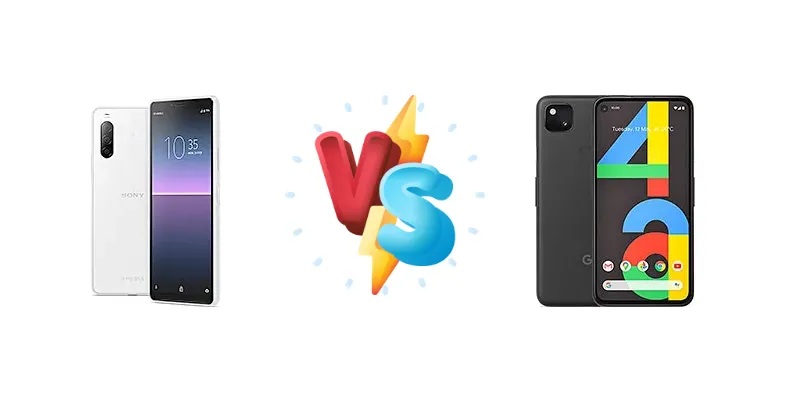
|
🏆 Quick Verdict
The Pixel 4a emerges as the winner thanks to its superior camera, brighter display, and more modern chipset. While the Xperia 10 II boasts incredible battery life, the Pixel 4a's overall package delivers a more polished and enjoyable user experience.
| PHONES | ||
|---|---|---|
| Phone Names | Sony Xperia 10 II | Google Pixel 4a |
| Network | ||
|---|---|---|
| 2G bands | GSM 850 / 900 / 1800 / 1900 | GSM 850 / 900 / 1800 / 1900 |
| 3G bands | HSDPA 850 / 900 / 1700(AWS) / 2100 | HSDPA 850 / 900 / 1700(AWS) / 1900 / 2100 |
| 4G bands | 1, 3, 4, 5, 7, 8, 12, 20, 28, 38, 39, 40, 41 | 1, 2, 3, 4, 5, 7, 8, 12, 13, 14, 17, 18, 20, 25, 26, 28, 29, 30, 38, 39, 40, 41, 66, 71 |
| Speed | HSPA 42.2/5.76 Mbps, LTE Cat11 600/75 Mbps | HSPA 42.2/5.76 Mbps, LTE (3CA) Cat12 600/75 Mbps |
| Technology | GSM / HSPA / LTE | GSM / HSPA / LTE |
| Launch | ||
|---|---|---|
| Announced | 2020, February 24 | 2020, August 03 |
| Status | Available. Released 2020, May 05 | Available. Released 2020, August 20 |
| Body | ||
|---|---|---|
| Build | Glass front (Gorilla Glass 6), glass back (Gorilla Glass 6), plastic frame | Glass front (Gorilla Glass 3), plastic back, plastic frame |
| Dimensions | 157 x 69 x 8.2 mm (6.18 x 2.72 x 0.32 in) | 144 x 69.4 x 8.2 mm (5.67 x 2.73 x 0.32 in) |
| SIM | · Nano-SIM· Nano-SIM + Nano-SIM | Nano-SIM + eSIM |
| Weight | 151 g (5.33 oz) | 143 g (5.04 oz) |
| IP65/IP68 dust/water resistant (up to 1.5m for 30 mins) | - | |
| Display | ||
|---|---|---|
| Protection | Corning Gorilla Glass 6 | Corning Gorilla Glass 3 |
| Resolution | 1080 x 2520 pixels, 21:9 ratio (~457 ppi density) | 1080 x 2340 pixels, 19.5:9 ratio (~443 ppi density) |
| Size | 6.0 inches, 84.1 cm2 (~77.6% screen-to-body ratio) | 5.81 inches, 83.2 cm2 (~83.3% screen-to-body ratio) |
| Type | OLED | OLED, HDR |
| - | Always-on display | |
| Platform | ||
|---|---|---|
| CPU | Octa-core (4x2.0 GHz Kryo 260 Gold & 4x1.8 GHz Kryo 260 Silver) | Octa-core (2x2.2 GHz Kryo 470 Gold & 6x1.8 GHz Kryo 470 Silver) |
| Chipset | Qualcomm SDM665 Snapdragon 665 (11 nm) | Qualcomm SDM730 Snapdragon 730G (8 nm) |
| GPU | Adreno 610 | Adreno 618 |
| OS | Android 10, upgradable to Android 12 | Android 10, upgradable to Android 13 |
| Memory | ||
|---|---|---|
| Card slot | microSDXC (uses shared SIM slot) | No |
| Internal | 64GB 4GB RAM, 128GB 4GB RAM | 128GB 6GB RAM |
| - | UFS 2.1 | |
| Main Camera | ||
|---|---|---|
| Features | LED flash, HDR, panorama | LED flash, Pixel Shift, Auto-HDR, panorama |
| Single | - | 12.2 MP, f/1.7, 27mm (wide), 1/2.55", 1.4µm, dual pixel PDAF, OIS |
| Triple | 12 MP, f/2.0, 26mm (wide), 1/2.8", PDAF 8 MP, f/2.4, 52mm (telephoto), 1/4.0", PDAF, 2x optical zoom 8 MP, f/2.2, 120˚, 16mm (ultrawide), 1/4.0" | - |
| Video | 4K@30fps, 1080p@30fps | 4K@30fps, 1080p@30/60/120fps; gyro-EIS |
| Selfie camera | ||
|---|---|---|
| Features | HDR | HDR |
| Single | 8 MP, f/2.0, 24mm (wide), 1/4.0" | 8 MP, f/2.0, 24mm (wide), 1.12µm |
| Video | 1080p@30fps | 1080p@30fps |
| Sound | ||
|---|---|---|
| 3.5mm jack | Yes | Yes |
| 35mm jack | Yes | Yes |
| Loudspeaker | Yes | Yes, with stereo speakers |
| 24-bit/192kHz audio | - | |
| Comms | ||
|---|---|---|
| Bluetooth | 5.0, A2DP, LE, aptX HD | 5.0, A2DP, LE, aptX HD |
| NFC | Yes | Yes |
| Positioning | GPS, GLONASS | GPS, GLONASS, GALILEO, QZSS, BDS |
| Radio | No | No |
| USB | USB Type-C 2.0, OTG | USB Type-C 3.1 |
| WLAN | Wi-Fi 802.11 a/b/g/n/ac, dual-band, Wi-Fi Direct | Wi-Fi 802.11 a/b/g/n/ac, dual-band, Wi-Fi Direct, DLNA |
| Features | ||
|---|---|---|
| Sensors | Fingerprint (side-mounted), accelerometer, proximity, compass | Fingerprint (rear-mounted), accelerometer, gyro, proximity, compass, barometer |
| Battery | ||
|---|---|---|
| Charging | 18W wired, PD, QC3 | 18W wired, PD2.0 |
| Type | Li-Po 3600 mAh | Li-Po 3140 mAh |
| Misc | ||
|---|---|---|
| Colors | Black, White, Mint Green, Berry Blue | Just Black, Barely Blue |
| Models | XQ-AU51, XQ-AU52, SO-41A | G025J, GA02099, G025N |
| Price | About 700 EUR | $ 139.99 / C$ 159.99 |
| Tests | ||
|---|---|---|
| Battery life | Endurance rating 92h | Endurance rating 76h |
| Camera | Photo / Video | - |
| Display | Contrast ratio: Infinite (nominal) | Contrast ratio: Infinite (nominal) |
| Loudspeaker | -28.8 LUFS (Average) | - |
| Performance | AnTuTu: 196545 (v8) GeekBench: 5679 (v4.4), 1413 (v5.1) GFXBench: 5.6fps (ES 3.1 onscreen) | AnTuTu: 268714 (v8) GeekBench: 6426 (v4.4), 1626 (v5.1) GFXBench: 17fps (ES 3.1 onscreen) |
Sony Xperia 10 II
- Exceptional battery life
- Large, cinematic display
- Headphone jack
- Expandable storage (microSD)
- Less powerful processor
- Dimmer display
- Less impressive camera
Google Pixel 4a
- Excellent camera
- Smooth performance
- Clean Android experience
- Compact size
- Bright display
- Shorter battery life compared to Xperia 10 II
- No expandable storage
- Plastic build
Display Comparison
The Pixel 4a's display shines with a measured 803 nits of brightness, significantly outperforming the Xperia 10 II's 520 nits. Both offer infinite contrast ratios, but the Pixel 4a's brightness makes it much more usable outdoors. The Xperia 10 II has a slightly larger screen, which some may prefer for media consumption.
Camera Comparison
Google's Pixel 4a camera is a standout feature. Its computational photography capabilities are renowned, delivering excellent image quality in various conditions. The Xperia 10 II's camera is decent, but lacks the Pixel 4a's dynamic range and low-light performance. The Pixel 4a also benefits from Google's software updates and camera features.
Performance
The Pixel 4a's Snapdragon 730G chipset (8nm) provides a noticeable performance boost over the Xperia 10 II's Snapdragon 665 (11nm). The 730G offers better CPU and GPU performance, resulting in smoother multitasking and gaming. While both have octa-core processors, the Pixel 4a's architecture is more efficient.
Battery Life
The Xperia 10 II takes the crown in battery life, boasting an impressive endurance rating of 92 hours. The Pixel 4a's 76-hour rating is still respectable, but falls short of the Xperia 10 II's longevity. This makes the Xperia 10 II a great choice for heavy users who need a phone that can last for days.
Buying Guide
The Sony Xperia 10 II is ideal for users prioritizing exceptional battery life and a large, cinematic display. The Google Pixel 4a is perfect for those who value a fantastic camera, smooth performance, and a clean Android experience.