
Sony Xperia 1 vs LG V50 ThinQ 5G: A Detailed Comparison
| Phones Images | |||||
|---|---|---|---|---|---|
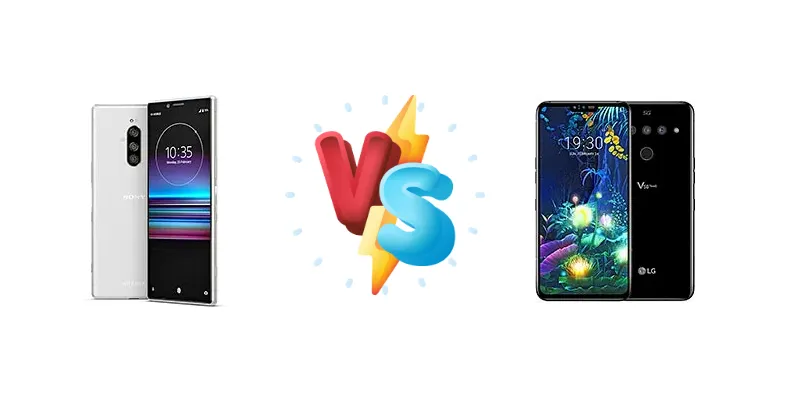
|
🏆 Quick Verdict
The LG V50 ThinQ 5G edges out the Xperia 1 thanks to its superior battery life, inclusion of wireless charging, and slightly faster charging speeds. While the Xperia 1 boasts a stunning display, the V50's overall package provides better value and longevity.
| PHONES | ||
|---|---|---|
| Phone Names | Sony Xperia 1 | LG V50 ThinQ 5G |
| Network | ||
|---|---|---|
| 2G bands | GSM 850 / 900 / 1800 / 1900 | GSM 850 / 900 / 1800 / 1900 |
| 3G bands | HSDPA 800 / 850 / 900 / 1700(AWS) / 1900 / 2100 | HSDPA 850 / 900 / 1700(AWS) / 1900 / 2100 - USA |
| 4G bands | 1, 2, 3, 4, 5, 7, 8, 12, 13, 17, 19, 20, 26, 28, 29, 32, 38, 39, 40, 41, 46, 66 | 1, 2, 3, 4, 5, 7, 8, 12, 13, 17, 20, 25, 26, 28, 40, 41, 46, 66, 71 - USA |
| 5G bands | - | 41, 260, 261 NSA |
| Speed | HSPA 42.2/5.76 Mbps, LTE Cat19 1600/150 Mbps | HSPA 42.2/5.76 Mbps, LTE (6CA) Cat18 1200/75 Mbps, 5G (2+ Gbps DL) |
| Technology | GSM / HSPA / LTE | GSM / CDMA / HSPA / EVDO / LTE / 5G |
| - | CDMA2000 1xEV-DO | |
| Launch | ||
|---|---|---|
| Announced | 2019, February 25. Released 2019, May 30 | 2019, February 24. Released 2019, April 19 |
| Status | Discontinued | Discontinued |
| Body | ||
|---|---|---|
| Build | Glass front (Gorilla Glass 6), glass back (Gorilla Glass 6), aluminum frame | Glass front (Gorilla Glass 5), glass back (Gorilla Glass 6), aluminum frame |
| Dimensions | 167 x 72 x 8.2 mm (6.57 x 2.83 x 0.32 in) | 159.2 x 76.1 x 8.3 mm (6.27 x 3.00 x 0.33 in) |
| SIM | · Nano-SIM· Nano-SIM + Nano-SIM | · Nano-SIM· Nano-SIM + Nano-SIM |
| Weight | 178 g (6.28 oz) | 183 g (6.46 oz) |
| IP65/IP68 dust/water resistant (up to 1.5m for 30 mins) | IP68 dust/water resistant (up to 1.5m for 30 min) MIL-STD-810G compliant* *does not guarantee ruggedness or use in extreme conditions | |
| Display | ||
|---|---|---|
| Protection | Corning Gorilla Glass 6 | Corning Gorilla Glass 5 |
| Resolution | 1644 x 3840 pixels, 21:9 ratio (~643 ppi density) | 1440 x 3120 pixels, 19.5:9 ratio (~538 ppi density) |
| Size | 6.5 inches, 98.6 cm2 (~82.0% screen-to-body ratio) | 6.4 inches, 100.2 cm2 (~82.7% screen-to-body ratio) |
| Type | OLED, HDR BT.2020 | P-OLED, HDR10 |
| Runs at 1096 x 2560 pixels except for select use cases Triluminos display X-Reality Engine | Always-on display | |
| Platform | ||
|---|---|---|
| CPU | Octa-core (1x2.84 GHz Kryo 485 & 3x2.42 GHz Kryo 485 & 4x1.78 GHz Kryo 485) | Octa-core (1x2.84 GHz Kryo 485 & 3x2.42 GHz Kryo 485 & 4x1.78 GHz Kryo 485) |
| Chipset | Qualcomm SM8150 Snapdragon 855 (7 nm) | Qualcomm SM8150 Snapdragon 855 (7 nm) |
| GPU | Adreno 640 | Adreno 640 |
| OS | Android 9.0 (Pie), upgradable to Android 11 | Android 9.0 (Pie), upgradable to Android 11 |
| Memory | ||
|---|---|---|
| Card slot | microSDXC (uses shared SIM slot) - dual SIM model only | microSDXC (dedicated slot) |
| Internal | 64GB 6GB RAM, 128GB 6GB RAM | 128GB 6GB RAM |
| UFS 2.1 | UFS 2.1 | |
| Main Camera | ||
|---|---|---|
| Features | Color spectrum sensor, LED flash, panorama, HDR, eye tracking | LED flash, HDR, panorama |
| Triple | 12 MP, f/1.6, 26mm (wide), 1/2.55", 1.4µm, predictive dual pixel PDAF, 5-axis OIS 12 MP, f/2.4, 52mm (telephoto), 1/3.4", 1.0µm, predictive PDAF, 2x optical zoom, 5-axis OIS 12 MP, f/2.4, 16mm (ultrawide), 1/3.4", 1.0µm | 12 MP, 27mm (wide), f/1.5, 1/2.55", 1.4µm, dual pixel PDAF, 3-axis OIS 12 MP, 52mm (telephoto), f/2.4, 1/3.4", 1.0µm, 2x optical zoom, PDAF, OIS 16 MP, 16mm (ultrawide), f/1.9, 1/3.1", 1.0µm, no AF |
| Video | 4K@24/25/30fps HDR, 1080p@60fps, 1080p@30fps (5-axis gyro-EIS), 1080p@960fps | 4K@30/60fps, 1080p@30/60/240fps, 24-bit/192kHz stereo sound rec., HDR10 video, gyro-EIS |
| Selfie camera | ||
|---|---|---|
| Dual | - | 8 MP, f/1.9, 26mm (wide), 1/4.0", 1.12µm 5 MP, 21mm (wide), f/2.2, 1/5.0", 1.12µm |
| Features | HDR | HDR |
| Single | 8 MP, f/2.0, 24mm (wide), 1/4.0", 1.12µm | - |
| Video | 1080p@30fps (5-axis gyro-EIS) | 1080p@60fps |
| Sound | ||
|---|---|---|
| 3.5mm jack | No | Yes |
| 35mm jack | No | Yes |
| Loudspeaker | Yes, with stereo speakers | Yes, with stereo speakers |
| 24-bit/192kHz audio Dynamic vibration system | 32-bit/192kHz audio 24-bit/192kHz audio recording Tuned with Meridian Audio | |
| Comms | ||
|---|---|---|
| Bluetooth | 5.0, A2DP, aptX HD, LE | 5.0, A2DP, LE, aptX HD |
| NFC | Yes | Yes |
| Positioning | GPS, GLONASS, BDS, GALILEO | GPS, GLONASS, GALILEO |
| Radio | No | FM radio |
| USB | USB Type-C 3.1, OTG | USB Type-C 3.1 |
| WLAN | Wi-Fi 802.11 a/b/g/n/ac, dual-band, Wi-Fi Direct, DLNA | Wi-Fi 802.11 a/b/g/n/ac, dual-band, Wi-Fi Direct, DLNA |
| Features | ||
|---|---|---|
| Sensors | Fingerprint (side-mounted), accelerometer, gyro, proximity, barometer, compass | Fingerprint (rear-mounted), accelerometer, gyro, proximity, compass, barometer |
| Battery | ||
|---|---|---|
| Charging | 18W wired, PD2.0 | 18W wired, PD2.0, QC3, 50% in 36 min 10W wireless (Qi) |
| Type | Li-Ion 3330 mAh, non-removable | Li-Po 4000 mAh, non-removable |
| Misc | ||
|---|---|---|
| Colors | Black, Gray, Purple, White | New Aurora Black |
| Models | J8110, J8170, J9110, J9150, SOV40, SO-03L | LM-V500, LM-V500N, LM-V500EM, LM-V500XM, LM-V450PM, LM-V450 |
| Price | About 500 EUR | About 550 EUR |
| Tests | ||
|---|---|---|
| Audio quality | Noise -93.6dB / Crosstalk -85.2dB | Noise -92.5dB / Crosstalk -92.6dB |
| Battery life | Endurance rating 79h | Endurance rating 96h |
| Camera | Photo / Video | Photo / Video |
| Display | Contrast ratio: Infinite (nominal) | Contrast ratio: 194000:1 (nominal) |
| Loudspeaker | -26.7 LUFS (Good) | -25.2 LUFS (Very good) |
| Performance | AnTuTu: 356734 (v7), 418206 (v8) GeekBench: 10985 (v4.4), 2753 (v5.1) GFXBench: 33fps (ES 3.1 onscreen) | AnTuTu: 343758 (v7), 421934 (v8) GeekBench: 10928 (v4.4), 2672 (v5.1) GFXBench: 22fps (ES 3.1 onscreen) |
Sony Xperia 1
- Stunning 21:9 display
- Excellent camera versatility
- Clean Android experience
- Premium build quality
- Shorter battery life
- No wireless charging
- Slower charging speeds
- Higher price (at launch)
LG V50 ThinQ 5G
- Longer battery life
- Wireless charging
- Faster charging
- 5G connectivity
- User-friendly camera software
- Slightly dimmer display
- Less premium design
- Software support ended earlier
Display Comparison
The Xperia 1’s 6.5-inch OLED display shines with 665 nits of brightness and an infinite contrast ratio, delivering vibrant colors and deep blacks. However, the V50 ThinQ’s 6.4-inch display, while slightly dimmer at 533 nits, still offers excellent image quality with a remarkable 194000:1 contrast ratio. The Xperia 1’s taller 21:9 aspect ratio is unique and great for media consumption.
Camera Comparison
The Xperia 1 features a triple-lens setup with a 26mm main lens, a 52mm telephoto lens, and a 16mm ultrawide lens. The V50 ThinQ 5G also has a triple-lens system, including a 12MP main lens, a 12MP ultrawide lens, and a 12MP telephoto lens with 2x optical zoom. Both offer excellent image quality, but the Xperia 1’s dedicated telephoto lens provides more versatility for zoomed shots. The V50's camera software was generally considered more user-friendly.
Performance
Both phones are powered by the Snapdragon 855 chipset and share the same Octa-core CPU, ensuring smooth performance for demanding tasks and gaming. Real-world performance differences are minimal, with both handling apps and multitasking with ease. The V50's 5G capabilities were a significant advantage at the time.
Battery Life
The LG V50 ThinQ 5G takes a clear lead in battery life, boasting an endurance rating of 96 hours compared to the Xperia 1’s 79 hours. The V50 also includes wireless charging (10W Qi) and faster wired charging (PD2.0, QC3), further enhancing its convenience.
Buying Guide
The Sony Xperia 1 is ideal for photography enthusiasts who prioritize a cinematic display and a clean Android experience. The LG V50 ThinQ 5G is a better choice for users who need all-day battery life, appreciate wireless charging, and want a versatile camera system.