
Sony Xperia 1 VI vs Samsung Galaxy S24 Ultra: A Deep Dive into Flagship Performance
| Phones Images | |||||
|---|---|---|---|---|---|
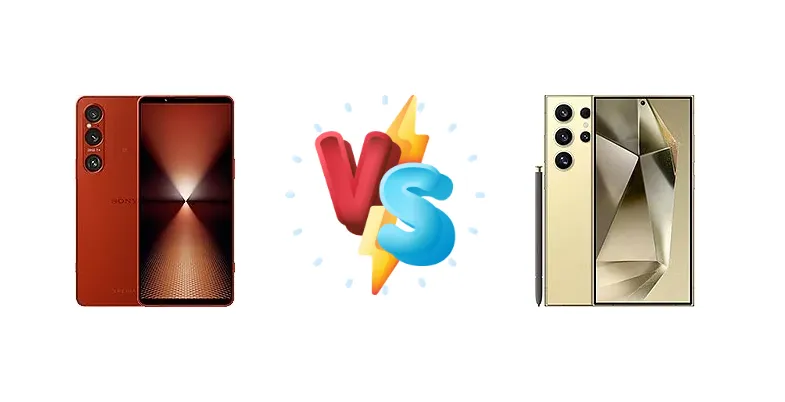
|
🏆 Quick Verdict
For the average user prioritizing all-day battery life and a natural display, the Sony Xperia 1 VI is the superior choice. Its 17:27-hour active use score significantly outperforms the S24 Ultra’s 13:49, despite the S24 Ultra’s slightly brighter display and faster charging.
| PHONES | ||
|---|---|---|
| Phone Names | Sony Xperia 1 VI | Samsung Galaxy S24 Ultra |
| Network | ||
|---|---|---|
| 2G bands | GSM 850 / 900 / 1800 / 1900 | GSM 850 / 900 / 1800 / 1900 |
| 3G bands | HSDPA 800 / 850 / 900 / 1700(AWS) / 1900 / 2100 | HSDPA 850 / 900 / 1700(AWS) / 1900 / 2100 |
| 4G bands | 1, 2, 3, 4, 5, 7, 8, 12, 13, 17, 19, 20, 25, 26, 28, 29, 32, 34, 38, 39, 40, 41, 46, 66 - Europe | 1, 2, 3, 4, 5, 7, 8, 12, 13, 17, 18, 19, 20, 25, 26, 28, 32, 38, 39, 40, 41, 66 - International |
| 5G bands | 1, 3, 5, 7, 8, 20, 28, 38, 40, 41, 75, 77, 78 SA/NSA/Sub6 - Europe | 1, 2, 3, 5, 7, 8, 12, 20, 25, 26, 28, 38, 40, 41, 66, 75, 77, 78 SA/NSA/Sub6 - International |
| Speed | HSPA, LTE, 5G | HSPA, LTE (up to 7CA), 5G |
| Technology | GSM / HSPA / LTE / 5G | GSM / CDMA / HSPA / EVDO / LTE / 5G |
| Launch | ||
|---|---|---|
| Announced | 2024, May 15 | 2024, January 17 |
| Status | Available. Released 2024, June 03 | Available. Released 2024, January 24 |
| Body | ||
|---|---|---|
| Build | Glass front (Gorilla Glass Victus 2), glass back (Gorilla Glass Victus), aluminum frame | Glass front (Corning Gorilla Armor), glass back (Corning Gorilla Armor), titanium frame (grade 2) |
| Dimensions | 162 x 74 x 8.2 mm (6.38 x 2.91 x 0.32 in) | 162.3 x 79 x 8.6 mm (6.39 x 3.11 x 0.34 in) |
| SIM | · Nano-SIM + eSIM· Nano-SIM + Nano-SIM | · Nano-SIM + Nano-SIM + eSIM + eSIM (max 2 at a time) - INT· Nano-SIM + eSIM + eSIM (max 2 at a time) - USA· Nano-SIM + Nano-SIM - CN |
| Weight | 192 g (6.77 oz) | 232 g or 233 g (8.18 oz) |
| Display | ||
|---|---|---|
| Protection | Corning Gorilla Glass Victus 2 | Corning Gorilla Armor |
| Resolution | 1080 x 2340 pixels, 19.5:9 ratio (~396 ppi density) | 1440 x 3120 pixels, 19.5:9 ratio (~505 ppi density) |
| Size | 6.5 inches, 103.7 cm2 (~86.5% screen-to-body ratio) | 6.8 inches, 113.5 cm2 (~88.5% screen-to-body ratio) |
| Type | LTPO OLED, 1B colors, 120Hz, HDR BT.2020 | Dynamic LTPO AMOLED 2X, 120Hz, HDR10+, 2600 nits (peak) |
| Platform | ||
|---|---|---|
| CPU | Octa-core (1x3.3 GHz Cortex-X4 & 3x3.2 GHz Cortex-A720 & 2x3.0 GHz Cortex-A720 & 2x2.3 GHz Cortex-A520) | 8-core (1x3.39GHz Cortex-X4 & 3x3.1GHz Cortex-A720 & 2x2.9GHz Cortex-A720 & 2x2.2GHz Cortex-A520) |
| Chipset | Qualcomm SM8650-AB Snapdragon 8 Gen 3 (4 nm) | Qualcomm SM8650-AC Snapdragon 8 Gen 3 (4 nm) |
| GPU | Adreno 750 | Adreno 750 (1 GHz) |
| OS | Android 14, upgradable to Android 16, up to 3 major Android upgrades | Android 14, up to 7 major Android upgrades, One UI 8.0 |
| Memory | ||
|---|---|---|
| Card slot | microSDXC (uses shared SIM slot) | No |
| Internal | 256GB 12GB RAM, 512GB 12GB RAM | 256GB 12GB RAM, 512GB 12GB RAM, 1TB 12GB RAM |
| Main Camera | ||
|---|---|---|
| Features | Zeiss optics, Zeiss T* lens coating, color spectrum sensor, LED flash, panorama, HDR, eye tracking | Laser AF, LED flash, auto-HDR, panorama |
| Quad | - | 200 MP, f/1.7, 24mm (wide), 1/1.3", 0.6µm, multi-directional PDAF, OIS 10 MP, f/2.4, 67mm (telephoto), 1/3.52", 1.12µm, PDAF, OIS, 3x optical zoom 50 MP, f/3.4, 111mm (periscope telephoto), 1/2.52", 0.7µm, PDAF, OIS, 5x optical zoom 12 MP, f/2.2, 13mm, 120˚ (ultrawide), 1/2.55", 1.4µm, dual pixel PDAF, Super Steady video |
| Triple | 48 MP, f/1.9, 24mm (wide), 1/1.35", 1.12µm, dual pixel PDAF, OIS 12 MP, f/2.3, 85mm (telephoto), f/3.5, 170mm (telephoto), 1/3.5", 1.0µm, dual pixel PDAF, 3.5x-7.1x continuous optical zoom, OIS, 4cm macro @ 120mm, no AF 12 MP, f/2.2, 16mm, 123˚ (ultrawide), 1/2.5", 1.4µm, dual pixel PDAF | - |
| Video | 4K@24/30/60/120fps HDR, 1080p@30/60/120fps; 5-axis gyro-EIS, OIS | 8K@24/30fps, 4K@30/60/120fps, 1080p@30/60/120/240fps, HDR10+, stereo sound rec., gyro-EIS |
| Selfie camera | ||
|---|---|---|
| Features | HDR | HDR, HDR10+ |
| Single | 12 MP, f/2.0, 24mm (wide), 1/2.9", 1.22µm | 12 MP, f/2.2, 26mm (wide), 1/3.2", 1.12µm, dual pixel PDAF |
| Video | 4K@30/60fps, 1080p@30/60fps, 5-axis gyro-EIS | 4K@30/60fps, 1080p@30fps |
| Sound | ||
|---|---|---|
| 35mm jack | Yes | No |
| Loudspeaker | Yes, with stereo speakers | Yes, with stereo speakers |
| Comms | ||
|---|---|---|
| Bluetooth | 5.4, A2DP, LE Audio, aptX HD, aptX Adaptive, aptX Lossless | 5.3, A2DP, LE |
| NFC | Yes | Yes |
| Positioning | GPS, GLONASS, BDS, GALILEO, QZSS | GPS, GLONASS, BDS, GALILEO, QZSS |
| Radio | No | No |
| USB | USB Type-C 3.2, OTG, video output | USB Type-C 3.2, DisplayPort 1.2, OTG |
| WLAN | Wi-Fi 802.11 a/b/g/n/ac/6e/7, tri-band, Wi-Fi Direct, DLNA | Wi-Fi 802.11 a/b/g/n/ac/6e/7, tri-band, Wi-Fi Direct |
| Features | ||
|---|---|---|
| Sensors | Fingerprint (side-mounted), accelerometer, gyro, proximity, barometer, compass | Fingerprint (under display, ultrasonic), accelerometer, gyro, proximity, compass, barometer |
| Battery | ||
|---|---|---|
| Charging | 30W wired, PD3.0, PPS, 50% in 30 min 15W wireless Reverse wireless | 45W wired, PD3.0, 65% in 30 min 15W wireless (Qi) 4.5W reverse wireless |
| Type | 5000 mAh | Li-Ion 5000 mAh |
| Misc | ||
|---|---|---|
| Colors | Black, Platinum silver, Khaki green, Scar red | Titanium Black, Titanium Gray, Titanium Violet, Titanium Yellow, Titanium Blue, Titanium Green, Titanium Orange |
| Models | XQEC54EUKCB.GC, XQEC54EUKCG.GC, XQEC54EUKCS.GC, XQ-EC72 | SM-S928B, SM-S928B/DS, SM-S928U, SM-S928U1, SM-S928W, SM-S928N, SM-S9280, SM-S928E, SM-S928E/DS |
| Price | $ 1,299.99 / £ 829.00 / € 977.98 | $ 514.94 / C$ 929.99 / £ 630.00 / € 658.53 / ₹ 84,999 |
| SAR | - | 1.26 W/kg (head) 0.62 W/kg (body) |
| SAR EU | - | 1.06 W/kg (head) 1.30 W/kg (body) |
Sony Xperia 1 VI
- Significantly longer battery life (17:27h active use)
- Potentially more color-accurate display
- Streamlined Android experience
- Lower peak display brightness
- Less detailed camera system information
Samsung Galaxy S24 Ultra
- Faster wired charging (45W)
- Likely more versatile camera system
- Brighter display (1447 nits)
- Shorter battery life (13:49h active use)
- One UI can be feature-bloated for some users
Display Comparison
Both the Xperia 1 VI and S24 Ultra boast impressive displays powered by the Snapdragon 8 Gen 3’s ISP, but differ in key metrics. The S24 Ultra achieves a peak brightness of 1447 nits, exceeding the Xperia 1 VI’s 1310 nits, making it marginally better in direct sunlight. However, the Xperia 1 VI’s display is likely tuned for greater color accuracy, a hallmark of Sony’s display technology, though specific color gamut coverage isn’t provided. Both are likely to utilize LTPO technology for variable refresh rates, optimizing battery consumption. The S24 Ultra’s larger screen size will provide a more immersive experience for media consumption, while the Xperia 1 VI’s aspect ratio may be preferred by those who value a more compact form factor.
Camera Comparison
The provided data only indicates that the S24 Ultra has a 'Photo / Video' camera. Without sensor size, aperture, or OIS details, a direct comparison is limited. Samsung typically emphasizes computational photography and versatile zoom capabilities, while Sony prioritizes natural color reproduction and manual control. The S24 Ultra likely features a more complex multi-camera system, offering greater flexibility in shooting scenarios. The absence of detailed camera specs for the Xperia 1 VI suggests a focus on refining core image quality rather than adding numerous auxiliary lenses.
Performance
Both devices are equipped with the Qualcomm SM8650-AC Snapdragon 8 Gen 3 (4 nm) chipset, but subtle CPU clock speed differences exist. The S24 Ultra’s CPU peaks at 3.39GHz, slightly higher than the Xperia 1 VI’s 3.3 GHz. While this difference is unlikely to be noticeable in most everyday tasks, it *could* translate to marginally faster performance in sustained, CPU-intensive workloads. Both utilize a similar core configuration (1x Cortex-X4, 3x Cortex-A720, 2x Cortex-A720, 2x Cortex-A520). The thermal management capabilities of each device will be crucial in preventing throttling under load, a factor not specified in the provided data. Both likely utilize LPDDR5x RAM, but the speed and capacity are unknown.
Battery Life
The Xperia 1 VI’s active use battery score of 17:27 hours is a significant advantage over the S24 Ultra’s 13:49 hours. This suggests superior power efficiency, potentially due to software optimization or a more efficient display panel. While the S24 Ultra supports faster 45W wired charging (65% in 30 minutes) compared to the Xperia 1 VI’s 30W (50% in 30 minutes), the Xperia 1 VI’s longer battery life mitigates the need for frequent top-ups. Both offer 15W wireless charging and reverse wireless charging, though the S24 Ultra’s reverse wireless is limited to 4.5W compared to the Xperia 1 VI’s unspecified wattage.
Buying Guide
Buy the Sony Xperia 1 VI if you need exceptional battery endurance, a more color-accurate display for content creation, and prefer a more streamlined Android experience. Buy the Samsung Galaxy S24 Ultra if you prioritize the fastest possible charging speeds, a more versatile camera system (despite similar processing power), and the extensive feature set of One UI.