
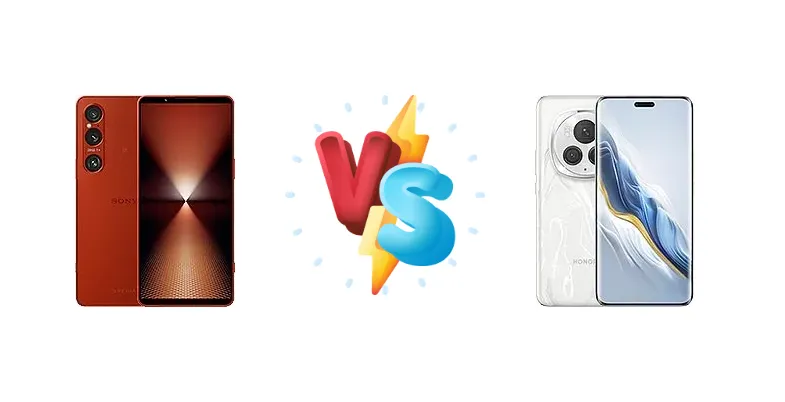
Sony Xperia 1 VI vs Honor Magic6 Pro: A Deep Dive into Flagship Performance
| Phones Images | |||||
|---|---|---|---|---|---|
|
🏆 Quick Verdict
For the average user prioritizing battery life and charging speed, the Honor Magic6 Pro emerges as the winner. Its 80W wired and 66W wireless charging significantly outperform the Xperia 1 VI’s 30W and 15W respectively, coupled with a longer active use battery score of 14:06h versus 17:27h.
| PHONES | ||
|---|---|---|
| Phone Names | Sony Xperia 1 VI | Honor Magic6 Pro |
| Network | ||
|---|---|---|
| 2G bands | GSM 850 / 900 / 1800 / 1900 | GSM 850 / 900 / 1800 / 1900 |
| 3G bands | HSDPA 800 / 850 / 900 / 1700(AWS) / 1900 / 2100 | HSDPA 800 / 850 / 900 / 1700(AWS) / 1900 / 2100 |
| 4G bands | 1, 2, 3, 4, 5, 7, 8, 12, 13, 17, 19, 20, 25, 26, 28, 29, 32, 34, 38, 39, 40, 41, 46, 66 - Europe | LTE |
| 5G bands | 1, 3, 5, 7, 8, 20, 28, 38, 40, 41, 75, 77, 78 SA/NSA/Sub6 - Europe | SA/NSA |
| Speed | HSPA, LTE, 5G | HSPA, LTE, 5G |
| Technology | GSM / HSPA / LTE / 5G | GSM / CDMA / HSPA / CDMA2000 / LTE / 5G |
| Launch | ||
|---|---|---|
| Announced | 2024, May 15 | 2024, January 11 |
| Status | Available. Released 2024, June 03 | Available. Released 2024, January 18 |
| Body | ||
|---|---|---|
| Build | Glass front (Gorilla Glass Victus 2), glass back (Gorilla Glass Victus), aluminum frame | Glass front (NanoCrystal Shield), glass back or silicone polymer back (eco leather) |
| Dimensions | 162 x 74 x 8.2 mm (6.38 x 2.91 x 0.32 in) | 162.5 x 75.8 x 8.9 mm (6.40 x 2.98 x 0.35 in) |
| SIM | · Nano-SIM + eSIM· Nano-SIM + Nano-SIM | · Nano-SIM + eSIM· Nano-SIM + Nano-SIM |
| Weight | 192 g (6.77 oz) | 225 g or 229 g (7.94 oz) |
| Display | ||
|---|---|---|
| Protection | Corning Gorilla Glass Victus 2 | NanoCrystal Shield |
| Resolution | 1080 x 2340 pixels, 19.5:9 ratio (~396 ppi density) | 1280 x 2800 pixels, 19.5:9 ratio (~453 ppi density) |
| Size | 6.5 inches, 103.7 cm2 (~86.5% screen-to-body ratio) | 6.8 inches, 112.8 cm2 (~91.6% screen-to-body ratio) |
| Type | LTPO OLED, 1B colors, 120Hz, HDR BT.2020 | LTPO OLED, 1B colors, 120Hz, Dolby Vision, HDR, 1600 nits (HBM), 5000 nits (peak) |
| Platform | ||
|---|---|---|
| CPU | Octa-core (1x3.3 GHz Cortex-X4 & 3x3.2 GHz Cortex-A720 & 2x3.0 GHz Cortex-A720 & 2x2.3 GHz Cortex-A520) | Octa-core (1x3.3 GHz Cortex-X4 & 3x3.2 GHz Cortex-A720 & 2x3.0 GHz Cortex-A720 & 2x2.3 GHz Cortex-A520) |
| Chipset | Qualcomm SM8650-AB Snapdragon 8 Gen 3 (4 nm) | Qualcomm SM8650-AB Snapdragon 8 Gen 3 (4 nm) |
| GPU | Adreno 750 | Adreno 750 |
| OS | Android 14, upgradable to Android 16, up to 3 major Android upgrades | Android 14, up to 4 major Android upgrades, MagicOS 8 |
| Memory | ||
|---|---|---|
| Card slot | microSDXC (uses shared SIM slot) | No |
| Internal | 256GB 12GB RAM, 512GB 12GB RAM | 256GB 12GB RAM, 256GB 16GB RAM, 512GB 12GB RAM, 512GB 16GB RAM, 1TB 16GB RAM |
| Main Camera | ||
|---|---|---|
| Features | Zeiss optics, Zeiss T* lens coating, color spectrum sensor, LED flash, panorama, HDR, eye tracking | Laser AF, color spectrum sensor, LED flash, HDR, panorama |
| Triple | 48 MP, f/1.9, 24mm (wide), 1/1.35", 1.12µm, dual pixel PDAF, OIS 12 MP, f/2.3, 85mm (telephoto), f/3.5, 170mm (telephoto), 1/3.5", 1.0µm, dual pixel PDAF, 3.5x-7.1x continuous optical zoom, OIS, 4cm macro @ 120mm, no AF 12 MP, f/2.2, 16mm, 123˚ (ultrawide), 1/2.5", 1.4µm, dual pixel PDAF | 50 MP, f/1.4-2.0, 23mm (wide), 1/1.3", 1.2µm, PDAF, OIS 180 MP, f/2.6, (periscope telephoto), 1/1.49", 0.56µm, PDAF, OIS, 2.5x optical zoom 50 MP, f/2.0, 13mm, 122˚ (ultrawide), 1/2.88", 0.61µm, AF |
| Video | 4K@24/30/60/120fps HDR, 1080p@30/60/120fps; 5-axis gyro-EIS, OIS | 4K@24/30/60fps, 1080p@30/60/120/240fps, gyro-EIS, OIS, HDR, 10-bit video |
| Selfie camera | ||
|---|---|---|
| Features | HDR | - |
| Single | 12 MP, f/2.0, 24mm (wide), 1/2.9", 1.22µm | 50 MP, f/2.0, 22mm (wide), 1/2.93", 0.6µm, AF TOF 3D, (depth/biometrics sensor) |
| Video | 4K@30/60fps, 1080p@30/60fps, 5-axis gyro-EIS | 4K@30fps, 1080p@30/60fps, gyro-EIS |
| Sound | ||
|---|---|---|
| 35mm jack | Yes | No |
| Loudspeaker | Yes, with stereo speakers | Yes, with stereo speakers |
| Comms | ||
|---|---|---|
| Bluetooth | 5.4, A2DP, LE Audio, aptX HD, aptX Adaptive, aptX Lossless | 5.3, A2DP, LE, aptX HD |
| Infrared port | - | Yes |
| NFC | Yes | Yes |
| Positioning | GPS, GLONASS, BDS, GALILEO, QZSS | GPS (L1+L5), GLONASS, BDS (B1I+B1c+B2a), GALILEO (E1+E5a) |
| Radio | No | No |
| USB | USB Type-C 3.2, OTG, video output | USB Type-C 3.2, DisplayPort 1.2, OTG |
| WLAN | Wi-Fi 802.11 a/b/g/n/ac/6e/7, tri-band, Wi-Fi Direct, DLNA | Wi-Fi 802.11 a/b/g/n/ac/6/7, dual-band, Wi-Fi Direct |
| Features | ||
|---|---|---|
| Sensors | Fingerprint (side-mounted), accelerometer, gyro, proximity, barometer, compass | Fingerprint (under display, optical), Face ID, accelerometer, gyro, proximity, compass |
| Battery | ||
|---|---|---|
| Charging | 30W wired, PD3.0, PPS, 50% in 30 min 15W wireless Reverse wireless | 80W wired 66W wireless Reverse wireless 5W reverse wired |
| Type | 5000 mAh | Si/C Li-Ion 5600 mAh |
| Misc | ||
|---|---|---|
| Colors | Black, Platinum silver, Khaki green, Scar red | Black, Green, Blue, Purple, White |
| Models | XQEC54EUKCB.GC, XQEC54EUKCG.GC, XQEC54EUKCS.GC, XQ-EC72 | BVL-AN16, BVL-N49 |
| Price | $ 1,299.99 / £ 829.00 / € 977.98 | € 455.54 / $ 899.00 / £ 598.99 |
Sony Xperia 1 VI
- Potentially superior image processing for natural photos
- Refined software experience (Sony's UI)
- More compact form factor
- Slower charging speeds (30W wired, 15W wireless)
- Lower peak display brightness
- Shorter active use battery life
Honor Magic6 Pro
- Significantly faster charging (80W wired, 66W wireless)
- Higher peak display brightness for outdoor use
- Longer active use battery life
- Potentially more aggressive image processing
- Larger and heavier design
- Software experience may not appeal to all users
Display Comparison
Both the Xperia 1 VI and Magic6 Pro utilize the Snapdragon 8 Gen 3, but their displays diverge significantly. The Honor Magic6 Pro boasts a peak brightness of 1578 nits, measured, exceeding the Xperia 1 VI’s 1310 nits. This difference translates to superior visibility in direct sunlight. While both likely employ LTPO technology for adaptive refresh rates (though not explicitly stated), the Magic6 Pro’s higher peak brightness is a clear advantage for outdoor users. The Xperia 1 VI’s display, while excellent, is geared towards color accuracy for content creation, while the Magic6 Pro prioritizes sheer brightness.
Camera Comparison
Detailed camera specifications are missing, but the focus should be on image processing and sensor size. While megapixel counts are important, the Xperia 1 VI’s history suggests a focus on natural color reproduction and advanced video capabilities. The Magic6 Pro, based on Honor’s recent offerings, likely emphasizes computational photography and AI-powered scene optimization. Without sensor size data, it’s difficult to definitively declare a winner, but the Xperia 1 VI’s brand reputation in photography gives it a slight edge for users prioritizing manual control and image fidelity. We can safely ignore any 2MP macro lenses on either device.
Performance
Both devices are powered by the Qualcomm SM8650-AB Snapdragon 8 Gen 3 (4 nm) chipset, featuring an identical CPU configuration: 1x3.3 GHz Cortex-X4, 3x3.2 GHz Cortex-A720, 2x3.0 GHz Cortex-A720, and 2x2.3 GHz Cortex-A520. This means raw processing power will be nearly identical. Performance differences will likely stem from thermal management and software optimization. The 4nm process node ensures efficient power consumption, but the Magic6 Pro’s larger chassis may allow for a more robust cooling solution, potentially mitigating thermal throttling during sustained workloads. RAM specifications are not provided, but both are expected to utilize LPDDR5x for fast memory access.
Battery Life
The Honor Magic6 Pro’s charging capabilities are a standout feature. Its 80W wired charging can replenish the battery to 50% in under 20 minutes, while the Xperia 1 VI’s 30W charging takes 30 minutes for the same result. The Magic6 Pro also supports 66W wireless charging, significantly faster than the Xperia 1 VI’s 15W wireless charging. Despite the Xperia 1 VI achieving a longer active use score of 17:27h compared to the Magic6 Pro’s 14:06h, the faster charging speeds of the Magic6 Pro make it more convenient for users who frequently need to top up their battery.
Buying Guide
Buy the Sony Xperia 1 VI if you prioritize a more refined software experience, a focus on photography and videography tools, and a slightly more compact form factor. Buy the Honor Magic6 Pro if you demand the fastest possible charging speeds, a brighter display for outdoor visibility, and a longer-lasting battery for power users who frequently utilize demanding applications.