
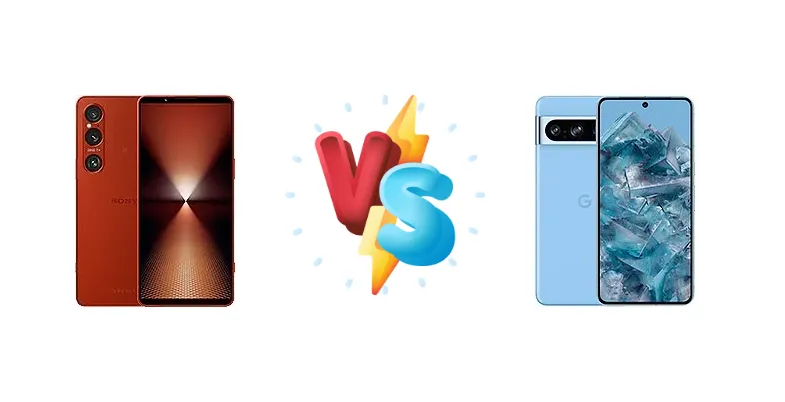
Sony Xperia 1 VI vs Google Pixel 8 Pro: A Deep Dive into Flagship Performance
| Phones Images | |||||
|---|---|---|---|---|---|
|
🏆 Quick Verdict
For the average user prioritizing all-day battery life and effortless photography, the Google Pixel 8 Pro is the stronger choice. However, the Sony Xperia 1 VI excels for content creators and power users who demand a customizable experience and exceptional display quality.
| PHONES | ||
|---|---|---|
| Phone Names | Sony Xperia 1 VI | Google Pixel 8 Pro |
| Network | ||
|---|---|---|
| 2G bands | GSM 850 / 900 / 1800 / 1900 | GSM 850 / 900 / 1800 / 1900 |
| 3G bands | HSDPA 800 / 850 / 900 / 1700(AWS) / 1900 / 2100 | HSDPA 800 / 850 / 900 / 1700(AWS) / 1900 / 2100 |
| 4G bands | 1, 2, 3, 4, 5, 7, 8, 12, 13, 17, 19, 20, 25, 26, 28, 29, 32, 34, 38, 39, 40, 41, 46, 66 - Europe | 1, 2, 3, 4, 5, 7, 8, 12, 13, 14, 17, 18, 19, 20, 25, 26, 28, 29, 30, 38, 39, 40, 41, 46, 48, 66, 71 - G1MNW |
| 5G bands | 1, 3, 5, 7, 8, 20, 28, 38, 40, 41, 75, 77, 78 SA/NSA/Sub6 - Europe | 1, 2, 3, 5, 7, 8, 12, 20, 25, 26, 28, 29, 30, 38, 40, 41, 48, 66, 70, 71, 77, 78, 257, 258, 260, 261 SA/NSA/Sub6/mmWave - G1MNW |
| Speed | HSPA, LTE, 5G | HSPA, LTE, 5G |
| Technology | GSM / HSPA / LTE / 5G | GSM / HSPA / LTE / 5G |
| Launch | ||
|---|---|---|
| Announced | 2024, May 15 | 2023, October 04 |
| Status | Available. Released 2024, June 03 | Available. Released 2023, October 12 |
| Body | ||
|---|---|---|
| Build | Glass front (Gorilla Glass Victus 2), glass back (Gorilla Glass Victus), aluminum frame | Glass front (Gorilla Glass Victus 2), glass back (Gorilla Glass Victus 2), aluminum frame |
| Dimensions | 162 x 74 x 8.2 mm (6.38 x 2.91 x 0.32 in) | 162.6 x 76.5 x 8.8 mm (6.40 x 3.01 x 0.35 in) |
| SIM | · Nano-SIM + eSIM· Nano-SIM + Nano-SIM | Nano-SIM + eSIM |
| Weight | 192 g (6.77 oz) | 213 g (7.51 oz) |
| Display | ||
|---|---|---|
| Protection | Corning Gorilla Glass Victus 2 | Corning Gorilla Glass Victus 2 |
| Resolution | 1080 x 2340 pixels, 19.5:9 ratio (~396 ppi density) | 1344 x 2992 pixels, 20:9 ratio (~489 ppi density) |
| Size | 6.5 inches, 103.7 cm2 (~86.5% screen-to-body ratio) | 6.7 inches, 108.7 cm2 (~87.4% screen-to-body ratio) |
| Type | LTPO OLED, 1B colors, 120Hz, HDR BT.2020 | LTPO OLED, 120Hz, HDR10+, 1600 nits (HBM), 2400 nits (peak) |
| Platform | ||
|---|---|---|
| CPU | Octa-core (1x3.3 GHz Cortex-X4 & 3x3.2 GHz Cortex-A720 & 2x3.0 GHz Cortex-A720 & 2x2.3 GHz Cortex-A520) | Nona-core (1x3.0 GHz Cortex-X3 & 4x2.45 GHz Cortex-A715 & 4x2.15 GHz Cortex-A510) |
| Chipset | Qualcomm SM8650-AB Snapdragon 8 Gen 3 (4 nm) | Google Tensor G3 (4 nm) |
| GPU | Adreno 750 | Immortalis-G715s MC10 |
| OS | Android 14, upgradable to Android 16, up to 3 major Android upgrades | Android 14, upgradable to Android 16, up to 7 major Android upgrades |
| Memory | ||
|---|---|---|
| Card slot | microSDXC (uses shared SIM slot) | No |
| Internal | 256GB 12GB RAM, 512GB 12GB RAM | 128GB 12GB RAM, 256GB 12GB RAM, 512GB 12GB RAM, 1TB 12GB RAM |
| Main Camera | ||
|---|---|---|
| Features | Zeiss optics, Zeiss T* lens coating, color spectrum sensor, LED flash, panorama, HDR, eye tracking | Multi-zone Laser AF, Dual-LED flash, Pixel Shift, Ultra-HDR, panorama, Best Take, Zoom Enhance |
| Triple | 48 MP, f/1.9, 24mm (wide), 1/1.35", 1.12µm, dual pixel PDAF, OIS 12 MP, f/2.3, 85mm (telephoto), f/3.5, 170mm (telephoto), 1/3.5", 1.0µm, dual pixel PDAF, 3.5x-7.1x continuous optical zoom, OIS, 4cm macro @ 120mm, no AF 12 MP, f/2.2, 16mm, 123˚ (ultrawide), 1/2.5", 1.4µm, dual pixel PDAF | 50 MP, f/1.7, 25mm (wide), 1/1.31", 1.2µm, dual pixel PDAF, OIS 48 MP, f/2.8, 113mm (periscope telephoto), 1/2.55", 0.7µm, dual pixel PDAF, OIS, 5x optical zoom 48 MP, f/2.0, 126˚ (ultrawide), 1/2.0", 0.8µm, dual pixel PDAF |
| Video | 4K@24/30/60/120fps HDR, 1080p@30/60/120fps; 5-axis gyro-EIS, OIS | 4K@30/60fps, 1080p@24/30/60/120/240fps; gyro-EIS, OIS, 10-bit HDR |
| Selfie camera | ||
|---|---|---|
| Features | HDR | HDR, panorama |
| Single | 12 MP, f/2.0, 24mm (wide), 1/2.9", 1.22µm | 10.5 MP, f/2.2, 20mm (ultrawide), 1/3.1", 1.22µm, PDAF |
| Video | 4K@30/60fps, 1080p@30/60fps, 5-axis gyro-EIS | 4K@24/30/60fps, 1080p@30/60fps |
| Sound | ||
|---|---|---|
| 35mm jack | Yes | No |
| Loudspeaker | Yes, with stereo speakers | Yes, with stereo speakers |
| Comms | ||
|---|---|---|
| Bluetooth | 5.4, A2DP, LE Audio, aptX HD, aptX Adaptive, aptX Lossless | 5.3, A2DP, LE, aptX HD |
| NFC | Yes | Yes |
| Positioning | GPS, GLONASS, BDS, GALILEO, QZSS | GPS (L1+L5), GLONASS (G1), GALILEO (E1+E5a), QZSS (L1+L5) |
| Radio | No | No |
| USB | USB Type-C 3.2, OTG, video output | USB Type-C 3.2 |
| WLAN | Wi-Fi 802.11 a/b/g/n/ac/6e/7, tri-band, Wi-Fi Direct, DLNA | Wi-Fi 802.11 a/b/g/n/ac/6e/7, tri-band, Wi-Fi Direct |
| Features | ||
|---|---|---|
| Sensors | Fingerprint (side-mounted), accelerometer, gyro, proximity, barometer, compass | Fingerprint (under display, optical), accelerometer, gyro, proximity, compass, barometer, thermometer (skin temperature) |
| Battery | ||
|---|---|---|
| Charging | 30W wired, PD3.0, PPS, 50% in 30 min 15W wireless Reverse wireless | 30W wired, PD3.0, PPS, 50% in 30 min 23W wireless Reverse wireless Bypass charging |
| Type | 5000 mAh | Li-Ion 5050 mAh |
| Misc | ||
|---|---|---|
| Colors | Black, Platinum silver, Khaki green, Scar red | Obsidian, Porcelain, Bay, Mint |
| Models | XQEC54EUKCB.GC, XQEC54EUKCG.GC, XQEC54EUKCS.GC, XQ-EC72 | GC3VE, G1MNW |
| Price | $ 1,299.99 / £ 829.00 / € 977.98 | € 362.00 / $ 289.97 / £ 329.95 / ₹ 54,999 |
Sony Xperia 1 VI
- Exceptional battery life (17:27h active use)
- Powerful Snapdragon 8 Gen 3 processor
- Bright and color-accurate display (1310 nits)
- Less emphasis on AI-powered features
- Camera may require more user expertise
Google Pixel 8 Pro
- AI-powered camera with excellent image processing
- Seamless Google ecosystem integration
- Faster wireless charging (23W) and bypass charging
- Significantly shorter battery life (11:14h active use)
- Tensor G3 processor may throttle under sustained load
Display Comparison
The Pixel 8 Pro boasts a peak brightness of 1600 nits, exceeding the Xperia 1 VI’s 1310 nits, making it more visible in direct sunlight. While both utilize 4nm chipsets, the display’s impact on overall power draw is significant. Sony’s display, while slightly dimmer, is likely tuned for color accuracy, a key feature for professional photo and video editing. The absence of detailed panel information (LTPO, refresh rate) for the Xperia 1 VI leaves a gap, but Sony historically prioritizes display quality over variable refresh rates for smoother content creation.
Camera Comparison
The context data for the cameras is limited, but the Pixel 8 Pro’s strength lies in its computational photography prowess, leveraging Google’s AI algorithms for exceptional image processing. The Xperia 1 VI, traditionally, focuses on providing a more natural image with greater control over settings. The lack of sensor size information for either device makes a direct comparison difficult, but Sony’s emphasis on manual controls suggests a target audience comfortable with adjusting ISO, aperture, and shutter speed. The Pixel 8 Pro’s video capabilities are also highly regarded, benefiting from Google’s advanced stabilization and dynamic range processing.
Performance
The Xperia 1 VI’s Snapdragon 8 Gen 3, with its octa-core configuration (1x3.3 GHz Cortex-X4, 3x3.2 GHz Cortex-A720, 2x3.0 GHz Cortex-A720, 2x2.3 GHz Cortex-A520), offers a clear architectural advantage over the Pixel 8 Pro’s Google Tensor G3 (1x3.0 GHz Cortex-X3, 4x2.45 GHz Cortex-A715, 4x2.15 GHz Cortex-A510). The Cortex-X4 core in the Snapdragon is a newer generation, promising superior single-core performance crucial for responsiveness and demanding applications. While the Tensor G3 excels in AI tasks, the Snapdragon 8 Gen 3 is expected to deliver superior sustained performance and thermal management during prolonged gaming or video rendering.
Battery Life
The Xperia 1 VI’s active use battery score of 17:27h significantly outperforms the Pixel 8 Pro’s 11:14h. This difference, despite both phones offering 30W wired charging with PD3.0 and PPS, is substantial. The Pixel 8 Pro’s older endurance rating of 90h is less relevant than the measured active use score. The Xperia 1 VI’s superior battery life is likely a combination of the Snapdragon 8 Gen 3’s efficiency and Sony’s software optimization. The Pixel 8 Pro compensates with 23W wireless charging, compared to the Xperia 1 VI’s 15W, and the addition of bypass charging, allowing for direct power delivery even while the phone is on.
Buying Guide
Buy the Sony Xperia 1 VI if you need a versatile camera with extensive manual controls, a stunningly bright and color-accurate display for media consumption, and long-lasting battery life for extended creative sessions. Buy the Google Pixel 8 Pro if you prefer a streamlined, AI-enhanced photography experience, consistently excellent image processing, and a phone that seamlessly integrates with the Google ecosystem.